The Finance Minister has announced in the 2025-26 Union Budget, the launch of a six-year ‘Mission for Aatmanirbharta (self-reliance) in Pulses’.
Mission for Aatmanirbharta in Pulses
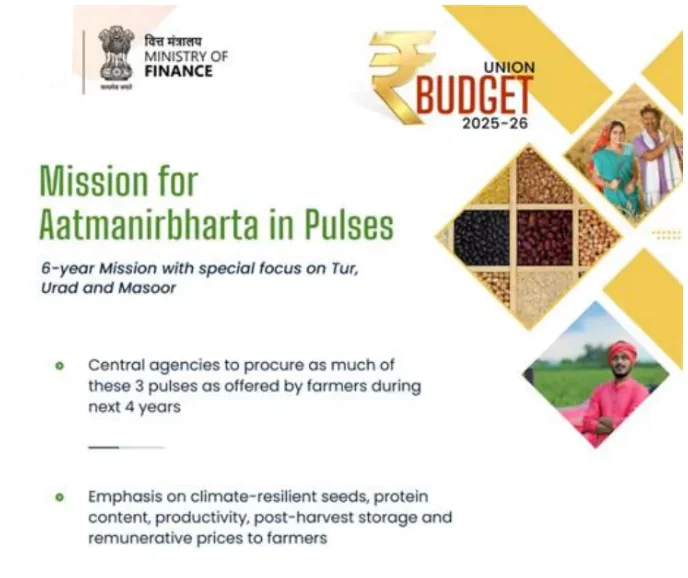
- Budget Allocation: ₹1,000 crore allocated for the mission.
- Objectives:
- Achieve self-reliance in pulses production.
- Provide MSP-based procurement and post-harvest warehousing solutions.
- Reduce dependence on imports.
Enroll now for UPSC Online Course
Key Features of the Mission
- MSP-Based Procurement: NAFED (National Agricultural Cooperative Marketing Federation of India) and NCCF (National Cooperative Consumers’ Federation of India) will procure pulses from farmers who register and enter into agreements.
- Aim: Ensure fair prices for farmers and stabilize market prices.
- Post-Harvest Warehousing: Focus on reducing post-harvest losses and improving storage infrastructure.
- Targeted Crops:
- Tur/Arhar: Traditionally a long-duration crop (250-270 days), now reduced to 150-180 days with lower yields (from 20 quintals/hectare to 15-16 quintals/hectare).
- Urad: Black gram, a key pulse crop.
- Masoor: Red lentil, with record imports in recent years.
About Tur/Arhar
- Tur/Arhar is a legume plant that is a staple food in India.
- It is also known as pigeon pea and red gram.
- Features
-
- Climate: Grow best in semi-arid tropical and subtropical regions with well-drained soil.
- Temperature: Between 26 C to 30 C in the rainy season (June to October) and 17 C to 22C in the post rainy (November to March) season.
- Rain: Requires 600-650mm of annual rainfall along with moist conditions for the initial eight weeks and dry conditions during its flowering and pod development phase.
- Nitrogen fixation: Known for their nitrogen-fixing abilities, which improve soil fertility.
- Uses: Mainly eaten as split pulses, or “dal”.
- Nutrition: Rich in iron, iodine, and essential amino acids.
- India: largest producer in the world
About Urad dal
- Urad dal, also known as black gram, is a lentil-like bean that is a staple of Indian cuisine.
- It is a rich source of protein and vitamins, and is used in both sweet and savory dishes.
- Features:
-
- Climate: Warm and humid conditions are ideal, making it a tropical crop.
- Temperature: Best growth occurs between 25-35°C, with temperatures above 40°C hindering yield.
- Soil type: Well-drained loamy or clay soils are preferred, with good water retention capacity.
- Rainfall: Optimal rainfall range is 600-1000mm per year.
- Season: Primarily cultivated during the kharif season (monsoon months).
- India is the largest producer and consumer of urad bean.
About Lentil (Masur)
- Lentil, scientifically known as Lens culinaris Medikus subsp. culinaris, is a highly nutritious pulse crop widely consumed in India and globally.
- It is commonly referred to as Masur or Malka (bold-seeded variety).
- Features
- Origin: Lentils originated in the region spanning Turkey to South Iran.
- Climate: Lentils thrive in cold climates and can tolerate frost and severe winter conditions.
- Optimum temperature: 18-30°C during growth, with warm temperatures required at maturity.
- Soil: Grows best in well-drained, loamy soils with a neutral pH.
- Unsuitable for acidic soils.
- Nutrition: Lentils are rich in protein (24-26%), carbohydrates (57-60%), iron, phosphorus, and fiber, making them a highly nutritious and easily digestible food source.
- Uses:
- Human Consumption: Primarily consumed as dal, snacks, and soups. It is easily digestible and often recommended for patients.
- Cattle Feed: Dry leaves, stems, and empty pods are used as nutritious fodder for cattle.
- Largest producer: Canada
|
Trend in Pulses Imports
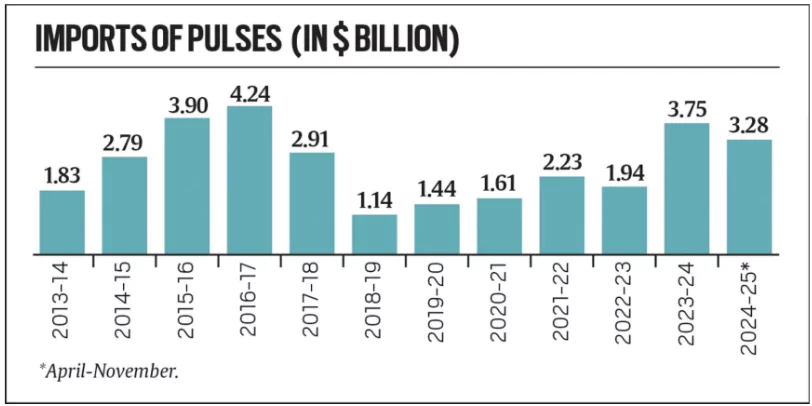
- 2017-18 to 2022-23: Imports declined, reaching a low of 24.96 lt in 2022-23.
- This period marked relative self-reliance in pulses, especially for matar (yellow/white peas) and chana (chickpea).
- 2023-24: Imports surged to 47.38 lt ($3.75 billion) due to drought.
- Masoor imports hit a record 16.76 lt, and matar imports also increased.
- April-November 2024: India’s pulses imports were valued at $3.28 billion, 56.6% higher than the $2.09 billion for the corresponding period of 2023.
- 2024-25 (Current Fiscal): Imports have already touched 40 lt, with tur/arhar crossing 10 lt for the first time and matar reaching a seven-year high.
- Projection for 2024-25: At this rate, imports for the fiscal year could reach $5.9 billion, surpassing the previous all-time-high of $4.24 billion in 2016-17.
Check Out UPSC CSE Books From PW Store
Key Drivers of Rising Imports
- Domestic Shortfall: Drought in 2023-24 led to a decline in domestic production, increasing reliance on imports.
- Production dropped to 242.46 lt in 2023-24 from 260.58 lt in 2022-23.
- Policy Decisions:
- Duty-Free Imports: The government allowed duty-free imports of pulses like tur/arhar, masoor, and urad, which discouraged domestic production.
- Price Disparity: Domestic prices of pulses like tur/arhar are close to MSP, reducing farmers’ incentive to grow these crops.
- Global Market Dependence: India imports pulses from countries like Mozambique, Tanzania, Myanmar, Canada, and Australia.
- Tur/Arhar: Mainly imported from Mozambique, Tanzania, and Myanmar.
- Masoor: Imported from Canada, Russia, and Turkey.
- Matar: Imported from Canada, Russia, and Turkey.
Impact of Rising Imports
- Economic Burden: Rising imports lead to foreign exchange outflow and increase the trade deficit.
- Farmers’ Disincentive: Duty-free imports and low domestic prices discourage farmers from growing pulses.
- Food Security Concerns: Over-reliance on imports makes India vulnerable to global price fluctuations and supply chain disruptions.
Government Response
- Mission for Aatmanirbharta in Pulses:
- Aims to reduce imports by boosting domestic production of tur/arhar, urad, and masoor.
- Focus on MSP-based procurement and post-harvest infrastructure.
- Policy Reforms: Need to restore import duties to incentivize domestic production.
- MSP Procurement: Significant MSP-based procurement of chana (25.56 lt in 2022-23) and moong (4.08 lt in 2022-23).
- Research and Development: Focus on developing short-duration, high-yielding, and climate-resilient varieties of pulses.
- Emphasis on photo-thermo insensitive varieties to enable year-round cultivation.
- National Food Security Mission (NFSM): It was launched in 2007-08 to increase the production of rice, wheat and pulses through area expansion and productivity enhancement.
Challenges in Achieving Aatmanirbharta
- Agronomic Limitations:
- Tur/Arhar: Despite reduction in duration (150-180 days), yields remain low (15-16 quintals/hectare).
- Cultivation is confined to rainfed regions like Marathwada-Vidarbha (Maharashtra) and northern Karnataka, where farmers have fewer alternative cropping options.
- Policy Ambiguity:
- Duty-Free Imports: The government has allowed duty-free imports of tur/arhar and other pulses, which discourages domestic production.
- Price Disparity: Tur/arhar prices in markets (₹7,300-7,400/quintal) are close to MSP (₹7,550/quintal), reducing farmers’ incentive to grow pulses.
- Climate Vulnerability:
- Pulses are often grown in rainfed areas, making them susceptible to drought and climate variability.
- Competition from Other Crops:
- Farmers prefer water-intensive crops like sugarcane and cereals over pulses due to higher profitability.
Enroll now for UPSC Online Classes
Way Forward
- Hybrid Development: Need for tur/arhar hybrids maturing in 140-150 days with yields of 18-20 quintals/hectare.
- Policy Reforms: Restore import duties to incentivize domestic production.
- Provide subsidies and insurance for pulse cultivation in rainfed areas.
- Farmer Awareness: Promote pulses as a sustainable and profitable crop option.
Conclusion
The Mission for Atma Nirbharta in Pulses is a significant step toward reducing India’s dependence on imports. However, achieving self-reliance in pulses requires addressing agronomic challenges, policy ambiguities, and climate vulnerabilities. The success of the mission will depend on effective implementation, technological advancements, and farmer-centric policies.
Ready to boost your UPSC 2025 preparation? Join PW’s UPSC online courses today!


 3 Feb 2025










 GS Foundation
 Crash Course
 Combo
Combo Optional Courses
 Degree Program