The J & K Government has approved the inclusion of religious places, especially mosques, under the PM Surya Ghar Muft Bijli Yojana.
- The initiative aims to utilize the unique multi-tiered and broad-sloped roofs of mosques in Kashmir to generate renewable energy and address the region’s frequent power cuts.
About PM Surya Ghar Muft Bijli Yojana
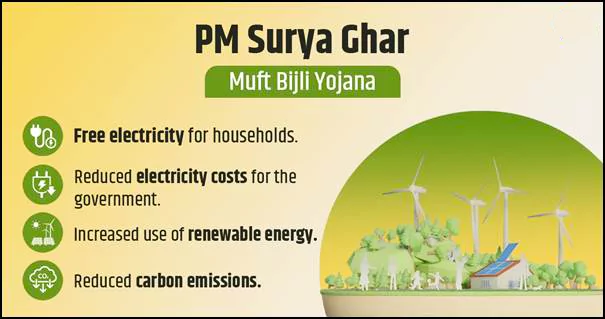
- The Surya Ghar Bijli Yojana is a ₹75,000 crore central government initiative aimed at promoting rooftop solar installations (RTS) across India.
- Aim: To install rooftop solar panels on one crore households by March 2027, providing free electricity and promoting sustainable energy practices
Enroll now for UPSC Online Classes
About Model Solar Village
- Under the “Model Solar Village” component of the PM Surya Ghar Muft Bijli Yojana, the focus is on establishing one Model Solar Village per district throughout India.
- This initiative aims to promote solar energy adoption and empower village communities to achieve energy self-reliance.
- Objective: Promote solar energy adoption and empower communities to achieve energy self-reliance.
- Funding: An allocation of ₹800 crore has been designated for this component, with ₹1 crore provided to each selected Model Solar Village.
- Eligibility Criteria: Revenue village status required.
- Population thresholds:
- 5,000 or more in general states.
- 2,000 or more in special category states.
- Selection Process
- Villages evaluated based on their distributed renewable energy (RE) capacity six months after identification.
- The top-performing village in RE capacity per district receives the financial grant.
- Implementation: Oversight by State/UT Renewable Energy Development Agency, under District Level Committee (DLC) supervision.
- Goal: Transition villages to solar energy and create benchmarks for replication.
|
-
- It targets providing 300 units of free electricity per month to one crore households through RTS installation.
- Nodal Ministry: Ministry of New and Renewable Energy (MNRE)
- Subsidy Provisions: The scheme offers financial support for installing rooftop solar panels:
- 60% subsidy for systems up to 2 kW capacity.
- 40% subsidy for systems between 2-3 kW capacity.
- Implementation Agency
- DISCOMs (Electricity Distribution Companies) are designated as the State Implementation Agencies (SIAs).
- DISCOMs are tasked with ensuring:
- Availability of net meters.
- Timely inspection and commissioning of solar panel installations.
- Incentives for DISCOMs: DISCOMs earn incentives for increasing grid-connected rooftop solar capacity beyond established baselines.
- Eligibility Criteria
- Applicants must be Indian citizens.
- They must own a house with a roof suitable for installing solar panels.
- A valid electricity connection is required.
- The applicant should not have availed of any other solar panel subsidy.
- This comprehensive approach integrates renewable energy into households, providing a sustainable solution to electricity needs while supporting national energy goals.
Achievements under the Scheme
- Cumulative Installed Capacity: India has achieved a cumulative installed rooftop solar capacity of 13,889 MW as of August 2024.
- State-wise Installations: Gujarat leads with 7-10 lakh households equipped with RTS systems.
- Gujarat leads with an installed capacity of 4,195 MW, followed by Maharashtra (2,487 MW) and Rajasthan (1,269 MW).
- Financial Inclusion: Public sector banks offer collateral-free loans for RTS installations.
Challenges
- Financial Burden: Beneficiaries often rely on bank loans for installations.
- Limited Subsidy Eligibility: Subsidy is restricted to domestic empanelled solar panels, which are costlier.
- Lack of Battery Backup: Households remain vulnerable to power cuts.
- Discom Challenges: Distribution companies may face challenges in integrating rooftop solar power.
- Unmet Targets: The 40 GW RTS capacity target for 2022 has not been achieved.
- Low Household Penetration: Only 25% of total capacity is attributed to household installations.
Check Out UPSC NCERT Textbooks From PW Store
Way Forward
- Expand Subsidy and Accessibility: Increase subsidy amounts and simplify application processes to encourage wider participation.
- Promote Battery Storage: Incentivize the adoption of battery storage systems to enhance energy security and address grid integration challenges.
- Strengthen Discom Infrastructure: Upgrade distribution networks to accommodate increased solar power generation and ensure seamless integration.
- Create Awareness and Capacity Building: Conduct extensive awareness campaigns to educate beneficiaries about the scheme’s benefits and technical aspects of solar energy.


 9 Dec 2024










 GS Foundation
 Crash Course
 Combo
Combo Optional Courses
 Degree Program