According to the World Health Organisation, more than 2.2 billion people worldwide experience some forms of vision impairment.
- An estimated 5.5 million people suffer from IRDs around the world, with a prevalence rate of one in 3,450.
- Studies have revealed significantly higher prevalence of such cases in India
- one in 372 individuals in rural South India,
- one in 930 in urban South India,
- and one in 750 in rural Central India affected by these conditions.
Enroll now for UPSC Online Classes
What are Inherited Retinal Diseases (IRDs)?
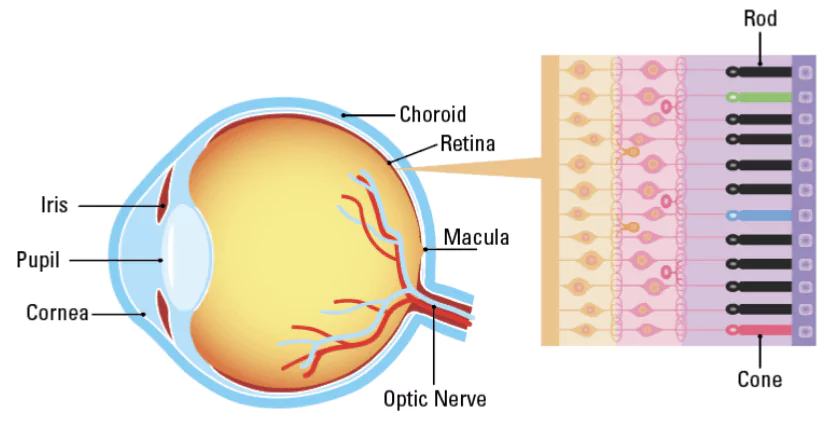
- IRDs are genetic disorders causing progressive vision loss, often leading to blindness.
- Caused by mutations in 300+ genes responsible for retinal function.
- Some individuals lose vision early, while others experience gradual deterioration.
- Early intervention can slow or prevent blindness in some cases.
How do Genes Affect Vision?
- The body is made up of cells, each containing a nucleus with chromosomes made of DNA.
- DNA contains genes, which provide instructions for making proteins essential for body functions.
- A change (mutation) in a gene can cause proteins to function incorrectly or be missing.
- Faulty proteins in the retina lead to IRDs and vision loss.
Risk Factors for IRDs
IRDs follow different inheritance patterns:
- Autosomal Dominant: The defective gene is located on an autosome (non-sex chromosome).
- A person inherits one faulty dominant gene from a parent and one normal gene from the other.
- The faulty dominant gene causes the disorder.
- Autosomal Recessive: Both copies of the gene (one from each parent) must be defective.
- Parents are usually asymptomatic carriers.
- 25% chance of inheriting the disease if both parents are carriers.
- X-linked Disorders: The defective gene is located on the X chromosome.
- Males (XY) are more severely affected as they have only one X.
- Females (XX) may be carriers or show milder symptoms.
- Mitochondrial Inheritance: Mutations occur in mitochondrial DNA (mtDNA), inherited exclusively from the mother (sperm do not contribute mitochondria).
- Can affect multiple organs, including the eyes.
What is RNA-Based Therapy?
- RNA-based therapies offer a safer alternative to gene therapy as they do not alter DNA permanently.
- These therapies temporarily modify gene expression, reducing long-term risks.
Check Out UPSC NCERT Textbooks From PW Store
Types of RNA-Based Therapies
- Antisense Oligonucleotides (ASOs)
- Used successfully for spinal muscular atrophy and Duchenne muscular dystrophy.
- Being tested for Stargardt disease, Leber congenital amaurosis, and retinitis pigmentosa.
- RNA-Editing with ADAR Enzymes
- Corrects specific mutations at the RNA level.
- Can restore protein production in retinal cells without altering DNA.
- Suppressor tRNA Therapy
- Bypasses stop-codon mutations that disrupt protein synthesis.
- Helps in producing full-length proteins to restore retinal function.
- Small Molecule RNA Therapy (PTC124/Ataluren)
- Used for cystic fibrosis and Duchenne muscular dystrophy.
- Clinical trials underway for treating aniridia (a rare eye disease).
India’s Role in Precision Medicine
- What is Precision Medicine?
- It tailors treatments based on a person’s genetics, lifestyle, and environment.
- Aims for personalized care instead of a one-size-fits-all approach.
- Need for Genetic Research in India
- Over 300 genes are linked to IRDs, but India lacks large-scale studies on genetic mutations in its population.
- No major study (500+ patients) has mapped genetic variations in Indian IRD patients.
- Identifying common genetic mutations is crucial for developing effective treatments.
- Challenges in India
- Genetic variations differ across communities in India, making research complex.
- Barriers include:
- Low awareness among doctors and patients.
- Limited access to genetic counseling.
- Insufficient research funding.
- Lack of diagnostic infrastructure, especially in rural areas.
Ready to boost your UPSC 2025 preparation? Join PW’s UPSC online courses today!


 30 Jan 2025










 GS Foundation
 Crash Course
 Combo
Combo Optional Courses
 Degree Program