The Union government recently reduced the export duty on three categories of rice from 20% to 10%.
More on News
- According to the notification, the reduction applies to rice in the husk (paddy or rough), husked (brown) rice, and parboiled rice.
Different Varieties of Rice
Husk:
- The outer layer of the rice grain, which is removed during the milling process.
- It is also known as the rice hull.
Husked (Brown) Rice:
- Rice grains that have had the husk removed but still retain the bran layer, which is the nutrient-rich layer beneath the husk.
- This type of rice is considered a whole grain and offers more nutritional value compared to white rice.
Parboiled Rice:
- A type of rice that has been partially cooked before being milled.
- This process helps to retain more nutrients, including B vitamins and iron, compared to regular white rice.
- Parboiled rice also has a firmer texture and is often used in dishes that require a longer cooking time.
White rice:
- Rice grains that have had both the husk and bran layer removed.
- While it has a softer texture and cooks quickly, it is less nutritious than brown or parboiled rice.
Basmati rice:
- A long-grain variety of rice known for its fragrant aroma and fluffy texture.
- It can be white or brown.
|
Enroll now for UPSC Online Course
Reasons for Reducing Export Duty
- Surplus Inventories: Stocks of the grain have increased, and a new harvest is expected in the coming weeks.
- Boosting Exports: Lower export duty will reduce India’s export prices and boost international shipments.
- Competitive Pressure: This move will force competing nations like Thailand, Vietnam, Pakistan, and Myanmar to reduce their prices.
Rice Production in India
- Global Trade Share:
- India is the second-largest rice producer globally, after China.
- The country is the world’s largest rice exporter, holding a 45% share in the global market.
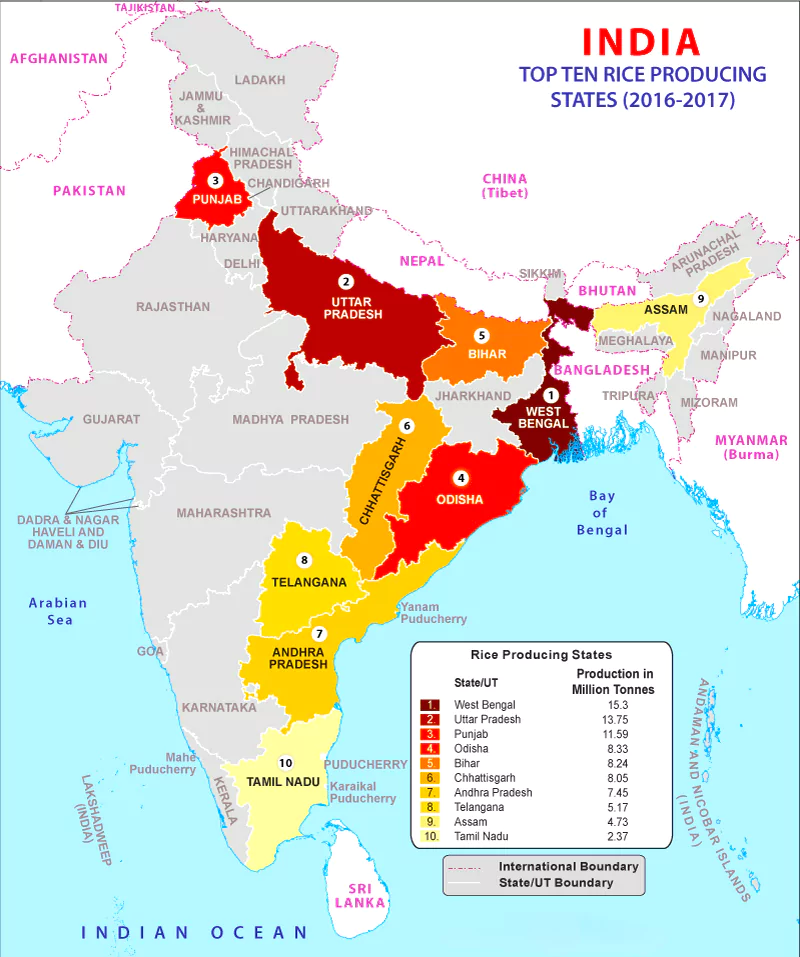
- Top Rice Producing States:
- Leading Producers: West Bengal, Uttar Pradesh, Punjab, and Tamil Nadu.
- High-Yielding States: Punjab, Tamil Nadu, Haryana, Andhra Pradesh, Telangana, West Bengal, Kerala.
Facts on Rice
- Staple Food: Rice is a primary food source for most Indians.
- Kharif Crop: Grows in high temperatures (above 25°C), requires high humidity, and annual rainfall exceeding 100 cm.
 Irrigation: In regions with less rainfall, rice is cultivated using irrigation.
- Multiple Crops: In states like West Bengal and southern states, farmers grow two to three rice crops annually.
- Three Crops in West Bengal: ‘Aus,’ ‘Aman,’ and ‘Boro’ rice are cultivated.
- Cropped Area: Approximately 25% of India’s total cropped area is devoted to rice cultivation.
Check Out UPSC CSE Books From PW Store
Key Issues Related to Rice Export in India
- Virtual Water Export:
- Rice cultivation is water-intensive, and large-scale rice exports can worsen water scarcity in already water-stressed regions.
- This can strain local water resources and negatively impact other crops like wheat and pulses that also rely on irrigation.
- Food Security Concerns:
- Over-reliance on rice exports may affect domestic food security, especially as India’s population grows.
- Excessive exports could lead to higher domestic prices, making rice less affordable for vulnerable populations.
- Impact on Crop Diversity:
- Focusing too much on rice cultivation may reduce crop diversity, making the agricultural sector more susceptible to pests, diseases, and climate change.
- Promoting a diversified agricultural system is essential for long-term food security and resilience.
- Trade Policies and Subsidies:
- Government policies such as subsidies and export incentives play a significant role in influencing rice exports.
- Policies must strike a balance to ensure they don’t negatively impact domestic farmers or consumers while avoiding unfair competition in global markets.
Technique to Improve Rice Cultivation
- Direct Seeded Rice (DSR):
- Also known as the ‘broadcasting seed technique,’ DSR is a method that uses less water in paddy cultivation.
- Seeds are directly sown in the fields, bypassing the traditional nursery setup and transplanting process.
Enroll now for UPSC Online Classes


 28 Sep 2024









 GS Foundation
 Crash Course
 Combo
Combo Optional Courses
 Degree Program