The Karnataka Waqfs Board has claimed 17 monuments inside the historic Bidar Fort ( including, the 16 Khamba mosque, 14 tombs of various Bahmani rulers etc) as their property.
Historical Relevance of Bidar City
- Bidar was the capital city of the Bahamani kingdom between 1422 and 1538.
- It was shifted from Gulbarga/Kalaburagi to Bidar (previously known as Muhammadabad) by the ninth ruler of Bahmanis ie. Ahmad Shah I
- Evolution: The city of Bidar has evolved with various dynasties controlling it in the Medieval Period of history starting from, Pre-kakatiya, Tughluq, Bahamani, Barid Shahi, Adil Shahi, Mughal and Nizam.
- Architectural Style: The architectural landscape of Bidar is an inter mixture of Hindu, Turkish and Persian artisanship.
- The plan of the Bidar city fortification is pentagonal and is built on the brink of the plateau.
Enroll now for UPSC Online Course
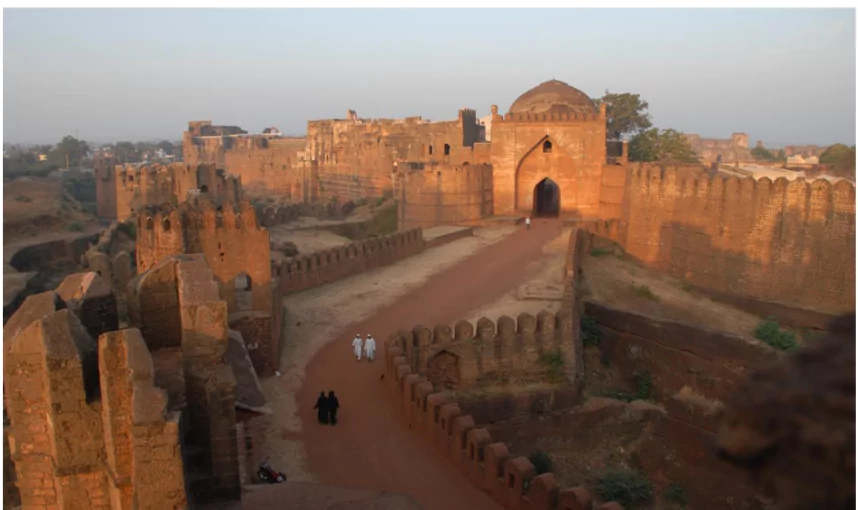
The Bidar Fort
- Built by: It was first built by the Kakatiya ruler-Madhav Varma II in the 10th century.
- Evolution: The fort was house to many dynasties including Bahmani Sultanate (1347 -1518) Barid Shahi Dynasty (1527-1619), Mughal Empire (1619-1724) Nizam of Hyderabad (1724 -1948).
- The fort has a three-layered fortification spread across 67 acres with a perimeter of 5.5 kilometres.
- Shape: It is shaped in the form of a rhombus housing palaces, mosques, and courtyards.
- Gateways: The Fort has seven grand arched gates of which the Gumbad Darwaza and Sharaza Darwaza are the most important entrance gates.
- Other Gates: Named on the basis of their directions, these are, Carnatic Darwaza, Mandu Darwaza, Kalyani Darwaza, Kalmadgi Darwaza, Delhi Darwaza
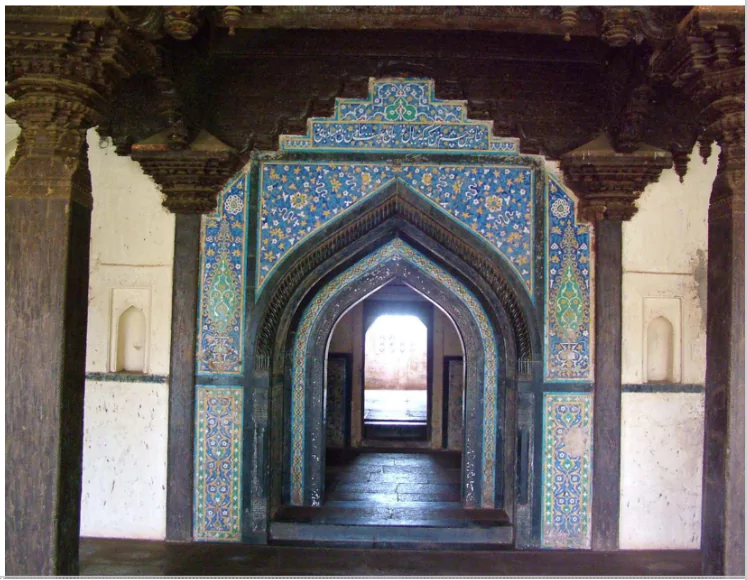 Palaces: Both the Takht Mahal and Rangeen Mahal are built around rectangular courtyards. The Fort Complex also houses Gagan Mahal and Tarkash Mahal which are in ruins.
- Takht Mahal (Throne Place): It is the royal palace built by Ahmed Shah and was the royal residence housing the splendid throne of the Bahmanis where coronations of several Bahamani and Barid Shahi Sultans were held.
- Rangeen Mahal: It is situated near Gumbad Barwaza, is one of the preserved palaces in the Fort with the walls adorned with Mother-of-Pearl of the finest quality inlaid in jet black stone. The designs of this monument represent the blend of the both Muslim and Hindu architecture.
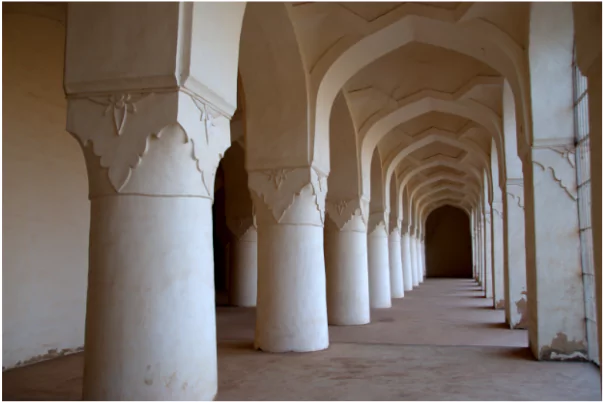 The Solah Khamba Masjid (16 Pillars mosque): It is said to have been built in 1423-24 A.D. by Qubli Sultani.
- The mosque was originally a ceremonial audience hall and was converted into a prayer space. The roof of the structure consists of a large dome surrounded by small domes.
- The Hazar Kothari: It was built for safe exit of the ruling family during attack from the enemies. There is an underground hall which leads to the outer wall of the fort.
- The Karez system (Qanat system): It is an ancient Persian technology used for water supply introduced by the Bahmani Sultans in the 15th century that played a crucial role in Bidar’s agricultural prosperity.
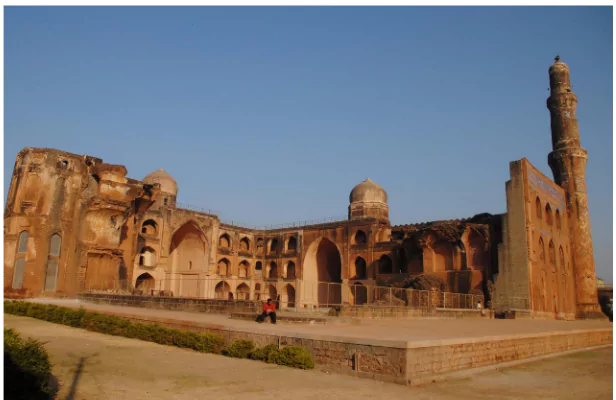 Mahmud Gawan Madrasa: It was built in 1472 by Gawan (prime Minister/wazir) , is considered as one of the oldest and most influential Islamic educational institutions in India. The structure is protected by the Archeological Survey of India (ASI).
- Residential University: It housed a Mosque, a library, lecture halls and quarters facing an open courtyard. The students were taught Arabic, Persian languages, theology, philosophy, astronomy, mathematics etc
- The Madrasa was adopted by Shaheen Group of Institutions under the Adopt-a-Heritage scheme and a MoU was signed by ASI in August 2024.
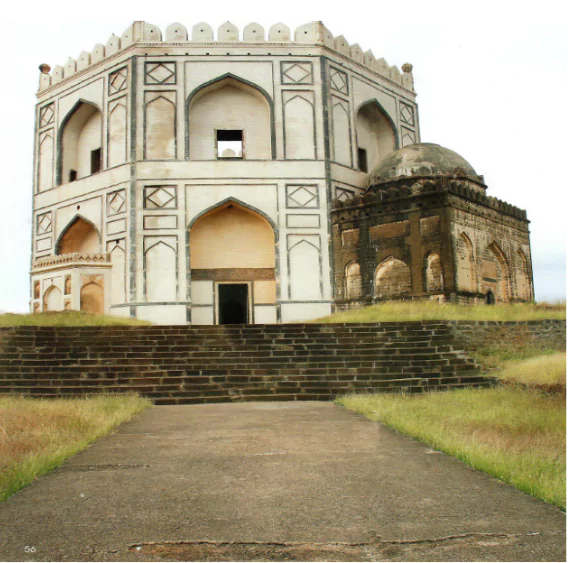 Ashtur Tombs: The Royal Necropolis of ten Bahmani rulers is situated in Ashtur village near Bidar city. The tomb’s interior is adorned with splendid paintings reflecting Deccani and Asian style of art.
-
- The first tomb belongs to Ahmad Shah, followed by tombs of Ala-ud-Din Ahmed Shah II, Ala-ud-Din Humayun Shah, Nizam-ud-din Ahmad Shah III, Shams-ud-din Muhammad Shah III, and Shihab-ud-din Mahmud Shah II were aligned.
- Chaukhandi tomb:It is a majestic mausoleum built in honor of Hazrath Khalil Ullah, the spiritual advisor of Ahmad Shah
The Bahmani Dynasty
- It was the first independent Muslim sultanate in the Deccan plateau of India that ruled for almost 200 years from 1347–1527.
- Founder: The Dynasty was established by Alauddin Hasan Gangu Bahman Shah, an Afghan adventurer, in 1347.
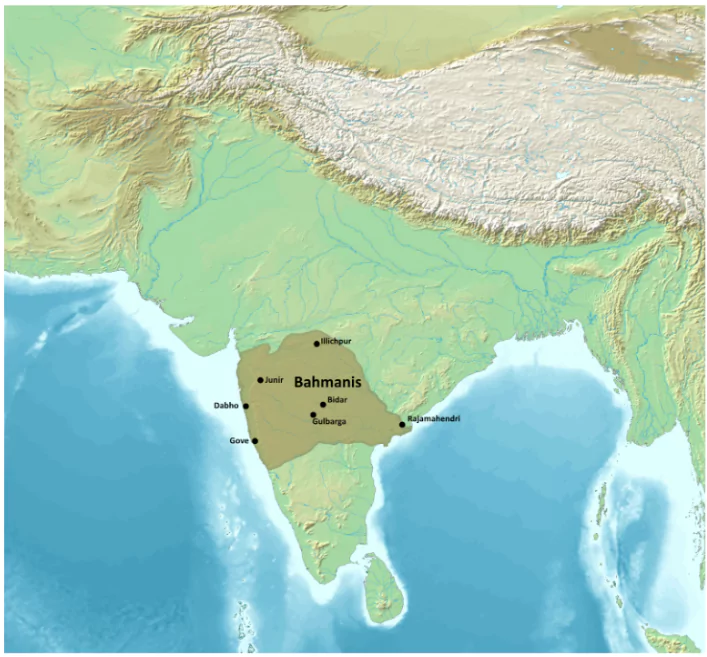 Capital: Gulbarga was the capital for the first 75 years followed by Bidar for over a century. Capital: Gulbarga was the capital for the first 75 years followed by Bidar for over a century.- Language: The official language was Persian, and the common languages were Marathi, Deccani, Telugu, and Kannada.
- Notable Rulers: In total the dynasty had 18 rulers,
- Muhammad Shah I: The son of Alauddin Bahman Shah,he defeated the Hindu principalities of Vijayanagara and Warangal.
- Firoz Shah Bahmani: He built an observatory near Daulatabad.
- Ahmad Shah I: Also Known as Wali (the Saint), he created an environment that attracted scholars from around the world.
|


 9 Nov 2024










 GS Foundation
 Crash Course
 Combo
Combo Optional Courses
 Degree Program