

Lorem Ipsum is simply dummy text of the printing and typesetting industry. Lorem Ipsum has been the industry's standard dummy text ever since the 1500s

Understanding the Nexus of Religion, Communalism, and Caste in Indian Politics

November 25, 2023

Introduction: Religion, Communalism, and Caste exploitation

Religion, communalism, and politics are intricately linked in India. While the Indian Constitution upholds secularism, religious diversity often becomes a tool in political mobilization. Communalism, the exploitation of religious identities for political gain, has fueled tensions and even violence.

Global Perspectives on Religion in Politics and the Call for Equality

  • Global Diversity: Religious diversity is widespread globally, leading to differences in practice and political expression. 
  • Minority Vulnerability: Human rights groups highlight minority vulnerability in communal riots, calling for government protection. 
  • Equal Treatment: Religion-based politics is acceptable if treating all religions equally and preventing discrimination.

Examining Communal Politics and the Risks of Religious Supremacy in Elections
  • Religious Superiority: Communal politics emerges from exclusive religious nationalism. It divides by asserting religious superiority.
  • Majoritarian Dominance: Flawed assumption of uniform interests fuels majoritarian dominance or minority separatism.
  • Communal Violence: Political mobilization exploits sacred symbols and emotions, causing communal violence. 
    • Example: Pakistan suffered severe communal riots during Partition.
  •  Religion-Based Politics: Communalism underscores the peril of religion-based politics, risking conflict and turmoil.

India’s Secular State in the Struggle Against Communalism

  • Secular State: The Constitution establishes a secular state with no official religion. 
    • It guarantees religious freedom while prohibiting discrimination.
  • Anti-Discrimination: State intervention ensures equality within religions, banning practices like untouchability.
  • Against Prejudice: Combating communalism is vital, requiring efforts against prejudice, propaganda, and religion-based political mobilization.

Caste Struggles and Transformation in Indian Politics

  • Caste Inequalities: India’s caste division is distinct, with hereditary occupations tied to rituals. 
    • The caste system excluded ‘outcaste’ groups, enforcing untouchability.
  • Efforts to eliminate caste inequalities: Leaders like Jyotiba Phule, Gandhiji, B.R. Ambedkar, and Periyar Ramaswami Naicker aimed to eliminate caste inequalities.
  • Traditional caste hierarchy: Modernization, urbanization, education, and economic changes have weakened the traditional caste hierarchy. 
    • Despite progress, caste effects remain, influencing marriage, education, and economic status.

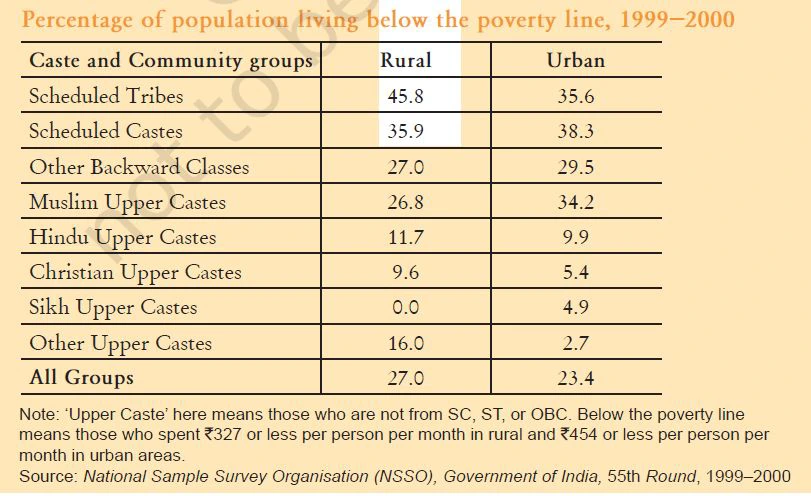
Percentage of Population Living Below the Poverty Line, 1999-2000

Percentage of Population Living Below the Poverty Line, 1999-2000

Caste in Indian Politics: Understanding Representation, Votes, and Shifting Trends

  • Caste as Social Community Basis:  Similar to communalism, casteism too asserts that caste forms the core of social community, uniting individuals of the same caste with presumed shared interests, distinct from other castes. 
    • However, this belief doesn’t align with reality as caste is only one facet of societal experience, not the sole or primary one.
  • Forms of Caste in Politics: In politics, caste manifests in several ways-
    • Parties select candidates considering caste demographics to secure electoral support.
    • Governments aim for caste and tribal representation.
    • Some parties align with specific castes, viewed as their representatives.
  • Impact on Elections: Despite caste’s role, elections aren’t solely caste-driven.
    • Multiple Communities:Constituencies lack a single caste majority, necessitating appeal to multiple communities.
    • Multi-Caste Constituencies: No party secures votes from an entire caste; the term “vote bank” implies significant support, not unanimous backing.
    • Diverse Candidate Choices: Multiple candidates from a caste might stand, and voters’ choices diverge due to varying interests.
    • Dynamic Political Shifts: Ruling parties and incumbents often lose, highlighting dynamic political shifts.
  • Multi-dimensional Influence: Beyond caste, various factors matter in politics.
    • Strong party affiliations often surpass caste loyalties.
    • Economic disparities within castes shape diverse voter interests.
    • Gender, wealth, and government performance assessment influence voting choices.

Caste and Politics: The Dynamic Connection and Its Impact on Empowerment in India

  • Caste and Politics Relationship: Caste’s interaction with politics isn’t unidirectional. 
    • Politics doesn’t merely succumb to caste influence; instead, it brings caste into the political sphere, politicizing it.
  • Transforming Caste Dynamics:
    • Caste groups expand by incorporating previously excluded neighboring castes or sub-castes.
      • Coalition necessitates dialogue and negotiation between diverse caste groups.
      • Emergence of new caste categories, such as ‘backward’ and ‘forward’ in politics.
  • Caste’s Multifaceted Role: Caste-based politics provides marginalized communities, like Dalits and OBCs, a platform to demand their share of power and dignity.
    • Against Discrimination: Advocacy against discrimination, seeking improved access to resources, land, and opportunities gains momentum.
    • Democratise Priorities: While caste’s involvement in politics empowers historically marginalized groups, exclusive concentration on caste dynamics can undermine broader democratic priorities and potentially lead to social discord.

Conclusion:

  • Caste’s role is undeniable in Indian politics, yet it coexists with myriad factors.
  • Voters’ diverse affiliations and complex considerations underscore the nuanced nature of political dynamics, challenging any simplification that reduces elections to a sole focus on caste.

Need help preparing for UPSC or State PSCs?

Connect with our experts to get free counselling & start preparing

Lorem Ipsum is simply dummy text of the printing and typesetting industry. Lorem Ipsum has been the industry's standard dummy text ever since the 1500s
Quick Revise Now !
AVAILABLE FOR DOWNLOAD SOON
UDAAN PRELIMS WALLAH
Comprehensive coverage with a concise format
Integration of PYQ within the booklet
Designed as per recent trends of Prelims questions
हिंदी में भी उपलब्ध
Quick Revise Now !
UDAAN PRELIMS WALLAH
Comprehensive coverage with a concise format
Integration of PYQ within the booklet
Designed as per recent trends of Prelims questions
हिंदी में भी उपलब्ध

<div class="new-fform">


    </div>

    Subscribe our Newsletter
    Sign up now for our exclusive newsletter and be the first to know about our latest Initiatives, Quality Content, and much more.
    *Promise! We won't spam you.
    Yes! I want to Subscribe.