India is infamously considered the ‘snakebite capital’ of the world with over 58000 snakebite related deaths occurring annually.
- As per the Central Bureau of Health Investigation (CBHI) reports (2016-2020), the average annual frequency of snakebite cases in India is around 3 lakhs and about 2000 deaths occur due to snakebite envenoming.
About Snakebite Envenoming
- Snakebite envenoming is a potentially life-threatening disease following the bite of a venomous snake resulting in medical issues which can lead to death or permanent impairment if timely and appropriate treatment is not given.
- Cocktail of Toxic Proteins: Snake Venom is a cocktail of toxins immobilising the human body by releasing,
- Haemotoxins: It destroys blood cells and disrupts clotting.
- Neurotoxins: It blocks nerve signals and paralyzes.
- Cytotoxins: It dissolves tissue at the bite site.
Enroll now for UPSC Online Course
- WHO Guidelines: It has categorised ‘snakebite envenoming’, as a Neglected Tropical Disease (NTD) globally and has issued certain guidelines for effective management of snakebite cases,
- Remove anything tight from around the bitten part of the body to avoid harm if swelling occurs.
- Immobilize the person completely, splint the limb to keep it still and transport the person to a health facility as soon as possible
- Applying pressure at the bite site with a pressure pad may be suitable in some cases.
- Avoid traditional first aid methods or herbal medicines like wound incision or excision, suction, or application of “black stones”
- Place the person on their left side with head down in the recovery position so as to not choke if vomiting occurs
- Closely monitor airway and breathing and be ready to resuscitate if necessary
- Health facilities should treat all snakebite cases as emergencies and give priority to assessing these patients and instituting treatment without delay.
- Symptoms: Bleeding disorders, Kidney failure, Paralysis, Tissue damage, and Amputation.
- Treatment: Making Safe and effective antivenoms widely available and accessible is the most effective treatment against snakebite envenoming.
-
- Antivenoms are included in the WHO List of essential medicines and should be part of any primary health care package where snake bites occur.
India- The Snakebite Capital of World
- India is home to more than 300 species of snakes, of which more than 60 are venomous, ranging from mild to high.
- Statistics: A 2020 study has estimated that between 2001 and 2014, approximately, 1.2 million snakebite deaths and three-times as many cases of permanent disability occurred in India.
- The study also said one in 250 Indians were at risk of dying from snakebite before the age of 70.
- Causes:
- Rural: Agricultural workers, Farmers, Tribals ect are the most vulnerable to snake bites particularly during the monsoon, when snakes become more active.
- Urban: Rapid, often unplanned urbanisation, poor garbage management, and urban floods have increased encounters between humans and snakes, making even city-dwellers vulnerable.
- Reasons for high Snake Bite related Mortality:
- Not easily accessible: Timely medical care in remote areas is a significant challenge as people often have to undertake long journeys to reach a healthcare facility equipped with antivenoms.
- Not Inclusive: The present method of treatment ie. Polyvalent antivenoms (PVAs) is not effective on the venom of other less known but venomous snakes like,
- king cobra, monocled cobra, banded krait, Sochurek’s saw-scaled viper, hump-nosed viper, and several species of pit vipers.
- Logistical Issues: Antivenoms often need to be transported in cold storage and India’s rural parts lack the supporting infrastructure and power supply.
- Delay in Treatment: Superstitious beliefs, cultural practices and using traditional medicine as the first line of treatment leads to delay in proper treatment..
- Inadequate Facilities: Lack of supporting infrastructure or proper handling of the antivenoms can cause them to degrade in storage and become ineffective.
- Unequal Access: The high cost of manufacturing antivenom limits accessibility for the economically-disadvantaged.
About Antivenoms
- Antivenoms are life-saving medicines used to treat snakebites. India is the world’s largest producer and consumer of antivenoms in the world.
- The Antivenoms work by specifically binding to the venom toxins to render them ineffective, allowing the body’s natural defence systems to clear them safely over time.
- Production Process: The first Antivenom was produced by French physician Albert Calmette in the 1890s using horses
- Antivenoms are produced by injecting small amounts of snake venom into horses, which then produce antibodies as part of their immune response.
- These antibodies are extracted from the horse’s blood and purified and formulated as antivenoms.
Check Out UPSC Modules From PW Store
- The Irula tribe of Tamil Nadu are experts in milking the snake and collecting its venom which is then supplied to Pharma companies to produce Antivenoms.
- Several companies in India, including Bharat Serums and Vaccines, Haffkine Bio-pharmaceutical Corporation, and ViNS Bioproducts, produce antivenom this way.
- Current Status in India: Polyvalent antivenoms (PVAs) are currently used in India as it targets the Big Four accounting for most snakebite deaths.
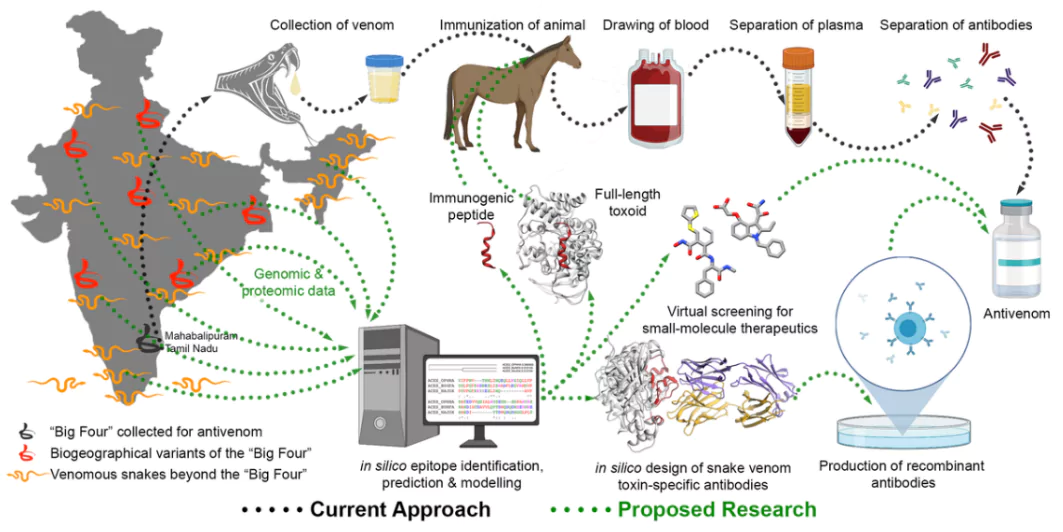 The Big Four: The venom extracted from Indian cobra (Naja naja), common krait (Bungarus caeruleus), Russell’s viper (Daboia russelii), and the saw-scaled viper (genus Echis) is used to produce PVAs in India.
- Future Research in Antivenom Development:
- Synthetic Antivenoms: Recombinant DNA technology is being used to produce lab-engineered, synthetic antivenoms that are free from animal-derived proteins and offer greater safety and efficacy.
- Example: A research led by 2024 Nobel laureate David Baker, reported successfully using Artificial Intelligence (AI) to design synthetic antivenoms.
- Region-Specific Antivenoms: Researching on the cross-species and geographic variability in venoms, scientist are developing Region-Specific Antivenoms.
- Tailored Antivenoms: By mapping the toxins’ compositions, scientists are attempting to create tailored antivenoms, holding the promise for more precise treatments.


 22 Jan 2025










 GS Foundation
 Crash Course
 Combo
Combo Optional Courses
 Degree Program