Books

15 August vs 26 January: Difference Between Independence Day and Republic Day explained here, covering history, significance, celebrations, flag hoisting, and constitutional meaning in India.
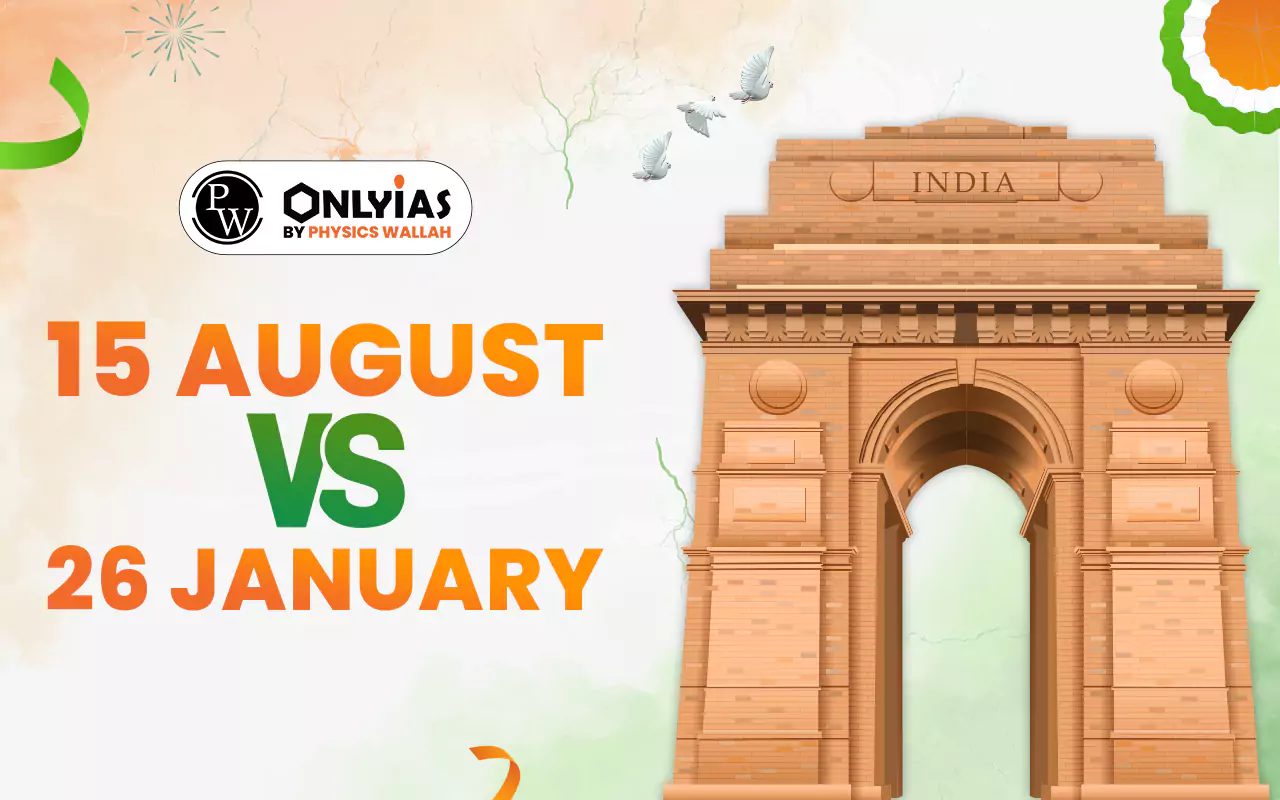
15 August vs 26 January often arises whenever one discusses the importance of these dates. Because both Independence Day and Republic Day hold significant importance for the achievements that were achieved on these days. Though the purpose behind celebrating these days might be different, both of these days are celebrated with equal patriotic fervor.
15 August vs 26 January highlights two different chapters of Indian sovereignty. Where one marks freedom from colonial rule, the other represents the birth of democratic self-governance under a constitution. Understanding the difference between 26 January and 15 August offers insight into the nation’s journey, from independence to a constitutional republic.
26 January 2026 marks Republic Day, commemorating India’s Constitution adoption, while 15 August 2026 celebrates Independence Day, marking freedom from British rule. Both national holidays feature flag hoisting, parades, and patriotic events across the country.
| 26 January vs 15 August Dates 2026 | ||
|---|---|---|
| Date | Significance | Key Celebrations |
| 26 January 2026 | Republic Day – Constitution effective | Delhi Parade, Beating Retreat, Awards |
| 15 August 2026 | Independence Day – Freedom from Britain | Red Fort speech, Kite flying, Flag hoisting |
On 15 August (Independence Day), the Prime Minister hoists the national flag from the bottom of the pole at Red Fort, symbolizing India’s rise to freedom from British rule in 1947, accompanied by the national anthem and guard of honour. In contrast, on 26 January (Republic Day), the President unfurls the flag tied at the top of the pole without raising it, representing the unfolding commitment to the Constitution adopted in 1950 and India’s democratic republic status. The hoisting signifies a nation’s emergence and patriotism, while unfurling highlights continuity and renewal of sovereign principles during parades. This distinction in flag presentation adds symbolic depth to both celebrations, rooted in their unique historical contexts.
15 August 1947 marks the day when India gained independence from British rule. This day symbolizes the end of nearly two centuries of British rule. Therefore, this day highlights the transfer of power that took place and the dawn that provided freedom to the entire nation.
On this day, the first Prime Minister, Jawaharlal Nehru, delivered the famous “Tryst with Destiny” speech and hoisted the Indian national flag at the Red Fort in Delhi. Since then, every 15 August, communities across India and abroad mark the struggle for freedom, honour the sacrifices of freedom fighters, and express gratitude for sovereignty.
While independence was achieved in 1947, India continued under transitional legal frameworks until it adopted its own Constitution. On 26 January 1950, the Indian Constitution came into force, formally making India a sovereign, democratic republic.
This date had historical significance, as it coincided with the 1930 declaration of Purna Swaraj by the Indian National Congress. 26 January thus marks the day when India assumed full constitutional authority and elected its own President, transitioning from a dominion to a republic.
Both 15th August and 26 January are significant national celebrations in India. But the key difference between Independence Day and Republic Day lies in the milestones that were achieved on both of these days.
While Independence Day honours political freedom from British rule, Republic Day celebrates the adoption of the Constitution and the establishment of India as a sovereign, democratic republic.
Provided here is the table that gives a better understanding of 15 August vs 26 January:
| 15 August vs 26 January | ||
| Aspect | 15 August (Independence Day) | 26 January (Republic Day) |
| Significance | Marks independence from British rule in 1947 | Marks adoption of the Constitution in 1950 |
| Year of Origin | 1947 | 1950 |
| Focus | Political freedom and end of colonial rule | Establishment of democratic governance |
| Main Event | Flag hoisting by the Prime Minister at the Red Fort | Republic Day Parade at Kartavya Path, New Delhi |
| Symbolism | Freedom, unity, and sacrifices of freedom fighters | Constitution, democracy, and national sovereignty |
Ready to boost your UPSC 2026 preparation? Join PW’s UPSC online courses today!
Explore UPSC Test Series

Independence Day marks freedom from British rule in 1947, while Republic Day celebrates the adoption of the Constitution in 1950.
On 15 August, the Prime Minister hoists the flag, while on 26 January, the President unfurls it.
It commemorates the 1930 Purna Swaraj declaration and the enforcement of the Constitution in 1950.
15 August is celebrated at the Red Fort in Delhi, while 26 January is observed at Kartavya Path with a grand parade.
15 August symbolises freedom and unity, while 26 January represents democracy, constitutional governance, and sovereignty.
Yes, both are gazetted holidays with nationwide celebrations, school closures, and government events honoring India's freedom and sovereignty.
Republic Day, commemorating the adoption of India's Constitution on January 26, 1950, featuring the President's flag unfurling and Delhi Parade.
India's Independence Day, marking freedom from British rule on August 15, 1947, with flag hoisting at Red Fort by the Prime Minister.



Explore SRIJAN Prelims Crash Course


Connect with our experts to get free counselling & start preparing
Books
Udaan (Prelims Wallah)
Prahaar (Mains Wallah)
Q&A Bank (Prelims & Mains)
Budget & Economic Survey
NCERT Wallah
Marks Booster
हिंदी माध्यम विशेष शृंखला
 Current Affairs
Monthly Current Wallah
Subject Wise Current Affairs
Editorial Analysis
Editorial PDFs
News of The Day
Download Our App



Download Our App
<div class="new-fform">
</div>

 GS Foundation
 Optional Course
 Combo Courses
 Degree Program