Recently , the Supreme Court directed Delhi-NCR authorities to remove all free-ranging dogs from public spaces and relocate them permanently to shelters.
Stray Dog Crisis in India
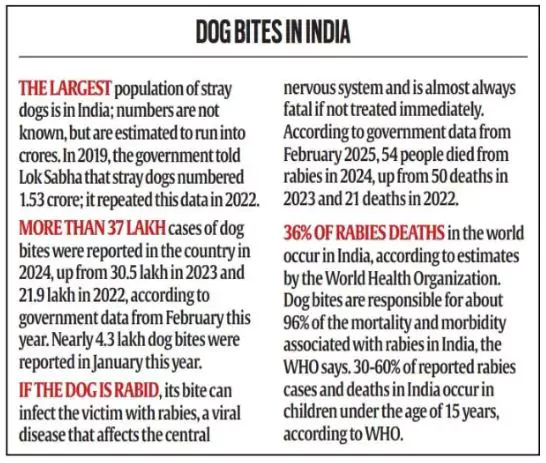
- Huge National Stray Population: India has an estimated 52.5 million stray dogs, according to the State of Pet Homelessness survey.
- Delhi’s Share of the Problem: The national capital alone is reported to have around 1 million stray dogs, contributing significantly to urban human–animal conflict.
- Dog Bite Incidence: In 2024, India recorded 37,17,336 dog bite cases, reflecting the scale of public health and safety concerns linked to the stray population.
- Rabies Impact: According to World Health Organization (WHO) data, India accounts for 36% of global rabies deaths, with 18,000 to 20,000 human rabies cases reported annually.
- The country also reported 54 suspected human rabies deaths in 2024, with the vast majority of rabies cases traced to dog bites.
- Shelter Capacity Gap: Only about 8 million homeless dogs are housed in shelters, leaving the vast majority on the streets without systematic control measures.
Key Highlight of the SC Order
- Immediate Removal: Authorities in Delhi, Noida, Gurugram, and Ghaziabad must immediately begin removing stray dogs from localities, prioritising vulnerable areas and city outskirts.
- Permanent Relocation: Captured dogs will be housed in dedicated shelters, sterilised, vaccinated, and monitored by CCTV, with a strict ban on returning them to public spaces.
- Enforcement and Penalties: Individuals or organisations obstructing removal operations will face legal consequences. Authorities may use force if required to capture the animals.
- Infrastructure Creation Timeline: Shelters with capacity for 5,000–6,000 dogs must be built within 6–8 weeks, with adequate staff for sterilisation, vaccination, and care.
- Rabies Prevention Measures: A public helpline for dog bites and rabies cases must be operational within a week, ensuring action within four hours
- Authorities must publish vaccine availability and stock data.
Criticism of the SC Order
- Blanket Order: Animal welfare groups argue the directive applies indiscriminately to all dogs, including vaccinated and sterilised ones, disregarding individual community contexts.
- Violation of Prevention of Cruelty to Animals Act and the Animal Birth Control (ABC) rules: The order contradicts the Animal Birth Control (ABC) Rules, 2023, which mandate that sterilised and vaccinated dogs be returned to their original territories.
- No Scientific Backing: Experts point out that large-scale relocation has no proven record of reducing rabies or controlling dog populations, and may even disrupt ecological balance.
- Ethical Concern: Activists describe the ruling as “inhumane” and “unscientific,” causing unnecessary suffering to healthy animals without addressing root causes.
- Violation of Animal Rights: Removing community dogs from familiar territories deprives them of their basic rights under animal protection frameworks and undermines coexistence principles.
- Impact on Community Rights : Residents who feed and care for community dogs view the removal as a breach of their rights and a disruption of established human-animal relationships.
Challenges in Implementation of the Order
- Structural Limitations: Delhi lacks government-run dog shelters; creating facilities for lakhs of dogs will require vast land, sanitation, and food infrastructure, taking years to complete.
- Financial Burden: Establishing adequate shelter infrastructure could cost upwards of ₹15,000 crore, a figure deemed unrealistic within the 2-month timeline set by the court.
- Public Outrage: Communities and animal welfare organisations are strongly opposing mass dog removal leading to legal challenges and nationwide protests.
- Logistical Constraints: Capturing and housing over 3 lakh stray dogs in Delhi alone would require massive manpower, transport, veterinary support, and operational coordination.
- Legal Constrain: ABC guidelines make a distinction between community dogs (living on the street or within a gated campus) and pet dogs, making it harder for authorities to assign responsibility.
Earlier Attempts to Control Stray Dogs
- Culling and removal: India’s past attempts to tackle stray dogs through culling by electrocution, poisoning, shooting, or clubbing proved ineffective.
- Partial elimination reduced competition and spurred breeding.
- Animal Birth Control (ABC) Initiative : Since 1992, NGOs like Blue Cross of India and various governments have implemented Animal Birth Control (ABC) programmes in cities.
- Legal Backing: In 2001, ABC (Dogs) Rules were notified under the Prevention of Cruelty to Animals Act, 1960.
- The Animal Birth Control (ABC) Rules, 2023 replaced the 2001 rules, mandating that sterilised and vaccinated stray dogs be released back to their original locations after the procedure.
- Operational Limitation: ABC drives require sterilising at least two-thirds of the stray population within 6–12 months to stabilise numbers.
- Most Indian cities fail to meet this target, as the responsibility rests largely with a few NGOs.
- Outcome Challenge: Even if the sterilisation target is met, stray populations may still grow, indicating limited long-term impact of current ABC efforts.
Alternatives to Address the Stray Dog Crisis
- Large-Scale Sterilisation and Vaccination Drives: Replicate Bhutan’s Nationwide Accelerated Dog Population Management and Rabies Control Programme (2021–2023), which achieved 100% sterilisation and vaccination of strays over time.
- Adoption Incentives: Netherlands’ model by imposing high taxes on store-bought dogs and promoting adoption from shelters, reducing street populations sustainably.
- Community-Based Management: Encourage local communities to participate in feeding, vaccinating, and monitoring dogs in their areas, combined with the Collect-Neuter-Vaccinate-Return (CNVR) approach.
- Pet Police : Establish dedicated animal welfare enforcement unit to penalise neglect and abandonment, ensuring pet responsibility and reducing stray numbers.
Conclusion
The Supreme Court’s order to remove stray dogs from Delhi-NCR aims to address public health and safety concerns, but faces legal, ethical, and logistical hurdles. Sustainable solutions require large-scale sterilisation, community participation, strict pet ownership laws, and humane management.


 12 Aug 2025




.png)






 Current Affairs




 GS Foundation
 Optional Course
 Combo Courses
 Degree Program