Snow Leopards

10 Oct 2025

Snow Leopards

Recently, a new Stanford University study finds that snow leopards have exceedingly low genetic diversity due to ‘Historic Inbreeding’, putting their long-term survival at risk amid climate change.

  • Analysis of 41 genomes revealed persistently low genetic diversity due to long-term small, stable populations.

Historic Inbreeding

  • Historic Inbreeding refers to the long-term mating among closely related individuals within a small, stable population, leading to low genetic diversity over generations.
  • For Example, in species like the snow leopard, persistent small population sizes in isolated, harsh habitats caused periodic inbreeding. 
  • This allowed natural selection to “purge” harmful mutations, keeping the population relatively healthy despite low overall genetic diversity, unlike species that underwent sudden population bottleneck.

What is Genetic Diversity?

Definition: Genetic diversity refers to the total variety of genes within a species’ population, determining its ability to adapt to changing environments and resist diseases.

  • Impact of Low Genetic Diversity:
    • Reduces adaptability to environmental stressors such as climate change and habitat loss.
    • Increases susceptibility to inherited disorders and disease.
    • Limits evolutionary potential, threatening species survival over generations.

Check Out UPSC CSE Books

Visit PW Store

online store 1

About Snow Leopard (Panthera uncia)

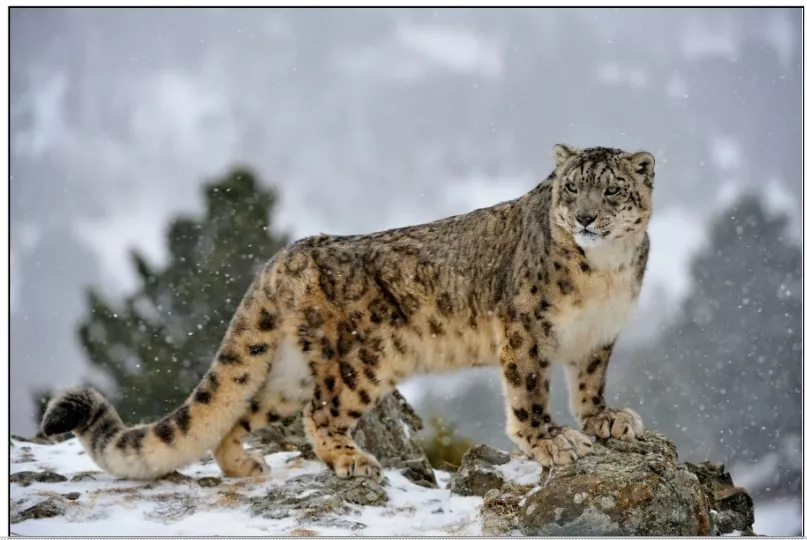
Snow leopards

  • The snow leopard, often called the “ghost of the mountains,” is a large feline native to the high-altitude regions of Central and South Asia, renowned for its elusive nature.
  • Habitat: It inhabits rugged terrains of the Himalayas, Karakoram, Pamir, and Tian Shan ranges, typically between 3,000–5,500 metres altitude.
  • Distribution: Found across 12 countries, including India, Bhutan,Nepal, China, Mongolia, and Afghanistan.
    • The global population is estimated at around 8,000 individuals.
  • Conservation Status
    • Listed as “Vulnerable” on the IUCN Red List.
    • Wildlife (Protection) Act of 1972 (Schedule I)
    • Convention on International Trade in Endangered Species (CITES) (Appendix I)
  • Protection  in India:
    • Hemis National Park (Ladakh)
    • Kibber Wildlife Sanctuary (Himachal Pradesh),
    • Gangotri National Park (Uttarakhand),
    • Nanda Devi Biosphere Reserve (Uttarakhand)
    • Khangchendzonga National Park (Sikkim).
  • Conservation initiatives : Project Snow Leopard (2009) under the Ministry of Environment, Forest and Climate Change (MoEFCC).

Enroll in SRIJAN Prelims Crash Course

Need help preparing for UPSC or State PSCs?

Connect with our experts to get free counselling & start preparing

Aiming for UPSC?

Download Our App

      
Quick Revise Now !
AVAILABLE FOR DOWNLOAD SOON
UDAAN PRELIMS WALLAH
Comprehensive coverage with a concise format
Integration of PYQ within the booklet
Designed as per recent trends of Prelims questions
हिंदी में भी उपलब्ध
Quick Revise Now !
UDAAN PRELIMS WALLAH
Comprehensive coverage with a concise format
Integration of PYQ within the booklet
Designed as per recent trends of Prelims questions
हिंदी में भी उपलब्ध

<div class="new-fform">


    </div>

    Subscribe our Newsletter
    Sign up now for our exclusive newsletter and be the first to know about our latest Initiatives, Quality Content, and much more.
    *Promise! We won't spam you.
    Yes! I want to Subscribe.