The Johannesburg G20 Summit, the first held in Africa, became significant as it added the African Union as a full member, strengthening global representation.
Significance of The Summit
- African Representation: The African Union’s admission as a permanent G-20 member during India’s 2023 Presidency ensured that African issues gained institutional space, strengthening Africa’s voice in multilateral decision-making.
- Global South Mood: The overall mood of the Summit was driven by the concerns of developing nations, with discussions focusing on conflicts, deepening inequalities, food insecurity, and global economic instability.
- Ubuntu Philosophy: The concept of Ubuntu i.e “I am because we are” infused the declaration with an emphasis on solidarity, interdependence, and collective responsibility.
- Broader Peace Agenda: The Summit expanded its conflict focus beyond Ukraine by explicitly calling for a “Just, Comprehensive, and Lasting Peace” in Sudan, the Democratic Republic of Congo, and the Occupied Palestinian Territory, while invoking the UN Charter.
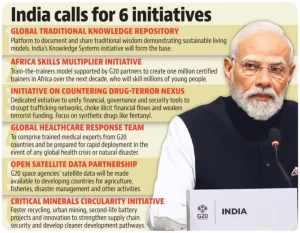
Six Initiatives Proposed by the Indian Prime Minister

- Traditional Knowledge Repository: India proposed a global digital library to document and disseminate Yoga, Ayurveda, and indigenous tribal knowledge, with a strong focus on supporting African nations.
- G20–Africa Skills Multiplier Initiative: Suggested a large-scale skilling programme to train one million African youth in high-growth sectors, addressing unemployment and capability gaps.
- Global Healthcare Response Team: Recommended a rapid-response medical team to strengthen global pandemic preparedness, drawing on lessons from COVID-19.
- Countering the Drug–Terror Nexus: Called for a global mechanism to curb drug trafficking and disrupt terror financing networks, aligning with India’s internal security priorities.
- Open Satellite Data Partnership: Offered ISRO’s satellite data as a global public good to support agriculture, fisheries, disaster management, and climate resilience in developing countries.
- Critical Minerals Circularity Initiative: Proposed a framework for recycling, reuse, and secure supply chains of critical minerals (lithium, cobalt, nickel) to reduce global dependence on dominant suppliers.
Criticisms of the Summit
- Weak Terrorism Language: India criticised the declaration for diluted references to terrorism, falling short of the 2023 New Delhi standard, despite recent attacks in Delhi and Pahalgam.
- U.S. Summit Boycott: The U.S. boycott over alleged discrimination against white minority farmers in South Africa hurt G-20 credibility and questioned USA’s multilateral commitment.
- Shift in G-20 Power Balance: The boycott was seen as ill-timed, weakening G-20 cohesion just as India–Brazil–South Africa–led Global South assertiveness is reshaping demands for a more democratic global order.
Conclusion
The spirit of ‘Ubuntu’ or “I am because we are”, referred to in this year’s declaration, must be heeded by the very powers that would seek to sideline the grouping today.