The Antarctic ozone hole closed earlier than usual in 2025, marking the second consecutive year of a smaller ozone hole and raising hopes for long-term ozone layer recovery.
- According to Copernicus, the European Earth observation agency, 2025 ozone hole is the smallest in the last five years, with higher ozone concentrations, indicating accelerated recovery.
What is an Ozone Hole/ Ozone Layer Depletion ?
- An Ozone Hole refers to a region in the Earth’s stratosphere where the ozone layer experiences extreme depletion, resulting in significantly lower concentrations of ozone molecules.
- Seasonal Occurrence: This depletion phenomenon occurs primarily during the Southern Hemisphere’s spring months, (August to December) , although global atmospheric factors can also influence its intensity.
- Location: The depletion of ozone leads to an area with extremely low ozone levels (220 Dobson Units or lower), most commonly detected over Antarctica.
- The amount of ozone in a column of air from the surface to the top of the atmosphere is expressed in Dobson Units (DU).
The Ozone Layer
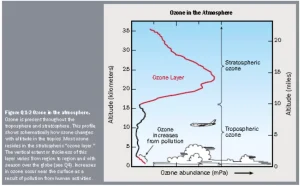
- The ozone layer is a region of high ozone concentration in the stratosphere, 15 to 35 kilometres above Earth’s surface.
- Role: The ozone layer acts as an invisible shield and protects us from harmful ultraviolet (UV-B and UV-C)radiation from the sun and protects life on the earth.
|
Reasons for Ozone Layer Depletion
- Emission of Ozone-Depleting Substances (ODS):
-
- Ozone is destroyed primarily by human-made chemicals such as chlorofluorocarbons (CFCs), halons, carbon tetrachloride, methyl chloroform, and hydrochlorofluorocarbons (HCFCs).
- These substances release chlorine and bromine atoms in the stratosphere, which break down ozone molecules.
- Long Atmospheric Lifetimes: ODS remain in the atmosphere for decades, allowing them to accumulate and reach the stratosphere through slow transport processes.
- Polar Stratospheric Clouds (PSCs): Extremely cold temperatures over Antarctica create PSCs that provide surfaces for chemical reactions, releasing active chlorine that triggers rapid ozone destruction during spring.
- Volcanic Eruptions: Large volcanic eruptions inject tiny particles (stratospheric aerosols) into the stratosphere, enhancing chemical reactions that accelerate ozone breakdown.
Ozone-Depleting Substances (ODS)
- Chlorofluorocarbons (CFCs): CFCs were widely used as refrigerants until the 1980s due to their effectiveness in cooling systems. They are used in in the production of plastic foam, Air conditioners.
- Hydrochlorofluorocarbons (HCFCs): These chemicals deplete ozone but are less harmful than CFCs.
- Hydrobromofluorocarbons (HBFCs): These substances contain bromine and contribute strongly to ozone depletion.
- Halons: These gases were primarily used in fire extinguishers due to their fire-suppressing ability.
- Methyl Bromide: This chemical was used as a fumigant for pest control by suffocating pests with toxic gases.
- Carbon Tetrachloride: This compound was commonly used in fire extinguishers, refrigeration systems, and as a cleaning agent & fumigant .
- Methyl Chloroform: This substance served as a solvent for organic compounds and was widely used for cleaning metal parts and circuit boards.
|
Global Initiatives to Curb Ozone Depletion
- Vienna Convention (1985): The Vienna Convention for the Protection of the Ozone Layer was adopted in 1985, where United Nations member states acknowledged the need to prevent damage to the ozone layer and committed to cooperative scientific and policy measures.
- Montreal Protocol (1987): The Montreal Protocol on Substances that Deplete the Ozone Layer, signed in 1987 by 197 parties, established binding controls on the production and consumption of ODS, primarily targeting CFCs. It promoted the development of safer substitutes such as HCFCs and later HFCs.
- Kigali Amendment (2016): The Kigali Amendment to the Montreal Protocol, adopted in 2016, aims to phase down selected HFCs, thereby reducing their projected growth and mitigating climate change impacts.
India’s Efforts to Control Ozone Layer Depletion
- International Commitments: India signed the Vienna Convention in 1991 and the Montreal Protocol in 1992.
- Ozone Depleting Substances (Regulation and Control) Rules, 2000: India enforces strict control through the ODS Rules, 2000, which regulate the production, import, export, sale, and use of ozone-depleting substances across the country.
- Phase-Out of ODS: India completely phased out CFCs (2010), halons, carbon tetrachloride, and methyl chloroform, and it is on track to phase out HCFCs by 2030, demonstrating strong commitment to global environmental governance.
- Hydrochlorofluorocarbons (HCFC) Phase-out Management Plan (HPMP): India implements the HCFC Phase-out Management Plan in multiple stages to gradually eliminate HCFCs.
- Kigali Amendment Ratification: India approved the ratification of the Kigali Amendment in 2021 to support the global transition away from high–global warming hydrofluorocarbons (HFCs).
- Institutional Mechanism: India operates a dedicated Ozone Cell under the Ministry of Environment and Forests, which collaborates with the United Nations Development Programme (UNDP) to implement ozone protection measures.


 5 Dec 2025





.png)






 Current Affairs




 GS Foundation
 Optional Course
 Combo Courses
 Degree Program