India’s aviation sector plunged into turmoil after massive IndiGo flight cancellations left thousands stranded, triggering urgent government action.
- In a contentious move, the Civil Aviation Ministry and DGCA suspended FDTL safety norms, raising deep concerns about pilot fatigue, passenger safety, and regulatory credibility.
About FDTL [Flight Duty Time Limitations] & its Rules
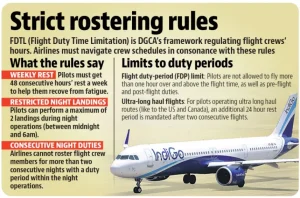
- Meaning of FDTL: FDTL stands for Flight Duty Time Limitations, which regulates the duty hours and rest periods for pilots.
- Purpose of FDTL: These rules exist because pilots are vulnerable to fatigue and sleep deprivation.
- Fatigue slows a pilot’s reaction time and impairs judgement.
- Role of Directorate General of Civil Aviation (DGCA): The DGCA formulated FDTL rules to regulate the sector and ensure pilot and passenger safety.
Incident of 5 December 2025
- Massive Flight Cancellations: 5 December 2025 is called by some as “Black Friday” because Indigo cancelled nearly 1,000 flights.
- Reason Given by Indigo: Indigo said that widespread cancellations happened due to a shortage of pilots needed to comply with the newly implemented FDTL rules.
- Government’s Response: The Civil Aviation Minister suspended the new FDTL rules, saying this was necessary to stabilise operations and provide relief to stranded passengers.
- Implication of Suspension: The suspension meant that pilots would again fly under old rules, effectively allowing fatigued pilots to fly planes.
- This reflected a clear conflict between safety and commercial interests, with the government prioritising operational stability over safety.
- Administrative Lapses: Both IndiGo’s management and the DGCA were aware for over a year that the new regulations would take effect from 1 November 2025, yet failed to prepare adequately.
Erosion of Safety Standards Since 2007
- Original Safety-Focused Rules: In 2007, the DGCA created improved rules that focused heavily on proper rest for operating crew.
- Interference from Airlines: Airline owners complained to the Ministry, and in 2008, the Ministry ordered the DGCA to suspend the improved rules.
- This shows a recurring pattern where commercial interests override crucial safety considerations.
- The Bombay High Court and DGCA: The Pilot Association filed a case arguing they were denied proper rest and that the DGCA’s safety-focused rules were shelved due to government pressure.
- Initial High Court Stand: The High Court initially supported the pilots and stated that safety cannot be compromised for financial interests.
- The Court suggested reducing the number of flights instead of increasing pilots’ duty hours during a shortage.
- High Court Reversal: Later, the High Court reversed its order and upheld the Ministry’s actions, effectively sidelining safety concerns.
- Court’s Later Findings: The Pilot Association continued its fight and eventually the Court ordered the DGCA to revise the rules and criticised the DGCA for treating pilots like “bonded labour
Issues Regarding Civil Aviation Safety In India
- Chronic Understaffing of Pilots: Even under the earlier FDTL norms, airlines required minimum six pilot sets per domestic aircraft and twelve sets per wide-body long-haul aircraft.
- Airlines, particularly IndiGo, allegedly exploited regulatory loopholes and deliberately underemployed crew to cut costs.
- Regulatory Apathy: For over two decades, the judiciary has deferred to the executive on aviation matters, contributing to a culture where safety concerns receive minimal judicial scrutiny.
- Ignored ICAO Warning: Despite ICAO’s 2006 warning, India still relies on a non-independent DGCA whose oversight has steadily weakened.
- Its placement under a ministry focused on industry growth creates a structural conflict of interest, allowing safety lapses and airline non-compliance to persist.
- Blatant Undermining of Safety Norms: On 5 December 2025, DGCA appealed for pilot cooperation, signalling an urgent safety concern. Yet, within hours, the Aviation Ministry suspended the FDTL CAR—the very rules mandated by the High Court—showing executive willingness to dilute safety norms.
- Culture of Non-Compliance: A persistent culture of non-compliance is evident as IndiGo has ignored the High Court–mandated CAR for over a year. Expecting full adherence within two months, ahead of the February 10, 2026 deadline, is highly unrealistic.
Conclusion
There have been three major aircraft accidents in India since 2010 (Mangaluru, Kozhikode and Ahmedabad). It is often repeated that safety is paramount. But the actions on December 5, 2025 prove that aviation safety is still a myth in India.


 8 Dec 2025





.png)






 Current Affairs




 GS Foundation
 Optional Course
 Combo Courses
 Degree Program