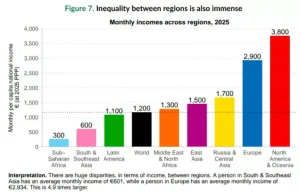
The recently released World Inequality Report 2026 highlights extreme and persistent economic disparities worldwide.
About the World Inequality Report
- Produced by the World Inequality Lab and involving over 200 global scholars.
- This is the 3rd edition of the report after 2018 and 2022.
Key findings from the World Inequality Report 2026

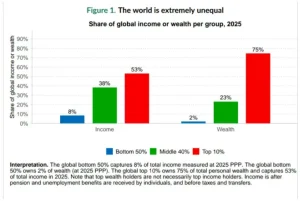
- Extreme Global Wealth Concentration: The top 10% of the global population owns around 75% of global wealth.
- The bottom 50% holds just 2% of total global wealth.
- The top 0.001% (fewer than 60,000 individuals) own more than 6% of global wealth, three times more than the entire bottom 50% combined.
- National Income Inequality: In many nations, the top earners capture a vastly disproportionate share of national income.
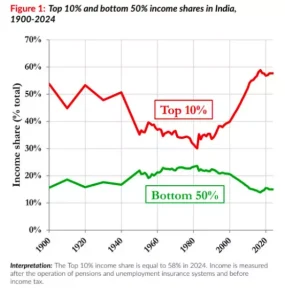
- In India the top 10% earns 58% of national income, while the bottom 50% earns only 15%.
- Global Gender Inequality: Excluding unpaid work, women earn only 61% of what men earn per working hour globally.
- When unpaid domestic and care work is counted, women’s total compensation falls to just 32% of men’s.
- Women’s share of global labor income has stagnated at just over 25% since 1990.
- Climate Responsibility is Highly Unequal: The poorest 50% of the global population is responsible for only 3% of carbon emissions from private capital ownership (investments, assets).
- The wealthiest 10% accounts for 77% of these investment-related emissions.
Shifts in Global Economic Geography: Since 1980, China has seen a major economic shift, with much of its population moving into the global middle class.
-
- In contrast, India has lost relative ground; almost its entire population is now within the global bottom 50% of income distribution.
- Global Financial Flows Favor the Rich: An annual flow of about 1% of global GDP moves from poorer to richer countries through financial returns and interest payments.
- This “reverse redistribution” is nearly three times larger than total global development aid, increasing global inequality.
India’s Deepening Inequality
- Income: The top 10% of earners capture 58% of national income, while the bottom 50% get only 15%.
- Wealth: The richest 10% hold about 65% of total wealth, and the top 1% alone holds about 40%.
- Gender: Female labor force participation remains very low at 15.7%, showing no improvement over the past decade.
|
Policy Recommendations to Reduce Inequality
- Progressive Taxation & Redistribution: Implementing effective taxes on extreme wealth (e.g., a minimum wealth tax) and using revenues for social investment.
- Public Investment: Funding universal, high-quality education, healthcare, and climate adaptation.
- Global Governance: Reforming the international financial system and creating an international panel on inequality to provide evidence-based policy guidance.
Conclusion
The World Inequality Report 2026 comes at a challenging political time, but it is more essential than ever. Only by continuing the historic movement toward equality will we be able to address the social and climate challenges of the coming decades.