The recent legislative moves, particularly the proposed Draft Indian Statistical Institute (ISI) Bill, 2025, and the preceding Indian Institutes of Management (Amendment) Act, 2023, highlight a concerted effort by the Union government to centralize autonomous Higher Education Institutions (HEIs).
- Recently, the Union Cabinet approved the Viksit Bharat Shiksha Adhikshan Bill, which proposes a single unified regulator for higher education in India.
- The Bill seeks to replace existing statutory bodies such as the University Grants Commission (UGC), the All India Council for Technical Education (AICTE) and the National Council for Teacher Education (NCTE).
- Earlier known as the Higher Education Commission of India (HECI) Bill, it has now been renamed the Viksit Bharat Shiksha Adhikshan Bill to reflect the vision of Viksit Bharat.
About Higher Education Institutions (HEIs)
- HEIs form the backbone of the knowledge economy, driving human capital formation, innovation, and social mobility.
- In India, HEIs are central to leveraging the demographic dividend and promoting inclusive growth, while addressing persistent challenges of quality, equity, governance, and employability under reforms initiated by New Education Policy (NEP) 2020.
India’s Transformation in Higher Education
- Current Status: The total number of Universities / University level institutions registered is 1,168, Colleges 45,473 and Standalone Institutions 12,002.
- Global Visibility: India has seen an impressive 318% increase in its representation in global rankings over the last decade—the highest growth among the G20 nations.
- Inclusivity: Enrollment for Socially and Economically Disadvantaged Groups (SEDGs) has soared (2011-2022):
- OBC enrollment grew by 80.9%.
- SC enrollment grew by 76.3% (from 15% to nearly 26% of the eligible population).
- ST enrollment grew by 106.8% (from 11% to 21% of eligible population).
- Gender Parity: The national Gender Parity Index (GPI) reached 1.01 in 2021-22, indicating a successful move toward gender equality in HEIs.
- 17 Universities (of which 14 are State Public Universities) and 4,470 Colleges are exclusively for women.
About Centralization in Higher Education Institutions (HEIs)
- Centralization in higher education refers to the increasing concentration of authority within the Union government over governance, funding, admissions, and curriculum in HEIs, often at the expense of institutional autonomy and state powers.
Historical Evolution of HEIs- From Coordination to Control
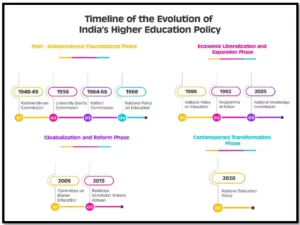
- Constitutional Foundation (1950s): The UGC Act, 1956, established the initial framework for coordination and maintenance of standards.
- However, its legislative power stems from the Union’s authority to coordinate and determine standards (Entry 66 of the Union List).
- Constitutional Shift (1976): The 42nd Constitutional Amendment (1976) shifted education to the Concurrent List (Entry 25).
- While this enabled national standardization, recent Union moves have often been criticized as exceeding this role.
- Recent Trends (Post-2014): This period is marked by an acceleration in central control, often linked to the broader “3Cs Crisis”.
- Centralization, Commercialization (e.g., loan-driven funding), and ideological influences), collectively eroding both equity and the spirit of cooperative federalism.
Indian Higher Education- From Ancient to Modern Times
- Ancient Indian Higher Education (Before 10th Century CE)
- Philosophy: Education was holistic, focusing on knowledge (Vidya), morality, and skill development rather than just academic learning.
- Gurukul System
- Teacher (Guru) – Disciple (Shishya) tradition with emphasis on oral transmission of knowledge.
- Famous Gurukuls: Located in Kashi, Ujjain, and Pushpagiri.
- Early Universities
- Takshashila (6th century BCE – 5th century CE): First recorded university in the world.
- Notable scholars: Chanakya (Arthashastra), Panini (Sanskrit grammar), Charaka (medicine).
- Nalanda University (5th century CE – 12th century CE): First residential university with 10,000+ students and 2,000 teachers.
- Attracted scholars from China, Korea, Japan, Tibet, Mongolia, and Persia.
- Destroyed by Bakhtiyar Khilji (1193 CE).
- Vikramshila University (8th–12th century CE): Known for Buddhist studies and Tantric education.
- Valabhi, Odantapuri, and Pushpagiri Universities also flourished during this period.
- Features of Ancient Higher Education
- Multidisciplinary approach with practical knowledge.
- Global knowledge hub with international students.
- Residential system with large libraries (e.g., Nalanda had a library called Dharmaganja).
- Medieval Period (10th–18th Century CE)
- Decline of ancient universities due to invasions and destruction.
- Rise of Madrasas (Islamic learning centers) focusing on Arabic, Persian, law, and theology.
- The Mughal period saw establishment of learning centers in Delhi, Agra, and Fatehpur Sikri.
- Emperor Akbar’s “Din-i-Ilahi” promoted knowledge exchange between different religions.
- Hindu temples and monasteries continued informal learning traditions.
- Colonial Period (18th–20th Century)
- Destruction of indigenous learning centers and imposition of British education policies.
- MountStuart Elphinstone’s Minutes (1823) and Macaulay’s Minute (1835) led to the promotion of English education over traditional Indian knowledge.
- Introduction of modern universities:
- Calcutta University, Bombay University, and Madras University (1857) based on the University of London model.
- Focused on administrative and clerical education rather than scientific research.
- Rise of nationalist education movements:
- Rabindranath Tagore’s Visva-Bharati University (at Santiniketan in 1921).
- Banaras Hindu University (BHU) (Founded by Madan Mohan Malaviya in 1916).
- Aligarh Muslim University (AMU) (Founded by Sir Syed Ahmed Khan in 1875).
- Post-Independence Era (1947–2000s)
- Focus on higher education expansion with central and state universities.
- Establishment of IITs (Indian Institutes of Technology) and IIMs (Indian Institutes of Management).
- Following the recommendations of the Sarkar Committee (1945) to build institutions that could produce world-class engineers to drive India’s post-independence industrialization, the first IIT was set up in Kharagpur in 1951.
- In the late 1950s, the Planning Commission of India recommended the establishment of management institutes to fulfil the need for quality management education in India, after which the first IIM was established in Calcutta in 1961.
- University Grants Commission (UGC) Act, 1956 to regulate higher education.
Regulatory Bodies in Higher Education
- University Grants Commission (UGC): Established by the UGC Act, 1956, coordinates and maintains standards of university education, provides grants to universities.
- All India Council for Technical Education (AICTE): Set up under the AICTE Act, 1987, promotes and regulates quality technical education, sets norms for technical institutes.
- National Medical Commission (NMC): Replaced the Medical Council of India (MCI) through the Indian Medical Council Amendment Act, 2019, regulates medical education and standards.
- Indian Council of Agricultural Research (ICAR): An autonomous organization under the Department of Agricultural Research and Education, established in 1929, oversees agricultural education and research.
- National Council for Teacher Education (NCTE): Constituted by the National Council for Teacher Education Act, 1993, regulates teacher education, sets norms for teacher training institutions.
|
-
- National Education Policies (NEP 1968, 1986, 1992) aimed at universal access and research development.
- Rapid privatization in the 1990s and 2000s.
- Contemporary Higher Education (2000–Present)
-
- Second Largest higher education system in the world (1,100+ universities, 50,000+ colleges).
- National Education Policy (NEP) 2020:
- Multidisciplinary universities and holistic learning.
- Gross Enrolment Ratio (GER) target of 50% by 2035.
- Academic Bank of Credits (ABC), multiple entry-exit options.
- Emphasis on digital learning (SWAYAM, NPTEL, e-Pathshala).
- R&D investments and global collaborations.
|
Recent Development Regarding Higher Education Institutions
Though constitutionally valid, higher education governance is increasingly executive-centralised, with rules and approvals shaping institutions, thereby eroding parliamentary oversight and democratic accountability.
- Indian Institutes of Management (IIMs): The IIM (Amendment) Act, 2023 effectively Revoked Sovereignty previously granted to the IIMs.
- The Act mandates that the Appointments of Directors and all key policy decisions must now be approved by the Ministry of Education and the President. The underlying message conveyed is that Autonomy is revocable.
- Draft Indian Statistical Institute (ISI) Bill, 2025: This proposed legislation aims at Statutory Subordination.
- It seeks to transform the peer-governed Indian Statistical Institute from a society into a statutory body, with Clause 17 (5) specifically mandating that the Board be accountable to the Central Government.
- Common University Entrance Test (CUET): The introduction of the CUET represents Homogeneity and Centralized Control over admissions.
- By imposing a single test, it creates a “Homogeneity Trap” that risks sidelining diverse regional curricula and potentially disadvantageous students from State Boards who lack access to centralized coaching resources.
- Visva-Bharati University: This institution faces the Imposition of Conformism.
- Pressure to adhere to the rigid structures of the NEP 2020 and programmes like the Rashtriya Karmayogi undermines its unique vision for independent, localized inquiry, leading to the erosion of localized knowledge systems.
- PARAKH: The initiative for Performance Assessment, Review, and Analysis of Knowledge for Holistic Development (PARAKH) aims for Centralized Assessment standards through the NCERT, risking the marginalization of State Boards.
- Financial Federalism as a Tool of Centralisation: Centralisation is increasingly reinforced through financial instruments such as Centrally Sponsored Schemes, performance-linked grants, and HEFA-based loans, converting universities into fiscally dependent institutions where autonomy is constrained by funding conditionalities rather than law alone.
Rationale for Centralised Higher Education Governance Reforms
The government justifies this centralization based on the need for:
- Addressing Institutional Failures: Acknowledging genuine governance deficits where a lack of centralized oversight led to the proliferation of “teaching shops” (low-quality private/deemed universities) and instances of financial embezzlement or academic cover-ups under the guise of autonomy.
- Standardized governance models are, in part, a necessary response to these lapses.
- Accountability and Mismanagement Prevention: Ensuring public funds are utilized efficiently and preventing financial or academic malpractices.
- The NEP 2020 advocates for “light but tight” regulation.
- National Alignment and Standardization: Harmonizing premier institutions for global competitiveness and ensuring research output aligns with national strategic goals (e.g., Atmanirbhar Bharat), aiming to improve global academic standing.
- This is framed as a necessary step to improve International Rankings (QS/THE) through standardization.
- Modernizing Governance: Updating decades-old governing frameworks (e.g., ISI Act, 1959) to fit a unified national educational landscape.
Challenges & Concerns Arising from Centralization
The trend toward subordination raises serious concerns that interlink with key governance themes:
- Erosion of Cooperative Federalism: Centralizing control is viewed as a legal and political overreach into the Concurrent List, transforming the relationship between the Union and States from Cooperative Federalism (working together) to Coercive Federalism (forced control).
- Although education falls under the Concurrent List, recent Union actions risk creating de facto central dominance without invoking repugnancy under Article 254, leading to the functional exclusion of States from higher education policymaking.
- Political Resistance: States like Tamil Nadu and Kerala have actively resisted central policies (like CUET), arguing they ignore unique regional needs and the constitutional role of the State Governments.
- Contradictory Views: Even central bodies have raised warnings:
- The Lok Sabha Standing Committee on Education (2024-25) explicitly criticized the “over-centralization” inherent in policies like the VBSA Bill, recommending extensive state consultations.
- NITI Aayog’s 2025 report paradoxically advocated for “decentralized implementation” of the NEP to effectively utilize State Public Universities.
- Deepening Socio-Economic Divides and Regional Disparity: The attempt to homogenize admissions through standardized tests (CUET/PARAKH) creates a “Homogeneity Trap” that reinforces existing inequalities.
- Unequal Impact Across Types of HEIs: The burden of centralisation is unevenly distributed, with State Public Universities, which educate over 80% of enrolled students, facing disproportionate policy and fiscal constraints, while Institutes of National Importance often gain greater visibility and resources.
- Disadvantage to Marginalized Groups: Students from rural areas or marginalized backgrounds usually cannot afford the expensive, specialized coaching required for national exams, risking favoring the urban and wealthy.
- Neglecting Backward States: Centralized mandates neglect states with persistent low development indices (e.g., Bihar GER at about 14% vs. Tamil Nadu GER at about 50%), which require customized, local solutions, not uniform rules.
- Attack on Academic Freedom and Innovation: Centralization fundamentally compromises the university’s role as a ‘Critical Space’—a necessary center for independent thinking and dissent.
- Moral Hazard: Centralization introduces a Moral Hazard by replacing academic ethics with bureaucratic compliance, threatening the integrity and objectivity of public institutions.
- Stakeholder-Level Impact: Bureaucratic oversight promotes contractualisation and compliance among faculty, enforces uniform assessments that dilute regional and socio-cultural diversity for students, and reduces Vice-Chancellors to administrative functionaries rather than academic leaders.
- Prioritizing Obedience: This trend prioritizes ‘conformity’ (following rules) over ‘critique’ (independent evaluation), suggesting a lack of trust in the institutions and risking turning them into mere government extensions.
- Hindrance to R&D: Bureaucratic control may hinder independent, cutting-edge research. India’s Gross Expenditure on R&D (GERD) is only 0.64% of GDP (2023-24), far below the global average.
- Risk to Global Standing and Brain Drain: Bureaucratic interference and politicization directly harm Academic Freedom, a key measure of quality for international recognition.
- Stagnant Global Rankings: While the number of Indian institutions in the QS 2026 rankings increased (46 institutions), none made it to the global top-100, primarily due to persistent low scores in academic freedom and research impact metrics.
- Losing Talent: This environment discourages top global faculty and researchers from joining Indian HEIs, which directly contributes to Brain Drain and undermines India’s goal of becoming a global knowledge center.
- Universities, Democracy, and Constitutional Morality: Universities serve as critical sites of democratic socialisation, fostering constitutional morality, informed dissent, and independent inquiry; excessive central control risks reducing them to administrative extensions of the state, undermining their democratic role.
- Legal and Judicial Warnings: The centralizing trend has been repeatedly cautioned against by both the judiciary and parliamentary committees.
- Supreme Court Precedent: The Supreme Court, in the landmark TMA Pai Foundation case (2002), affirmed that institutional autonomy is a Fundamental Right (Article 19(1)(g)), warning against excessive state interference.
- Judicial Intervention: In more recent NEP-related petitions (e.g., concerning CUET’s language bias in Oct 2025), the Supreme Court has made critical observations, cautioning that uniform imposition may violate the principles of Article 14 (Equality) and Article 21A (Right to Education).
- Parliamentary Scrutiny: Parliamentary committees have also raised concerns, recommending a simpler regulatory structure “without excessive centralisation.”
| Data Snapshot: Progress and the NEP Target |
| Metric |
Latest Data |
Target |
Note on Progress & Challenge |
| Gross Enrolment Ratio (GER) |
~29.2% (Age 18-23) |
50% by 2035 (NEP 2020) |
- Slow but steady growth towards the ambitious NEP target.
|
| Regional GER Disparity |
Bihar: ~14% vs. Tamil Nadu: ~50% |
N/A |
- Highlights the failure of a ‘one-size-fits-all’ central policy to address deeply entrenched regional inequalities.
|
| R&D Investment (GERD) |
0.64% of GDP (2023-24) |
Global Average: 2.4% |
- Severe underinvestment underscores how micromanagement of research can stifle genuine innovation.
|
| Global Ranking Growth |
46 Institutions in QS 2026 (No Top-100) |
Top 100/World Class |
- 318% growth in visibility, but limited progress at the elite level due to low academic freedom scores.
|
Global Consensus on Autonomy-Based Higher Education Governance
Leading global universities thrive under a model that champions high autonomy paired with high accountability:
- OECD/European Models: Governments act as strategic funders, providing block grants and setting broad national goals, but refrain from micromanaging inputs (faculty appointments, curriculum). Accountability is ensured through rigorous, independent outcome-based evaluations and accreditation bodies.
- Decentralized Success (e.g., Finland): Teacher-led governance and decentralized decision-making have proven effective in generating world-class educational standards.
- International Consensus: The UNESCO 2024 World Higher Education Conference reiterated the global call for “autonomy with accountability” to promote intellectual freedom and prevent the politicization of academic decision-making.
- Federal systems such as Germany and Canada vest primary authority over higher education with sub-national governments, while the federal level focuses on coordination, funding support, and international competitiveness, demonstrating that strong standards can coexist with institutional autonomy.
Way Forward
- Constitutional Dialogue: The Union must engage in meaningful consultations with states to restore the spirit of the Concurrent List and cooperative federalism.
- Outcome-Based Accountability: The focus must shift from controlling inputs (like appointments) to monitoring and evaluating outcomes (like research impact and graduate employability) through independent bodies like the NAAC, as stressed by the Yash Pal Committee (2009).
- Preserving Academic Governance: Governing bodies must be dominated by eminent academicians and peer experts. True governance reform must build capacity and institutional trust, not impose command-and-control structures.
- Strengthening Internal Democracy: Promote shared governance, empowering Academic Councils and faculty bodies to be the ultimate authority on academic matters, consistent with the foundational principles of the UGC Act, 1956.
- Operationalising Accountability Without Micromanagement: Effective accountability requires independent governing boards with fixed tenures, transparent outcome dashboards, peer-review-based accreditation, and social accountability mechanisms involving students, alumni, and academic peers, rather than input-level bureaucratic control.
Conclusion
Centralization of HEIs risks stifling the intellectual dynamism needed for a knowledge superpower. True reform must shift from bureaucratic control to institutional freedom, reclaiming the spirit of Vidya (Knowledge) to empower universities as global hubs of critical inquiry (modern-day Nalandas) and achieve the NEP goals.


 15 Dec 2025






.png)






 Current Affairs






 GS Foundation
 Optional Course
 Combo Courses
 Degree Program