Recently, the Union Government introduced the Viksit Bharat Guarantee for Rozgar and Ajeevika Mission (Gramin) (VB-G RAM G) Bill, 2025 to replace the Mahatma Gandhi National Rural Employment Guarantee Act (MGNREGA).
About Mahatma Gandhi National Rural Employment Guarantee Act (MGNREGA)
- MGNREGA is the world’s largest employment guarantee programme, aiming to enhance livelihood security by providing at least 100 days of wage employment each year to rural households whose adult members volunteer to do unskilled manual work.
- Launch: MGNREGA was enacted in 2005 and came into force on February 2, 2006.
- It is a rights-based framework that legally guarantees rural employment, making the government accountable for providing jobs on demand.
- Implementation: The scheme is implemented by the Ministry of Rural Development (MoRD) in partnership with state governments.
- Gram Panchayats play a crucial role in planning and executing projects under MGNREGA, ensuring that local needs guide the nature of work undertaken.
- Funding Structure
- MGNREGA is primarily funded by the Central Government, which bears 100% of the cost of unskilled labour and 75% of the material cost.
- State governments contribute the remaining 25% of the material cost and are responsible for unemployment allowances when work is not provided within 15 days of demand.
Achievements under MGNREGA
- Massive Employment Generation: Since its launch in 2006, MGNREGA has generated over 31 billion person-days of employment.
- For FY 2024-25, it generated 196.30 Cr Person-days of rural work.
- Currently, it has 25 crore registered workers.
- Large-Scale Financial Investment: The government has spent over ₹6.4 lakh crore on this demand-driven employment scheme over the years.
- The allocation for MGNREGA was ₹86,000 crore in the Union Budget 2025.
- Water Conservation Efforts: More than 30 million water conservation-related assets (like ponds, canals, check dams) have been created.
- Technology-Driven Implementation: Introduction of tools like online registration, electronic fund transfer, and geotagging of assets through mobile apps to boost transparency and efficiency.
- Impact on Rural Wages: Various studies highlight that MGNREGA contributed to raising rural wages indirectly by enhancing workers’ bargaining power.
|
Key Provisions of the VB-G RAM G Bill
The VB-G RAM G Bill restructures the scheme around principles of strategic convergence and shared governance:
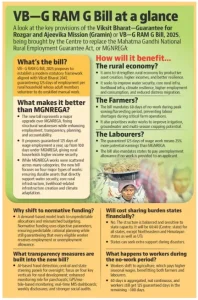
- Increased Guarantee: The statutory guarantee is raised from 100 days to 125 days of wage employment for every rural household.
- Funding Responsibility Shift: The financial burden moves from a predominantly Central-funded wage model to a Centrally Sponsored Scheme with shared financial liability:
- 60:40 Centre-State share for most states.
- 90:10 Centre-State share for northeastern and Himalayan states and UTs (Uttarakhand, Himachal Pradesh and Jammu and Kashmir).
- Allocation Model: The demand-driven ‘labour budget’ is replaced by a state-wise normative allocation determined by the Central Government.
- Mandatory Work Suspension: States are granted the authority to notify a period of up to 60 days in a financial year, coinciding with peak agricultural seasons (sowing/harvesting), during which scheme works shall not be undertaken to avoid labour shortages.
- Focus on Strategic Assets: Works must align with the Viksit Bharat National Rural Infrastructure Stack, focusing on four thematic domains:
- Water Security,
- Core Rural Infrastructure,
- Livelihood-related Infrastructure, and
- Mitigation of Extreme Weather Events.
- Digital Integration: Mandatory use of GIS-based tools, PM Gati Shakti layers, and AI audits is statutory.
- Retention of Unemployment Allowance: The Bill retains the provision for an unemployment allowance if work is not provided within 15 days of application.
Need for Change- The Government Rationale
The government argues that the 2005 framework is outdated and structurally flawed, necessitating a new legal reset:
- Structural Change: Rural poverty has fallen sharply (from 25.7% in 2011–12 to 4.86% in 2023–24).
- With improved digital access and diversified rural livelihoods, the old open-ended model no longer matches today’s rural economy.
- Systemic Failures: Despite advances (e.g., 99.99% e-payments), major systemic failures persisted.
- These include misappropriation (e.g., ₹193.67 crore in 2024–25), non-existent works, and widespread bypassing of digital attendance (NMMS).
- Asset Quality: Assets often failed to match expenditure or lacked strategic utility, making a new framework focused on strategic assets necessary.
Significance of the VB-G RAM G Bill
The proposed legislation is positioned as an upgrade to rural employment architecture, aimed at enhancing income security, productivity, agricultural stability, and climate resilience.
- Strengthened Income Security and Rural Demand: The enhanced 125-day employment guarantee expands the rural safety net, offering a 25% increase in potential earnings.
- This directly boosts village-level consumption, reduces distress migration, and stabilises incomes for casual labourers.
- Creation of Productive and Climate-Resilient Assets: Prioritisation of Water Security and livelihood infrastructure strengthens long-term rural productivity.
- Initiatives such as Mission Amrit Sarovar, which created over 68,000 water bodies, improve irrigation availability, groundwater recharge, and farm resilience, aligning rural employment with India’s climate adaptation goals.
- Support to Agriculture and Food Security: The 60-day pause during peak sowing and harvesting periods addresses the long-standing concern of labour diversion from agriculture.
- By ensuring labour availability for critical farm operations, the provision prevents seasonal labour shortages, avoids artificial wage inflation, and helps contain food production costs, thereby supporting farmers’ incomes and national food security.
- Social Justice and Inclusive Growth: Continued emphasis on individual asset creation for Scheduled Castes (SCs) and Scheduled Tribes (STs) advances social equity, while high participation of women strengthens female economic empowerment and household welfare.
- Predictable Employment and Transparent Delivery: The shift towards hyperlocal Viksit Gram Panchayat Plans ensures planned and predictable work availability.
- Near-universal electronic wage payments (99.94% in 2024–25) combined with real-time monitoring systems enhance transparency, curb wage leakage, and strengthen worker protection.
- Overall Rural Economic Strengthening: By integrating employment generation, agricultural stability, asset creation, and transparency, the Bill seeks to reinforce rural resilience, improve labour productivity, and promote sustainable rural development.
Challenges & Concerns with the VB-G RAM G Bill
The VB-G RAM G Bill introduces critical changes that have prompted debate on its federal and rights-based implications, drawing sharp political scrutiny.
- Erosion of the Right to Work: Replacing the demand-driven funding model with a normative allocation ceiling weakens the statutory employment guarantee, making the right to work and unemployment allowance conditional once funds are exhausted (Jean Drèze).
- Fiscal Federalism and State Burden: The 60:40 Centre–State funding ratio significantly increases state fiscal liabilities (₹50,000+ crore), disproportionately affecting high-demand states and risking uneven regional implementation, despite 90:10 support for special category states.
- Centralisation and Dilution of Decentralisation: National Rural Infrastructure Stack, GIS/AI-based templates, and Centre-notified areas weaken Gram Sabha and Panchayat autonomy, undermining the scheme’s universal, demand-driven character.
- Weakened Income Security and Labour Rights: The 60-day mandatory work suspension restricts access to the 125-day guarantee, leading to income deprivation for landless labourers and women workers during periods of distress.
- State-Managed Labour Supply Concerns: Mandatory work suspension effectively pushes workers into private farms, eroding choice and dignity, and potentially depressing seasonal wages.
- Technological and Administrative Exclusion: Statutory reliance on Aadhaar-Based Payment System, biometrics, and digital systems risks payment delays and exclusion due to connectivity gaps, low digital literacy, and system errors, compounded by job-card rationalisation.
- Dilution of Inclusivity and Political Contestation: Removal of mandatory social representation in the apex council weakens inclusive governance, while the symbolic erasure of “Mahatma Gandhi” fuels opposition claims of diluting a rights-based legacy.
Comparison between MGNREGA vs. VB-G RAM G Bill
| Feature |
MGNREGA (Rights-Based) |
VB-G RAM G Bill (Development-Oriented) |
| Core Philosophy |
- Justiciable Legal Entitlement
|
- Conditional Guaranteed Service
|
| Guarantee Days |
|
- 125 days/household/year (Statutory)
|
| Funding for Wages |
|
- 60:40 Centre-State (General states)
|
| Budgeting Model |
- Demand-driven (Open-ended commitment)
|
- Normative Allocation (Fixed annual ceiling by Centre)
|
| Work Interruption |
- None (Year-round right to work)
|
- Up to 60 days during peak agriculture
|
| Digital/Tech Integration |
- Basic Aadhaar/DBT for wage transfers
|
- Mandatory Biometric, GIS/AI for planning, execution, and audit
|
Way Forward
For the VB-G RAM G Bill to successfully deliver on the Viksit Bharat mandate without compromising the legacy of rights, a balanced approach is essential:
- Fund Flow Flexibility: The normative allocation must incorporate an accessible Contingency Fund that automatically triggers additional central releases for areas experiencing sudden spikes in demand due to distress, safeguarding the integrity of the work guarantee.
- Integrated Planning and Oversight: The planning process must utilize tools like PM GatiShakti for spatial mapping to ensure assets are strategically located for maximum economic impact, while retaining the essential role of independent social audits.
- Skilling and Economic Transition (Global Model): The scheme must be strategically linked to skill development programs.
- Incorporating conditional skill incentives, drawing inspiration from asset-focused programs like Ethiopia’s Productive Safety Net Programme, could transition workers from guaranteed low-skilled employment to higher-productivity, sustainable jobs.
- Phased and Pilot Rollout: A phased rollout, beginning with pilot testing, should precede national application to mitigate technical and fiscal teething issues effectively.
- Parliamentary Recommendation: The Standing Committee on Rural Development and Panchayati Raj has recommended 150 days of guaranteed work and minimum wages of ₹400 per day to strengthen income security and the scheme’s rights-based framework.
Conclusion
The VB-G RAM G Bill reflects a shift towards outcome-oriented rural governance. However, reforms must uphold the constitutional promise of social justice, cooperative federalism, and decentralised democracy, ensuring that efficiency gains do not dilute the justiciable right to livelihood for rural workers.


 16 Dec 2025





.png)






 Current Affairs




 GS Foundation
 Optional Course
 Combo Courses
 Degree Program