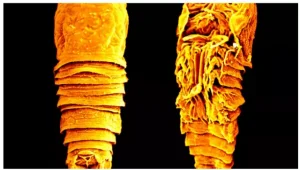
Indiaphonte Bijoyi

19 Jan 2026

Indiaphonte Bijoyi

Researchers have discovered a microscopic crustacean from the Kavaratti lagoon in Lakshadweep, which has now been formally established as a new genus and a new species.

About Crustaceans

  • New Genus and Species: The crustacean has been named Indiaphonte bijoyi, representing both a new genus and a new species.

About Crustaceans 

  • Crustaceans are a large group of arthropods (animals with a hard outer covering and jointed legs) that mostly live in water, especially the sea, but many also live in freshwater, and a few live on land.
  • Examples: Crabs, prawns/shrimps, lobsters, crayfish, Tiny ones like copepods and krill

    • Etymology
      • Naming: The genus name Indiaphonte honours India, while the species name bijoyi honours Dr. S. Bijoy Nandan, Dean, Faculty of Marine Sciences, Cochin University of Science and Technology (CUSAT).
  • Scientific Classification: It belongs to the family Laophontidae, under the class Copepoda and the order Harpacticoida.
    • Copepods are tiny crustaceans (usually ~1 – 2 mm long) found in marine and freshwater habitats.
  • Microscopic Nature: The organism is extremely small and can be studied only under a microscope.
  • Morphological Characteristics:
    • Body Structure: The species has a semi-cylindrical and depressed body, wider in the middle and tapering towards the posterior end.
    • Indiaphonte BijoyiAppendages: It possesses antennae-like appendages at the front.
    • Size Range:
      • Females measure 518 to 772 micrometres in length.
      • Males measure 508 to 756 micrometres in length
    • Sexual Dimorphism: Females are slightly larger than males.
  • Ecological Classification:
    • Meiofauna: Indiaphonte bijoyi is part of the meiofauna, a group of tiny invertebrates less than 1 millimetre in size that live within aquatic sediments.
    • Family Diversity: The family Laophontidae includes about 350 species across 77 genera, making it one of the most diverse families within Harpacticoida

Ecological and Economic Significance

  • Ecosystem Health: Despite their size, harpacticoid copepods play a vital role in marine and freshwater ecosystems.
  • Nutrient Cycling: Harpacticoid copepods can produce and convert omega-3 fatty acids, including Eicosapentaenoic Acid (EPA) and Docosahexaenoic Acid (DHA), which are crucial for fish and shellfish growth.
  • Food Web Role: They are widely used in aquaculture and fisheries as live feed for fish larvae, contributing to food security.
  • Bio-indicators: Due to their high sensitivity to pollution, oil spills, heavy metals, and climate change, they serve as reliable indicators of environmental change.

Check Out UPSC CSE Books

Visit PW Store

online store 1

Scientific Importance of the New Genus

  • Distinct Morphology: The genus Indiaphonte is considered new because it shows a unique combination of morphological traits not matching any previously recorded genus in Laophontidae

Need help preparing for UPSC or State PSCs?

Connect with our experts to get free counselling & start preparing

Aiming for UPSC?

Download Our App

      
Quick Revise Now !
AVAILABLE FOR DOWNLOAD SOON
UDAAN PRELIMS WALLAH
Comprehensive coverage with a concise format
Integration of PYQ within the booklet
Designed as per recent trends of Prelims questions
हिंदी में भी उपलब्ध
Quick Revise Now !
UDAAN PRELIMS WALLAH
Comprehensive coverage with a concise format
Integration of PYQ within the booklet
Designed as per recent trends of Prelims questions
हिंदी में भी उपलब्ध

<div class="new-fform">


    </div>

    Subscribe our Newsletter
    Sign up now for our exclusive newsletter and be the first to know about our latest Initiatives, Quality Content, and much more.
    *Promise! We won't spam you.
    Yes! I want to Subscribe.