Biodiversity Beyond National Jurisdiction (BBNJ) Agreement Comes into Force

19 Jan 2026

Biodiversity Beyond National Jurisdiction (BBNJ) Agreement Comes into Force

Biodiversity Beyond National Jurisdiction (BBNJ) entered into force on 17 January 2026 after achieving 60 ratifications (Morocco was the 60th in Sept 2025).
About Biodiversity Beyond National Jurisdiction (BBNJ) Agreement

  • Official Name: Officially called the Agreement under the United Nations Convention on the Law of the Sea (UNCLOS) on the Conservation and Sustainable Use of Marine Biological Diversity of Areas Beyond National Jurisdiction.
    • The agreement is commonly referred to as the BBNJ Agreement or High Seas Treaty.
  • Biodiversity Beyond National JurisdictionLegal Status: It is the first legally binding global framework specifically designed to protect marine biodiversity in international waters.

  • Scope & Coverage: The treaty applies to areas beyond national jurisdiction, waters and seabed beyond all countries’ Exclusive Economic Zones (EEZs).
  • Adoption and Entry into Force: Adopted by consensus in June 2023 at the UN Intergovernmental Conference.
    • Reached the required 60 ratifications in September 2025 (with Morocco as the 60th), triggering entry into force 120 days later on 17 January 2026.
  • Global Conservation Goals
    • Key enabler of the global “30 by 30” biodiversity target, aiming to protect 30% of oceans by 2030, especially through Marine Protected Areas (MPAs) in international waters.
  • The treaty will help achieve SDG Goal 14: Life Below Water > “Conserve and sustainably use the oceans, seas, and marine resources for sustainable development”.

Key Objectives of BBNJ Agreement

  1. Conservation & Sustainable Use: To conserve and sustainably use marine biological diversity in areas beyond national jurisdiction.
  2. Close Legal Gaps in Ocean Governance: It fills critical regulatory gaps left by the United Nations Convention on the Law of the Sea (UNCLOS), especially for biodiversity protection beyond territorial waters.

What are High Seas?

  • High Seas (open seas/international waters) refer to ocean areas beyond any national jurisdiction. They exist beyond the Exclusive Economic Zones (EEZ).
  • High or open seas cover almost 2/3rd of the world’s oceans.
  • These waters are considered the common heritage of humankind, and all nations have the freedom to navigate, fish, conduct scientific research, and engage in other lawful activities in these areas.

Four Main Pillars of the Treaty

  1. Marine Genetic Resources (MGRs): Framework for access to and fair and equitable sharing of benefits from genetic resources from the high seas and deep seabed.
  2. Area-Based Management Tools (ABMTs): Mechanisms for creating Marine Protected Areas (MPAs) and other spatial tools based on scientific evidence, to conserve ecologically important areas.
  3. Environmental Impact Assessments (EIAs): Requires environmental assessment of activities likely to cause significant harm to biodiversity beyond national jurisdiction.
  4. Capacity Building & Technology Transfer: Support for developing countries to participate fully, including technology transfer and scientific cooperation.

Obligations for Ratifying States

  • Collaborate on marine science, data sharing, and technology transfer;
  • Carry out EIAs and strategic environmental assessments;
  • Work toward designation and management of MPAs;
  • Participate in equitable benefit sharing from marine genetic resources.

Institutional Framework

  • Conference of Parties (COP): Decision Making Body
  • Permanent Secretariat & subsidiary bodies for implementation
  • Clearing‑House Mechanism: For Sharing data, science & technology

Check Out UPSC CSE Books

Visit PW Store

online store 1

Challenges & Limitations

  • The treaty does not regulate seabed mining, which falls under the International Seabed Authority.
  • Some major maritime powers (e.g., the United States and others) have signed but not yet ratified the treaty, which can affect global coordination and enforcement effectiveness.

About United Nations Convention on the Law of the Sea (UNCLOS)

  • UNCLOS was adopted in 1982 and entered into force in 1994; it is often called the “Constitution of the Oceans.”
  • It provides a comprehensive legal framework governing the use, conservation, and management of oceans and marine resources.
  • Members: 171 States Parties to UNCLOS, this includes sovereign states and the European Union.
  • India and UNCLOS: India is a full party to UNCLOS
    • It ratified the convention in 1995, committing to its framework for ocean governance, resource rights, navigation, and environmental protection.
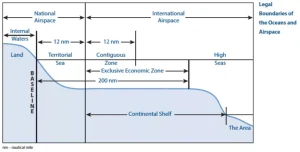
  • UNCLOS defines maritime zones:
    • Territorial Sea (up to 12 nautical miles)
    • Contiguous Zone (up to 24 nm)
    • Exclusive Economic Zone (EEZ) (up to 200 nm)
    • Biodiversity Beyond National JurisdictionContinental Shelf.
  • Coastal States enjoy sovereign rights over resources (living and non-living) within their EEZ, while other States retain freedom of navigation and overflight.
  • It establishes the principle of freedom of the high seas, including navigation, fishing, scientific research, and laying of submarine cables, subject to international law.
  • Institutions Under UNCLOS: TO implement its provisions, UNCLOS established three international institutions:
    • The International Tribunal for the Law of the Sea (ITLOS): Adjudicates disputes related to the interpretation and application of the Convention.
    • The International Seabed Authority (ISA): Regulates mineral-related activities in the international seabed area beyond national jurisdiction.
    • The Commission on the Limits of the Continental Shelf (CLCS): Examines and makes recommendations on claims by coastal states regarding the outer limits of their continental shelves.

Need help preparing for UPSC or State PSCs?

Connect with our experts to get free counselling & start preparing

Aiming for UPSC?

Download Our App

      
Quick Revise Now !
AVAILABLE FOR DOWNLOAD SOON
UDAAN PRELIMS WALLAH
Comprehensive coverage with a concise format
Integration of PYQ within the booklet
Designed as per recent trends of Prelims questions
हिंदी में भी उपलब्ध
Quick Revise Now !
UDAAN PRELIMS WALLAH
Comprehensive coverage with a concise format
Integration of PYQ within the booklet
Designed as per recent trends of Prelims questions
हिंदी में भी उपलब्ध

<div class="new-fform">


    </div>

    Subscribe our Newsletter
    Sign up now for our exclusive newsletter and be the first to know about our latest Initiatives, Quality Content, and much more.
    *Promise! We won't spam you.
    Yes! I want to Subscribe.