The World Economic Forum (WEF) has announced the launch of five new Centres for the Fourth Industrial Revolution (C4IR), including one in Andhra Pradesh, India.
About the Centre for the Fourth Industrial Revolution (C4IR) Network
- Launch & Leadership: Launched in 2017 by the World Economic Forum (WEF) to guide governance of emerging technologies.
- Nature of the Network: A global, multi-stakeholder platform connecting governments, industry, academia and civil society.
- Core Objective: Ensures emerging technologies deliver societal benefits while minimising ethical, security and economic risks.
 Network Structure: Comprises independent national and thematic Centres for the Fourth Industrial Revolution across continents.
- Key Technology Domains: Focuses on AI, data governance, cybersecurity, blockchain, IoT, energy transition and frontier technologies.
Centre for the Fourth Industrial Revolution (C4IR) in India
- Location: The new centre in India is located in Andhra Pradesh.
- Name: It is named the Centre for Energy and Cyber Resilience.
- It marks India’s third C4IR centre (after existing ones in Mumbai and Telangana).
- Partnership: Established in official partnership with the Government of Andhra Pradesh.
- The collaboration aligns with state priorities in building resilient digital and energy systems.
- Objectives: Promote innovation in energy transition (e.g., green energy systems), strengthen cyber resilience across industries, develop cybersecurity strategies, workforce upskilling, and trusted digital systems.
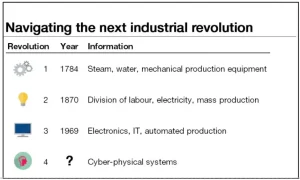
Stages of the Industrial Revolution
- The Industrial Revolution refers to a series of major transformations in manufacturing, technology, economy, and society.
- Historians traditionally divide it into distinct stages (or “revolutions”), with the modern understanding commonly recognizing four stages.
First Industrial Revolution (Industry 1.0)
- Time period: ~1760–1840 (starting in Britain, later spreading to Europe and North America)
- Key driver: Mechanization powered by water and especially steam
- Major developments: Steam engine (improved by James Watt), Mechanized textile production (spinning jenny, water frame, spinning mule, power loom), Iron production improvements, Rise of factories and shift from handcraft to machine-based production and Early railroads and steamships
- Impact: Transition from agrarian/handicraft economies to machine-based manufacturing; urbanization; significant boost in productivity.
Second Industrial Revolution (Industry 2.0)
- Time period: ~1870–1914 (late 19th to early 20th century)
- Key driver: Electricity, steel, and internal combustion engine
- Major developments: Widespread use of electricity for lighting and powering machines, Assembly line and mass production (pioneered by Henry Ford), Steel production, Chemical industry advances.
- Impact: Mass production; rise of large corporations; faster transportation and communication; higher living standards in industrialized nations; globalization of trade.
Third Industrial Revolution (Industry 3.0)
- Time period: ~1969–late 20th/early 21st century (often dated from the 1970s onward)
- Key driver: Electronics, computers, and information technology (also called the Digital Revolution)
- Major developments: Semiconductors, microprocessors, and personal computers, Automation in factories (programmable logic controllers, industrial robots), Internet and global connectivity, Software and IT systems in manufacturing and supply chains
- Impact: Shift to automated and computerized production; rise of service and knowledge economies; globalization accelerated by digital communication.
|
About the Fourth Industrial Revolution (4IR)
- Definition: The Fourth Industrial Revolution is the current era of rapid technological change characterized by the fusion of physical, digital, and biological spheres.
- Origin: It was first described by Klaus Schwab (founder of the World Economic Forum) in 2016 as a distinct new phase beyond the digital revolution (third industrial revolution).
- Exponential Pace of Change: Unlike previous industrial revolutions, 4IR progresses at an exponential speed due to breakthroughs in computing power, data storage, connectivity, and innovation velocity.
- Key Characteristics of 4IR:
-
- Speed: Change occurs at a pace unprecedented in human history.
- Scale: Impacts every single industry, country, and discipline.
- Systemic Transformation: Doesn’t just improve existing systems; it replaces or radically reshapes entire systems of production, management, and governance.
- Cyber-Physical Systems: A defining feature is the creation of cyber-physical systems, smart, interconnected networks where machines, sensors, software, and humans interact in real time.
- This enables smart factories, autonomous vehicles, predictive maintenance, and intelligent infrastructure.
About World Economic Forum (WEF)
- The World Economic Forum is an international, non-governmental organisation for public–private cooperation to address global challenges.
- Establishment: Founded in 1971 by Klaus Schwab.
- Headquarters: Geneva, Switzerland.
- Key Objectives:
- Improve the state of the world through dialogue and collaboration.
- Shape global, regional, and industry agendas.
- Promote inclusive and sustainable growth.
- Fourth Industrial Revolution (4IR) Role:
- Leads the C4IR Network for responsible tech governance.
- Focus on AI ethics, data governance, digital trust.
- Annual Meeting: Held every January in Davos, Switzerland.
- It is a platform for discussing global economic outlook, conflicts, climate action, and technology.
|


 27 Jan 2026






.png)






 Current Affairs






 GS Foundation
 Optional Course
 Combo Courses
 Degree Program