DoPT Report 2024–25: Social Representation in Central Government Jobs

30 Jan 2026

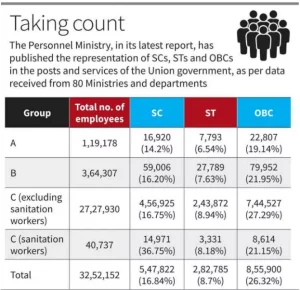
The Department of Personnel and Training (DoPT) recently released its first comprehensive report since 2018-19, accounting for 32.52 lakh employees across 80 Ministries/Departments. 

  • This marks a shift from the partial reporting (19-20 lakh employees) seen over the last five years.

About Department of Personnel and Training (DoPT)

  • Nodal department for personnel management in the Central Government
  • Functions under the Ministry of Personnel, Public Grievances and Pensions
  • Lays down recruitment rules, service conditions, and reservation policies
  • Responsible for civil services reforms and capacity building
  • Oversees reservation implementation for SCs, STs, OBCs, and EWS
  • Cadre-controlling authority for IAS and Central Secretariat Services
  • Publishes the Annual Report on representation in government employment

]

Key Highlights of the Report

  • Representation vs. Statutory Mandate: The report compares the actual percentage of employees against the direct recruitment reservation quotas (15% for SC, 7.5% for ST, 27% for OBC, and 10% for EWS).
    • DoPT Report 2024–25Scheduled Castes (SC): While the reservation quota is 15%, the actual representation stands at 16.84%. However, this reflects a downward trend from the 17.49% recorded in the 2018-19 report.
    • Scheduled Tribes (ST): Against a reservation quota of 7.5%, the current representation is 8.70%, marking a slight increase from the previous figure of 8.47%.
    • Other Backward Classes (OBC): This category saw the most significant rise, with representation jumping from 21.57% in 2018-19 to 26.32% in 2024, bringing it very close to the 27% reservation mandate.
    • Economically Weaker Sections (EWS): Although a 10% reservation quota exists, the 2024-25 report did not provide data on EWS representation, leaving the impact of this policy unaccounted for in the latest statistics.
  • Occupational Segregation (The “Safai Karmachari” Factor): A striking finding of the report is the over-representation of marginalized communities in lower-tier manual roles.
    • Group C (Safai Karmacharis): More than 76% of sanitation workers (Safai Karmacharis) in the Central Government belong to SC, ST, or OBC categories.
    • This highlights a persistent social hierarchy where historically marginalized groups remain concentrated in sanitation-related roles.
  • Group-Wise Representation Breakdown: The data reveals a “tapering” effect, where representation often decreases as the seniority of the post increases.
    • Group A (Top Tier): Combined representation of SC, ST, and OBC stands at 39.88%.
      • SC: 14.20%; ST: 6.54% & OBC: 19.14%
    • Group B: SCs comprise 16.20%, STs 7.63%, and OBCs 21.95%.
    • Group C (Excluding Safai Karmacharis): SCs are at 16.75%, STs at 8.94%, and OBCs at 27.29% (meeting the 27% mandate).
  • Reporting Gaps and Issues:
    • Missing EWS Data: Despite being implemented since 2019, the report provides no data on EWS representation, hindering a complete assessment of the 103rd Constitutional Amendment’s impact.
    • Data Integrity: The DoPT noted that previous “shortfalls” in reporting (2019–2023) occurred because various Ministries failed to submit data on time, a point previously criticized by Parliamentary Committees.

The Legal Architecture of Reservations in India
Category Constitutional Provisions Judicial Doctrines & Supreme Court Benchmarks
Enabling Rights
  • Art. 16(4): Empowers the State to provide reservation for classes not adequately represented.
  • Indra Sawhney (1992): Upheld 27% OBC quota but capped total reservation at 50%.
Promotions
  • Art. 16(4A): Allows reservation in promotions for SC/ST (77th Amendment).
  • M. Nagaraj (2006): Mandatory to collect quantifiable data on representation and efficiency.
Backlog Posts
  • Art. 16(4B): The “Carry Forward” rule—unfilled seats don’t count toward the 50% limit (81st Amendment).
  • Jarnail Singh (2018): Applied the “Creamy Layer” principle to SC/STs in promotions.
Economic Basis
  • Art. 16(6): Provides up to 10% reservation for EWS (103rd Amendment).
  • Janhit Abhiyan (2022): Ruled that the 50% cap is not “inflexible” and EWS is constitutional.
Safeguards
  • Art. 335: Reservation must be balanced with the maintenance of administrative efficiency.
  • State of Kerala v. N.M. Thomas: Reservation is an extension of equality, not an exception to it.
Oversight
  • Art. 338, 338A, 338B: Constitutional status for National Commissions (SC, ST, and OBC).
  • Ram Singh v. Union of India: Social backwardness is a dynamic concept; must be periodically reviewed.

Arising Concerns

  • The “Glass Ceiling” in Senior Bureaucracy:
    • Hierarchical Disparity: While overall representation is statistically healthy, it is skewed. The tapering effect in Group A (e.g., STs at only 6.54% vs the 7.5% mandate) indicates that marginalized groups are not reaching decision-making roles in proportion to their population.
    • Promotion Bottlenecks: The shortfall in senior grades suggests that the benefits of Article 16(4A) (Reservation in Promotions) are either not being implemented effectively or are hindered by litigation and administrative delays.
  • Persistent Occupational Stereotyping:
    • The Sanitation Trap: The fact that over 66% (and up to 76% in some sub-data) of Safai Karmacharis belong to SC/ST/OBC categories reveals that “numerical representation” is still tied to traditional caste-based occupations.
    • Impact: This raises concerns about the dignity of labor and whether government employment is successfully breaking the cycle of caste-based labor or merely formalizing it.
  • The “EWS” Accountability Gap:
    • Transparency Issues: By not providing EWS data since the 2019 implementation, the DoPT leaves a policy vacuum
      • It is impossible to evaluate if the 10% quota is being utilized or if it is impacting the available pool for “General” (Unreserved) seats.
  • Data Integrity and Accountability:
    • Administrative Apathy: The “shortfall” in previous reports (2019–2023) due to Ministries not submitting data highlights a lack of institutional accountability. Without consistent data, the government cannot conduct the “Periodic Review” of backwardness suggested in Ram Singh v. Union of India.

Check Out UPSC CSE Books

Visit PW Store

online store 1

Way Forward

  • Mandatory Digital Rosters: The government should move away from manual reporting to a Centralized e-Roster System
    • This would allow the DoPT to monitor vacancies and representation in real-time across all 80 Ministries, preventing “data shortfalls.”
  • Addressing the Group A Gap: Conduct Special Recruitment Drives (SRDs) specifically for Group A and B backlog vacancies to ensure representation at the policy-making level.
    • Bridge Training: Implement “Capacity Building” programs for Group B employees from marginalized backgrounds to prepare them for senior leadership roles.
  • Skill Upgradation for Group C: Focus on the vertical mobility of Safai Karmacharis. 
    • Providing technical training and educational support can help these employees move from manual labor to clerical or technical roles, breaking the occupational caste link.
  • Sub-categorization of OBCs: To ensure that the 26.32% OBC representation is not monopolized by a few dominant castes, the government should consider the recommendations of the Rohini Commission for a more equitable distribution of benefits.
  • Compliance with SC Directives: Following the M. Nagaraj and Jarnail Singh judgments, the government must use this 2024-25 data to create a permanent mechanism for assessing “inadequacy of representation” before making policy changes in reservations.

Enroll in SRIJAN Prelims Crash Course

Need help preparing for UPSC or State PSCs?

Connect with our experts to get free counselling & start preparing

Aiming for UPSC?

Download Our App

      
Quick Revise Now !
AVAILABLE FOR DOWNLOAD SOON
UDAAN PRELIMS WALLAH
Comprehensive coverage with a concise format
Integration of PYQ within the booklet
Designed as per recent trends of Prelims questions
हिंदी में भी उपलब्ध
Quick Revise Now !
UDAAN PRELIMS WALLAH
Comprehensive coverage with a concise format
Integration of PYQ within the booklet
Designed as per recent trends of Prelims questions
हिंदी में भी उपलब्ध

<div class="new-fform">


    </div>

    Subscribe our Newsletter
    Sign up now for our exclusive newsletter and be the first to know about our latest Initiatives, Quality Content, and much more.
    *Promise! We won't spam you.
    Yes! I want to Subscribe.