India Semiconductor Mission 2.0 Launched in Union Budget 2026-27

2 Feb 2026

India Semiconductor Mission 2.0 Launched in Union Budget 2026-27

Finance Minister Nirmala Sitharaman announced the launch of India Semiconductor Mission (ISM) 2.0 while presenting the Union Budget 2026-27 in Parliament.
About the India Semiconductor Mission 2.0

  • ISM 2.0 builds on the progress of the first phase and aims to create a self-reliant, end-to-end semiconductor ecosystem in India.
  • Budget: 1000 Crore for FY 2026-27

Key focus areas

  • Manufacturing of equipment & materials used in chipmaking
  • Development of full-stack Indian semiconductor IP
  • Strengthening semiconductor supply chains
  • Industry-led R&D and training centres to build skilled manpower

India Semiconductor Mission 1.0

  • Launch: 2021 with an outlay of ₹76,000 crore
  • Aim: Financial support for semiconductor fabs, display manufacturing & chip design, integrating India into global electronics value chains
  • Nodal Ministry: Ministry of Electronics and Information Technology (MeitY)
  • Key Schemes under ISM:
    • Semiconductor Fabs Scheme: Up to 50% fiscal support for wafer fab units
    • Display Fabs Scheme: Up to 50% project cost support for display fabs
    • Design Linked Incentive (DLI) Scheme: Financial support across design, development & deployment stages
    • Semicon India: Flagship platform bringing industry, policymakers, academia & startups for collaboration and investment.
  • Key Achievements:
    • 10 Semiconductor Projects Approved: Across six states, with cumulative investments exceeding ₹1.6 lakh crore.
    • These include a mix of fabrication plants, OSAT/ATMP units, compound semiconductor facilities (e.g., Silicon Carbide), and advanced packaging.

About Semiconductors

  • Semiconductors are materials with electrical conductivity between that of conductors (e.g., metals like copper) and insulators (e.g., glass or rubber).
  • Semiconductors are called the “brains” of modern electronics. Without them, the digital world (computing, AI, internet, smartphones, clean energy tech, etc.) would not exist.
  • Core Property: Their conductivity can be precisely controlled and changed by:
    • Adding impurities (doping)
    • Temperature
    • Light
    • Applied voltage or electric field
    • This makes them ideal for switching, amplifying, or processing electrical signals.
  • Most Common Material: Silicon (Si) is the dominant material for semiconductors. It is abundant, stable, and easy to process.
    • Others include germanium (Ge), gallium arsenide (GaAs), silicon carbide (SiC), and gallium nitride (GaN).

Key Devices Made from Semiconductors

  • Transistors: Act as switches/amplifiers (building blocks of modern electronics)
  • Diodes: Allow current in one direction
  • Integrated Circuits (ICs) / Microchips: Contain billions of transistors
  • Microprocessors (CPU), memory chips, sensors, LEDs, solar cells etc.

Opportunities for India in the Semiconductor Sector

  • Global Supply Chain Realignment: China+1 strategy and geopolitical risks open space for India as a trusted alternative semiconductor base.
    • The China+1 strategy is a supply chain approach where companies maintain manufacturing in China but diversify by adding at least one other country for sourcing and production.
  • Strong Policy & Fiscal Support: India Semiconductor Mission provides ~50% fiscal support for fabs, ATMP/OSAT units, and chip design.
  • India Semiconductor Mission 2.0Design & Talent Advantage: India hosts around 20% of global semiconductor design engineers, enabling leadership in chip design and IP creation.
  • Low-Barrier Entry via Packaging & Testing: Assembly, Testing, Marking and Packaging (ATMP) offers faster scalability, lower costs, and early export potential.
  • Rising Domestic Demand: Rapid growth in EVs, 5G, AI, defence, and electronics manufacturing ensures a stable internal market for chips.
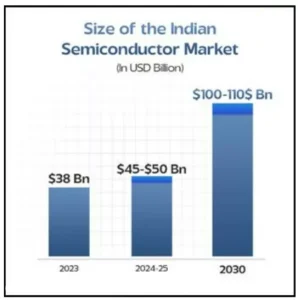
    • The semiconductor market in India is expected to rise to $100-110 Billion by 2030.

Challenges in Semiconductor Manufacturing in India

  • High Capital Intensity & Technology Gap: Setting up advanced semiconductor fabrication (fab) plants requires multibillion-dollar investments and cutting-edge production technology, which India currently lacks.
  • Shortage of Specialized Skilled Workforce: While India has a large engineering base, specialised skills for wafer fabrication, process tech, and semiconductor manufacturing are insufficient, affecting industrial execution.
  • Underdeveloped Supply Chain & Raw Material Dependence: India depends heavily on imported semiconductor equipment, specialty gases, and raw materials, making the ecosystem vulnerable to supply disruptions and foreign export-control risks.
  • Lack of Integrated Infrastructure: Semiconductor fabs need advanced infrastructure (reliable power, water, logistics, clean rooms, testing facilities).
  • Global Competition: India competes with established hubs such as Taiwan, South Korea and China that have economies of scale, mature ecosystems, and deeper supplier networks.

Check Out UPSC CSE Books

Visit PW Store
online store 1

Way Forward

  • Fast-track Fab Implementation: Expedite construction and commissioning of approved 10 semiconductor fabrication (fab) projects to move from incentive commitment to commercial chip production.
  • Build Domestic Supply Chain: Strengthen local manufacturing of semiconductor equipment, materials, chemicals and tools to reduce heavy import dependence.
  • Scale Design & IP Capabilities: Promote chip design houses, R&D centres, and indigenous IP development through focused incentives and industry–academic collaboration.
  • Develop Skilled Workforce: Expand targeted training programs and specialised courses to produce skilled engineers in fabrication, process technology, and advanced packaging.
  • Enhance Partnerships & Exports: Attract global semiconductor players for technology transfer, co-investment and export-oriented manufacturing, integrating India into global supply chains.

Enroll in SRIJAN Prelims Crash Course

Need help preparing for UPSC or State PSCs?

Connect with our experts to get free counselling & start preparing

Aiming for UPSC?

Download Our App

      
Quick Revise Now !
AVAILABLE FOR DOWNLOAD SOON
UDAAN PRELIMS WALLAH
Comprehensive coverage with a concise format
Integration of PYQ within the booklet
Designed as per recent trends of Prelims questions
हिंदी में भी उपलब्ध
Quick Revise Now !
UDAAN PRELIMS WALLAH
Comprehensive coverage with a concise format
Integration of PYQ within the booklet
Designed as per recent trends of Prelims questions
हिंदी में भी उपलब्ध

<div class="new-fform">


    </div>

    Subscribe our Newsletter
    Sign up now for our exclusive newsletter and be the first to know about our latest Initiatives, Quality Content, and much more.
    *Promise! We won't spam you.
    Yes! I want to Subscribe.