The Defence Research and Development Organisation (DRDO) successfully conducted the flight demonstration of Solid Fuel Ducted Ramjet (SFDR) technology, from the Integrated Test Range (ITR), Chandipur.
- India joins an elite group of nations with this advanced propulsion technology.
About Solid Fuel Ducted Ramjet (SFDR) Technology
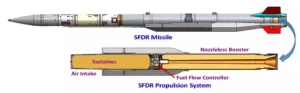
- Solid Fuel Ducted Ramjet (SFDR) is an advanced air-breathing missile propulsion technology in which a missile uses a booster for initial acceleration and then sustains high-speed flight using a ramjet combustor fed by atmospheric oxygen, while burning solid fuel through a ducted system.
About Ramjet Engine
- Operating Principle: A ramjet is an air-breathing jet engine that uses the vehicle’s forward motion to compress incoming air, without employing axial or centrifugal compressors
- Launch Requirement: Ramjet-powered vehicles require assisted take-off, such as rocket boost, to reach speeds at which the engine can begin generating thrust
|
- Development Agency: The system is being developed by DRDO, led by the Hyderabad-based Defence Research and Development Laboratory (DRDL).
- Combat Role: It provides fighter aircraft with a decisive advantage in beyond-visual-range (BVR) air combat.
Why SFDR is a Game-Changer in Air Combat ?
- Sustained Supersonic Flight: Unlike conventional solid rocket motors that burn out quickly, SFDR propulsion allows missiles to maintain Mach 2 to Mach 3.8 speeds for extended durations.
- Extended Engagement Envelope: Missiles equipped with SFDR can engage manoeuvrable aerial targets at ranges between 50 km and 340 km.
- Operational Flexibility: The system operates from sea level up to 20 km altitude, with vertical snap-up or snap-down capability of 10 km.
- Enhanced Lethality: SFDR provides a wider no-escape zone, stronger tail-chase capability, and high ‘g’ manoeuvring, making evasion by enemy aircraft difficult.
Working Mechanism of SFDR Propulsion System
- Booster Phase: The missile is first accelerated to supersonic speed using a nozzle-less booster, allowing fast transition into ramjet operation within three seconds
- The propellant grain is specially designed for efficiency and meets no-ejecta safety requirements for air-launched missiles. The propellant was developed by High Energy Material Research Laboratory (HEMRL), Pune.
- High Energy Material Research Laboratory
- Sustainer Phase: A solid fuel ducted ramjet sustainer takes over and supports long-duration powered flight.
- The SFDR uses a boron-based high-energy solid fuel. Partial combustion occurs initially, with full combustion inside the ramjet chamber using atmospheric oxygen, enabling powered flight for 50 seconds at sea level to up to 200 seconds at higher altitudes.
- Thrust Control: A hot gas valve regulates combustion flow to adjust thrust depending on speed and altitude.
- It operates between 1100K and 1400K and uses advanced materials such as carbon-carbon composites, tungsten-copper alloys and maraging steel.
- Air Intake Operation: Cheek-mounted titanium-alloy air intakes open during flight using a pyrotechnic mechanism and compress incoming air through a three-ramp design.
- Advanced Onboard Systems: The missile integrates an onboard computer, inertial navigation system, radio-frequency seeker, jam-resistant data link, high-torque electro-mechanical actuators and compact lithium thermal batteries.
- Warhead and Fuse: For lethality, the missile carries a proximity fuse and a fragmentation warhead designed to maximise target destruction
SFDR vs Conventional Rocket Motors
- Atmospheric oxygen use: SFDR-powered missiles do not carry oxidiser for the cruise phase, because the ramjet ingests oxygen from the air, unlike conventional solid rockets that carry both fuel and oxidiser.
|
Significance of the Test
- Missile Capability Enhancement: SFDR technology is a critical capability for long-range air-to-air missiles, significantly enhancing combat effectiveness.
- Tactical Edge: It provides a decisive tactical advantage against adversaries by enabling greater range, speed, and end-game manoeuvrability.
- Force Multiplier: The technology strengthens India’s air combat capability and contributes to defence preparedness.
- Strategic Autonomy: Advances India’s self-reliance in advanced missile propulsion technologies.
- Atmanirbhar Bharat in Defence: Reinforces indigenous defence research, development and industry participation


 4 Feb 2026






.png)






 Current Affairs




 GS Foundation
 Optional Course
 Combo Courses
 Degree Program