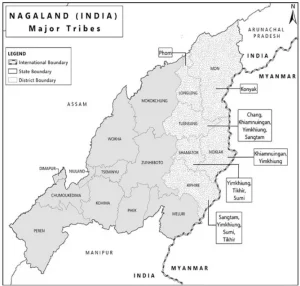
A tripartite agreement has been signed between the Ministry of Home Affairs (MHA), the Nagaland Government, and the Eastern Nagaland People’s Organisation (ENPO) to pave the way for the creation of the Frontier Nagaland Territorial Authority (FNTA) for Eastern Nagaland.
Key Features of the Agreement
- Districts Included: FNTA will cover six districts that includes Tuensang, Mon, Kiphire, Longleng, Noklak and Shamator.
- Devolution of Powers: The agreement provides for devolution of powers over 46 subjects to the FNTA.
 Nature: FNTA is a territorial authority within the State of Nagaland and it is distinct from Sixth Schedule Autonomous District Councils.
-
- Nagaland is not covered under the Sixth Schedule of the Constitution.
- Financial and Administrative Provisions:
- Mini-Secretariat: The agreement provides for a mini-Secretariat for FNTA, headed by an Additional Chief Secretary/Principal Secretary.
- Development Outlay: Development funds for Eastern Nagaland will be shared proportional to Population and Area.
- Initial Support: The MHA will provide initial expenditure for establishment, and a fixed annual amount will be decided.
- Constitutional Safeguard: The agreement explicitly states that it “does not affect in any manner whatsoever the provisions of Article 371(A)” of the Constitution.
Significance of the Arrangement
- Unique Development Model: The arrangement envisages overall development through:
- Financial autonomy
- Enhanced decision-making
- Accelerated infrastructure development
- Economic empowerment
- Optimum resource utilisation
- Addressing Regional Aspirations: Eastern Nagaland tribes had long demanded region-specific powers, with negotiations beginning in 2015.
- Strategic Importance: Eastern Nagaland shares proximity with the Myanmar border, making the region significant for border development and India’s Act East policy
Article 371(A)
- Parliamentary Laws: Article 371A provides that no Act of Parliament will apply to Nagaland in certain sensitive matters unless the Nagaland Legislative Assembly passes a resolution approving it.
- Article 371A was inserted into Part XXI of the Constitution through the 13th Constitutional Amendment Act, 1962, when Nagaland was granted full statehood in the Indian Union.
- Protected Subjects:
- Religious and Social Practices: Parliament cannot interfere unless the State Assembly permits it.
- Customary Law and Procedure: Nagaland’s customary laws and traditional legal procedures are protected.
- Administration of Justice: Civil and criminal justice involving decisions based on Naga customary law remains under State control.
- Land and Resource Rights: Ownership and transfer of land and its natural resources cannot be altered by central laws without State approval
- Role of Nagaland Legislative Assembly: Any central law on these subjects will apply only if the Nagaland Legislative Assembly passes a resolution agreeing to its implementation.
- Governor’s Special Responsibility: Article 371A grants the Governor of Nagaland special responsibility for maintaining law and order as long as internal disturbances continue in the former Naga Hills–Tuensang area.
- Financial Safeguard: The Governor must ensure that any money provided by the Government of India for a specific purpose is included only in the appropriate demand for grant related to that service.
- Establishment of Tuensang Regional Council:
- Article 371A provides for the creation of a Regional Council for Tuensang district consisting of 35 members.
- The Deputy Commissioner of Tuensang acts as the ex-officio Chairman of the Council.
- The Governor is empowered to frame rules regarding its composition, qualifications, tenure, procedure, staffing, and functioning.
- Restricted Application of Nagaland State Laws in Tuensang:
- No law passed by the Nagaland Legislature applies to Tuensang unless the Governor approves it based on the Regional Council’s recommendation.
- The Governor may apply such laws with modifications or even retrospective effect.
- Governor’s Regulatory Powers:
- The Governor can make regulations for peace, progress, and good governance of Tuensang district.
- Such regulations may amend or repeal even Parliamentary laws applicable to the district
|


 6 Feb 2026








.png)






 Current Affairs




 GS Foundation
 Optional Course
 Combo Courses
 Degree Program