India faces a widening conflict between industrial growth and constitutional environmental protection, as policy and judicial shifts prioritise short-term economic gains over carbon sinks and water security, demanding Ecological Constitutionalism, placing environmental rights at the core of the Environmental Rule of Law.
About The “Environmental Rule of Law”
- Environmental governance requires more than just laws; it requires the Environmental Rule of Law.
- This encompasses four pillars:
- Fair and clear laws
- Effective implementation
- Public participation in decision-making
- Accountability for ecological damage.
- Without these, environmental rights remain “parchment barriers” against economic pressure.
|
About Environmental Jurisprudence
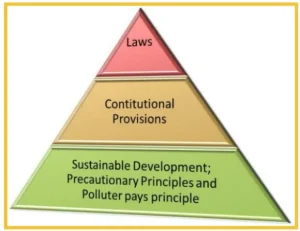
- Definition: A framework of legal philosophy, principles, and judicial doctrines through which courts balance developmental needs with environmental protection and nature’s intrinsic value.
- Core Doctrines:
- Precautionary Principle: Where potential environmental harm exists, lack of full scientific certainty cannot delay preventive action; the burden of proof lies on the developer.
- Polluter Pays Principle: The polluting entity must bear the cost of remediation and compensation.
- Public Trust Doctrine: Air, water, forests, and coasts are held by the State in trust for the public, not for private appropriation.
- Sustainable Development: Development must proceed without undermining ecological balance.
- Inter-generational Equity: Present generations must conserve natural resources for future generations.
- Significance: Functions as a constitutional check on executive and economic activity, ensuring growth aligns with ecological sustainability.
Essential Landmark Jurisprudence
- Subhash Kumar v. State of Bihar (1991): Interpreted Article 21 to include the right to pollution-free air and water for the full enjoyment of life.
- Vellore Citizens Welfare Forum v. Union of India (1996): Formally integrated the Precautionary Principle and Polluter Pays Principle into the Indian legal framework as part of sustainable development.
- M.C. Mehta (Oleum Gas Leak Case, 1987): Established the principle of Absolute Liability for hazardous industries, moving beyond the traditional “Strict Liability” rule.
- T.N. Godavarman Thirumulpad Case (1996–Ongoing): Introduced the concept of “Continuing Mandamus” in forest governance, expanding the definition of “forest” to its dictionary meaning regardless of ownership.
- A.P. Pollution Control Board v. Prof. M.V. Nayudu (1999): Clarified the Burden of Proof in environmental cases, placing it on the developer to prove a project is environmentally benign.
- Narmada Bachao Andolan v. Union of India (2000): Emphasized that while development is necessary, it must be balanced with the rights of displaced communities and ecological impact.
|
India’s Legal Frameworks for Environmental Protection
India possesses one of the most robust legal frameworks for environmental protection, rooted in its supreme law:
- Article 21 (Fundamental Right): While not explicitly mentioned in 1950, the Supreme Court interpreted the “Right to Life” to encompass the right to a clean and healthy environment, making ecological protection a judicially enforceable fundamental right.
- Article 48A (Directive Principle): This constitutional mandate requires the State to protect and improve the environment and to safeguard the forests and wildlife of the country.
- Article 51A(g) (Fundamental Duty): It imposes a moral and legal duty on every citizen to have compassion for living creatures and to protect the natural environment.
- National Green Tribunal (NGT) Act, 2010: Established as a specialized body equipped with the expertise to handle environmental disputes expeditiously, reducing the burden on conventional courts.
Recent Cases of Dilution of Environmental Regulation
Recent legal and legislative shifts indicate a trend toward “Regulatory Leniency,” where environmental safeguards are increasingly treated as procedural hurdles rather than substantive protections.
- The Redefinition of Natural Landscapes: By narrowing the legal criteria for what constitutes a protected area, the state has removed massive ecological zones from strict oversight.
- Aravalli Height Threshold (2025): The Supreme Court of India accepted a 100-meter height-based definition for hills.
- This reductionist strategy stripped legal protection from lower ridges and foothills, ignoring their critical role in groundwater recharge and preventing desertification in the National Capital Region (NCR).
- Forest (Conservation) Amendment Act (FCAA), 2023: These amendments redefined “forests” to include only lands officially recorded in government registers.
- This effectively deregulated large tracts of “deemed forests,” allowing for easier land diversion for infrastructure and security projects, particularly in sensitive border areas.
- The Normalization of “Post-Facto” Governance: The shift from “Prior Permission” to “Retrospective Forgiveness” has significantly weakened the deterrent effect of the law.
- Vanashakti vs. Union of India Recall (2025): In a major judicial reversal, the Court recalled its previous ban on Ex-Post Facto Environmental Clearances (the practice of starting construction before seeking approval).
- The judiciary argued that a total ban would have “devastating economic consequences” for ongoing public investments.
- Monetization of Violations: This allows projects to begin illegal construction and later seek post-facto approval by simply paying a fine, essentially treating environmental damage as a transactional cost of business.
- Institutional Weakening of Impact Assessments: The Environmental Impact Assessment (EIA) process, the primary tool for vetting projects has been hollowed out by new notifications.
- EIA Policy Dilution (Dec 18, 2025): New policies now allow assessments to be conducted without providing specific location and area details.
- This turns the Environmental Impact Assessment into a theoretical exercise, failing to account for site-specific ecological sensitivities.
- Compliance Relaxation: Changes to the Environmental Impact Assessment (EIA) Notifications have expanded project exemptions, increased reliance on self-certification, and reduced the frequency of public consultations.
- Strategic Infrastructure vs. Geological Stability: National Security and Strategic Connectivity are increasingly used to override the Precautionary Principle in fragile zones.
- The Char Dham Highway Project: Despite studies in June 2025 identifying over 811 landslide zones, the project continues to expand.
- Prioritizing Strategic Connectivity over the fragile Himalayan geology has led to catastrophic flash floods and severe soil instability.
- Citizens for Green Doon vs. Union of India (2021): The Court allowed the construction of wider roads based on Strategic Defense needs, despite recognizing the area’s ecological importance.
- This “balancing act” has been linked to subsequent ecological disturbances and floods in Uttarakhand.
- Coastal Ecology and the “Compensatory” Fallacy: Coastal protections are being traded for industrial growth through questionable ecological logic.
- Mangrove Destruction & Adani Cementation Ltd: Judicial approval for the destruction of mangroves in Raigarh, Maharashtra, reflects a growing reliance on Compensatory Afforestation.
- This ignores ecological science, as saplings cannot replace the storm-surge protection and biodiversity of a mature mangrove ecosystem.
- Coastal Regulation Zone (CRZ) Notification, 2019: Recent updates allowed for higher construction activity and tourism infrastructure in coastal areas, increasing the disaster vulnerability of these ecosystems to rising sea levels.
- Biological Diversity (Amendment) Act, 2023: This act relaxed compliance requirements for specific industries and weakened benefit-sharing provisions with local communities, reducing oversight of how biodiversity resources are commercialized.
| Structured Framework of “Regulatory Leniency” |
| Category |
Specific Dilution / Shift |
Impact on Rule of Law |
| Definition Dilution |
- Re-classification of “Forests” (FCAA 2023) & “Hills” (Aravalli 100m rule).
|
- Creates “Cartographic Gaps” allowing legal exploitation of ecologically sensitive zones.
|
| Process Dilution |
- Weakening of EIA notification; exemptions for strategic border roads.
|
- Erodes the Precautionary Principle by bypassing site-specific impact rigor.
|
| Compliance Dilution |
- Regularization of Ex-Post Facto clearances (Vanashakti Recall 2026).
|
- Normalizes a “Pay-to-Pollute” culture; environmental damage becomes a transactional cost.
|
| Institutional Dilution |
- High vacancy rates in SPCBs (over 40%) and NGT expert benches.
|
- Leads to “Check-box Compliance” rather than substantive field monitoring.
|
Importance of Environmental Regulation
Rigorous regulation is not an obstacle to growth; it is the infrastructure of sustainable wealth. It prevents the “Tragedy of the Commons,” where shared resources—like clean air and water—are depleted for individual short-term gain, leaving the state and future generations to bear the cost of restoration.
- Protecting Public Health (The National Health Dividend): The most immediate benefit of environmental regulation is the prevention of disease and premature death.
- Air Quality Standards: Regulations like the Air (Prevention and Control of Pollution) Act, 1981 limit particulate matter (PM2.5) and nitrogen dioxide (NO2), directly reducing the incidence of asthma, heart disease, and lung cancer.
- Water Safety: Standards for lead, PFAS (“forever chemicals”), and industrial runoff ensure that drinking water does not become a delivery system for toxins.
- Economic Return: Studies often estimate a 30:1 benefit-to-cost ratio for clean air standards; every ₹1 spent on regulation saves ₹30 in healthcare costs and lost productivity.
- Maintaining “Free” Ecosystem Services: Nature provides services worth trillions of dollars to the global economy. Regulation ensures these systems do not collapse:
- Flood Mitigation (Bio-shields): Mangroves and wetlands act as natural sponges.
- For instance, the Bhitarkanika Mangroves (Odisha) shielded inland villages during Cyclone Dana (2024), while the East Kolkata Wetlands save the city approximately ₹4,680 million annually by naturally treating sewage.
- Water Security: Protecting watersheds and aquifers via the Water (Prevention and Control of Pollution) Act, 1974 ensures long-term supply for both irrigation and drinking, preventing expensive “water-stressed” economic shutdowns.
- Carbon Sequestration: Forest protections maintain the Earth’s natural ability to absorb CO2.
- Initiatives like the MISHTI Scheme (2023) aim to restore 540 sq km of mangroves, creating a massive carbon sink.
- Economic Stability and Innovation: Smart regulations drive growth by forcing industrial modernization and internalizing costs.
- Driving Innovation: When the state mandates lower emissions, it forces the automotive and energy sectors to innovate, creating new markets like Electric Vehicles (EVs) and Renewable Energy.
- India’s environmental technology market is currently valued at approximately $23 billion.
- Preventing “Externalities”: Without regulation, a factory “externalizes” the cost of its waste onto the taxpayer.
- Regulation forces companies to internalize these costs, leading to more efficient, circular business models.
- Leveling the Playing Field: Stringent rules ensure that “clean” companies are not undercut by “dirty” competitors who save money by dumping waste into local rivers.
- Resource Longevity and Disaster Risk Reduction: Regulations prevent the “boom and bust” cycles of resource extraction that lead to total ecosystem collapse.
- Soil Conservation: Agricultural and mining regulations prevent the topsoil erosion and land degradation that threaten food security.
- Climate Resilience: A robust Environmental Impact Assessment (EIA) ensures that infrastructure—like the Char Dham Highway—is “climate-proofed.”
- Ignoring these safeguards leads to catastrophic landslides that cause massive fiscal losses and infrastructure destruction.
Challenges for Environmental Regulation in India
- The Growth vs. Governance Paradox: There is an intensifying tension between the “Ease of Doing Business” and the Precautionary Principle.
- Pressure for Rapid Execution: Environmental compliance is frequently framed as “red-tape” that delays vital infrastructure.
- This has led to a weakening of oversight in favor of speed.
- Normalization of Post-Facto Clearances: As seen in the Vanashakti vs. Union of India (2025) deliberations, there is immense pressure to “regularize” projects that began without permits.
- The judicial pivot to allow retrospective approvals—provided a fine is paid—undermines the law’s deterrent effect, treating ecological damage as a mere transactional cost.
- Dilution of Appraisal Processes: Recent policy shifts have expanded exemptions for industries like small-scale mining and strategic border roads, often bypassing Public Consultations and reducing the power of local communities to protect their land and water.
- Institutional & Enforcement Gaps: While India possesses strong legislation on paper, the “implementation gap” remains a significant hurdle.
- Bureaucratic Capture: Environmental clearance committees often lack independent ecological experts.
- This creates a conflict of interest where permits may be granted based on industrial influence rather than scientific merit.
- Resource Depletion in Oversight: State Pollution Control Boards (SPCBs) are chronically underfunded and understaffed.
- With technical vacancy rates often exceeding 40%, these boards are forced into a “check-box” approach to monitoring rather than conducting rigorous field inspections.
- The “Polluter Pays” Paradox: While courts can levy heavy fines, these are often tied up in years of litigation. Large corporations frequently view these penalties as a “cost of doing business” rather than a reason to change their practices.
- The “Green vs. Green” Conflict: A modern challenge emerging in 2026 is the friction between different environmental goals—specifically Climate Mitigation (Renewables) and Biodiversity Conservation.
- Renewables vs. Habitats: Large-scale solar and wind farms in Rajasthan and Gujarat frequently fragment the habitat of the Great Indian Bustard, a critically endangered bird.
- Regulatory Dilemma: Regulators are forced to choose between meeting “Net Zero” carbon targets and preventing the extinction of a flagship species, illustrating that “green” energy projects are not always ecologically neutral.
- The “Compensatory” Fallacy & Data Gaps: The legal system often relies on flawed ecological logic to justify industrial expansion.
- Monoculture vs. Biodiversity: Under Compensatory Afforestation, the law often accepts monoculture timber plantations as a “replacement” for ancient, biodiversity-rich forests.
- However, a new plantation cannot replicate the complex nutrient cycling and carbon sequestration of a 100-year-old ecosystem.
- Monitoring Deficit: There is a significant lack of real-time, transparent data on air, water, and forest cover.
- Without high-fidelity baseline data, it is nearly impossible for the judiciary to hold violators accountable with scientific precision.
- Example: As per the 2024 World Air Quality Report, 62% of data relies on Low-Cost Sensors (LCS) and urban-centric weighting, which lack the ‘regulatory grade’ precision required for judicial evidence.
- This scientific vacuum makes it impossible to establish an exclusive correlation between specific violators and health impacts, effectively shielding polluters from the ‘Polluter Pays Principle.’
Global Initiatives Taken
- The Financial Architecture (The Trillion-Dollar Pivot): Following COP29 (Baku) and COP30 (Belém, 2025), the world has overhauled how climate action is funded, moving away from “voluntary aid” toward “systemic investment.”
- The Baku to Belém Roadmap ($1.3T Goal): This initiative aims to scale climate finance to at least $1.3 trillion annually by 2035.
- It moves beyond the previous $100 billion target to help developing nations manage the energy transition and build climate resilience.
- New Collective Quantified Goal (NCQG): At COP29, a new baseline of $300 billion per year by 2035 was established as the public-finance floor to catalyze the larger $1.3T ambition.
- Tropical Forests Forever Facility (TFFF): Launched by Brazil at COP30, this $125 billion fund treats standing forests as a financial asset.
- It pays tropical nations (including India as an observer) to maintain forest cover, with a mandate that 20% of funds go directly to Indigenous Peoples and Local Communities (IPLCs).
- Biodiversity and Marine Governance: The world is now in the “Implementation Phase” of the Kunming-Montreal Global Biodiversity Framework (GBF).
- The 30×30 Mandate: Nations are legally aligning their domestic laws to protect 30% of land and oceans by 2030. India submitted its updated NBSAP (National Biodiversity Strategy and Action Plan) in late 2025, committing to 23 global targets for ecosystem restoration.
- High Seas Treaty (BBNJ) Entry into Force: On January 17, 2026, this historic treaty became legally binding. It provides the first-ever framework for creating Marine Protected Areas (MPAs) in international waters (the “High Seas”), which cover nearly half the planet’s surface.
- Ramsar Convention (COP15): The 2025 Victoria Falls summit focused on Freshwater Protection, emphasizing that wetlands are “natural infrastructure” essential for urban flood defense.
- The Global Plastics Treaty (INC-5.3): One of the most ambitious environmental negotiations in history is reaching its final, high-pressure stage in Geneva (February 2026).
- Lifecycle Regulation: Unlike previous voluntary efforts, this treaty aims to be legally binding, covering the entire lifecycle of plastic—from the extraction of raw materials to “end-of-life” management.
- The 2026 Deadlock Break: With the election of Ambassador Julio Cordano (Chile) as Chair in early February 2026, the committee is pushing to finalize a “Chair’s Text” that bans specific harmful chemical additives and single-use designs globally.
- Transparency and Market-Based Rules: New standards are forcing corporations to be as transparent about their “Nature Footprint” as they are about their finances.
- Taskforce on Nature-related Financial Disclosures (TNFD): By 2026, thousands of global firms have begun reporting their nature-related dependencies and risks.
- This makes biodiversity impact a standard part of corporate auditing, preventing “greenwashing” by requiring science-based data.
- UN Global Carbon Market (Article 6): Technical rules finalized at COP29 have launched a UN-managed carbon trading system.
- This allows for higher-integrity trading of carbon credits, ensuring that emission reductions are not “double-counted” by different countries.
- Montreal Protocol & SDGs: The world continues to use the Montreal Protocol as a blueprint for success while accelerating the 2030 Sustainable Development Goals (SDGs), specifically Goals 13 (Climate Action) and 15 (Life on Land).
Way Forward
- The Judicial & Structural Support: The legal framework must transition from “procedure-based” to “outcome-based” oversight.
- Revival of the Green Bench: There is an urgent need for the Supreme Court of India to establish a permanent, regularly sitting Green Bench.
- This ensures that complex environmental matters are handled by specialized jurists rather than being deprioritized in favor of general civil or criminal cases.
- Institutional Autonomy: Shield Pollution Control Boards and Clearance Committees from “Bureaucratic Capture” by involving an independent roster of ecological experts.
- Ecological Definition of Landscapes: Legal definitions of “forests” or “hills” must shift from arbitrary metrics (like a 100m height threshold) to Scientific Parameters.
- Definitions should prioritize Hydrology, Biodiversity Value, and Groundwater Recharge Potential.
- Transition to Carrying Capacity: Shift project approvals from individual impact to Regional Carrying Capacity-based Assessments, particularly in the Himalayas and Western Ghats.
- Constitutional Primacy: Reinforcing the Environmental Rule of Law by aligning project clearances with Articles 21 (Right to Life) and 48A (Duty of the State).
- This includes declaring “Post-Facto” approvals unconstitutional to prevent a fait accompli—where a project is approved simply because it has already been built.
- Environmental Rule of Law: Prioritize Prior Clearance as a constitutional prerequisite. Post-facto approvals should be strictly limited to essential public utilities, not industrial expansion.
- Digital & AI-Enhanced Enforcement: The era of manual, periodic checks is being replaced by Continuous, Automated Monitoring.
- Environmental “Digital Twins”: As of 2026, the use of Digital Twins—real-time virtual replicas of ecosystems—allows planners to simulate the impact of a dam or highway before a single stone is moved.
- This shifts regulation from Reactive to Preventative.
- Automated Surveillance: Deploying IoT (Internet of Things) sensors and Satellite-Based AI to track industrial effluents and illegal mining.
- Automated alerts can now trigger immediate legal notices, making “greenwashing” or data manipulation significantly harder.
- Digital Governance: Integrate real-time compliance dashboards using GIS and Satellite-based monitoring to create a transparent public record of land-use changes.
- Integrated Data Architecture: Moving away from “siloed” governance.
- Successful models now integrate Water, Energy, and Waste Management data under a single architecture to ensure that solving a problem in one sector (e.g., solar energy) doesn’t inadvertently damage another (e.g., habitat fragmentation).
- Mainstreaming Environmental Finance: Protection is no longer just a “compliance cost”; it is now a Material Financial Risk.
- Mandatory Disclosures (TNFD & ISSB): By 2026, India is moving toward mandatory reporting under the Taskforce on Nature-related Financial Disclosures (TNFD).
- This forces corporations to treat natural loss with the same legal and fiscal weight as financial debt.
- Carbon Border Adjustments (CBAM): With the EU’s CBAM now operational, Indian exporters of steel and cement face a “carbon tax” unless they modernize.
- This creates a global level playing field that incentivizes domestic heavy industry to adopt green technology.
- The Green Credit Programme (GCP): India’s market-based mechanism is evolving to reward Eco-Restoration (shrubs, grasses, and soil health) rather than just “counting trees.”
- These credits are becoming tradable commodities, allowing firms to offset their footprint by investing in high-integrity restoration.
- Restoration-Linked Penalties: Link environmental compensation to actual restoration outcomes (measured by biodiversity indices) rather than arbitrary flat fines.
- The “Just Transition” Model: Decoupling Economic Growth from Environmental Degradation requires a four-pillar strategy, as outlined by NITI Aayog (2026):
- Electrification: Rapidly transitioning industrial and transport energy use to electricity.
- Greening the Grid: Accelerating the shift to Renewable Energy and Green Hydrogen.
- Efficiency & Circularity: Maximizing the lifecycle of materials to reduce the need for new extraction.
- Behavioral Shift (Mission LiFE): Nudging individuals toward Pro-Planet People (P3) lifestyles to reduce the overall national demand for resources.
Conclusion
India’s environmental journey in 2026 demands a shift from “economic expediency” to ecological constitutionalism. By integrating AI-driven monitoring and nature-based finance, the state can decouple growth from degradation, ensuring that developmental progress never compromises the intergenerational equity of its citizens.


 10 Feb 2026








.png)






 Current Affairs




 GS Foundation
 Optional Course
 Combo Courses
 Degree Program