Books

Question Hour and Zero Hour in Parliament enable MPs to hold the government accountable. Question Hour allows structured questioning of ministers, while Zero Hour lets MPs raise urgent public matters without prior notice, strengthening democratic oversight.
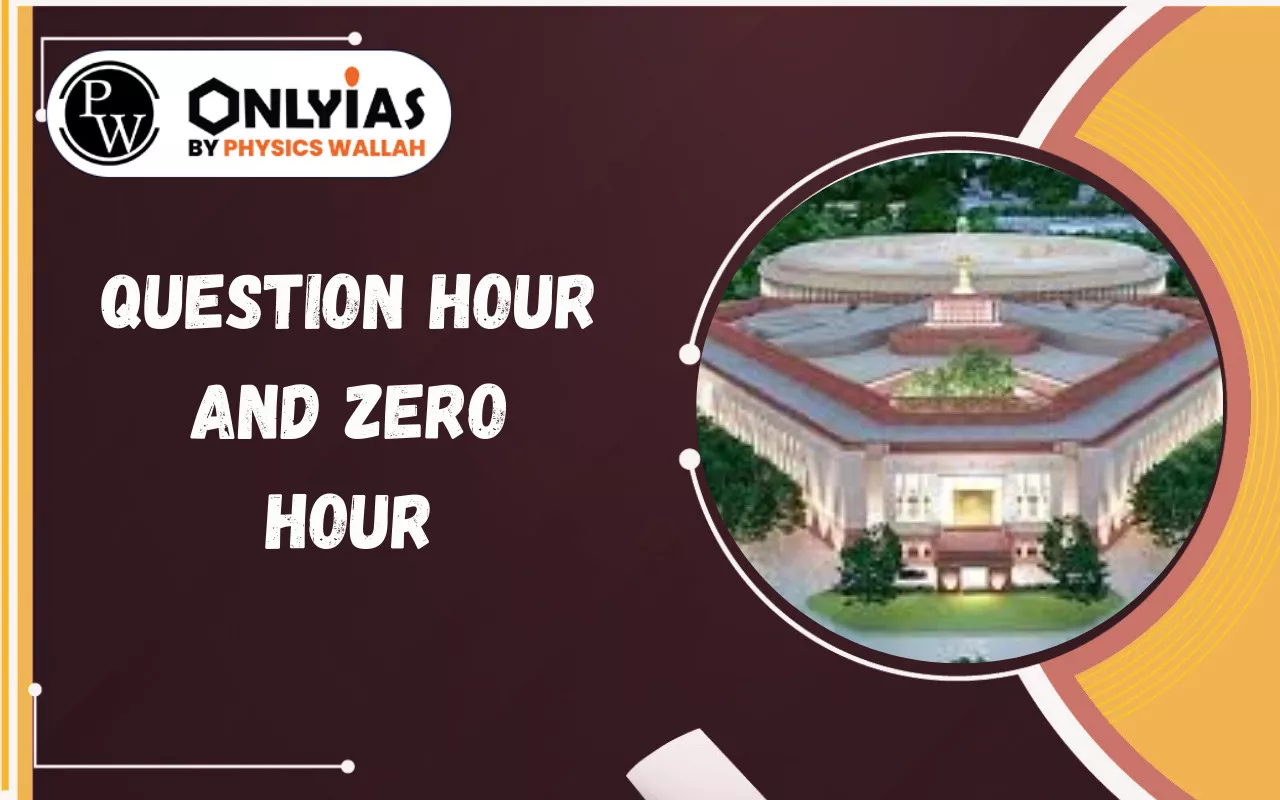
Question Hour and Zero Hour: In India’s parliamentary democracy, accountability of the executive to the legislature is a core principle. Two key mechanisms that ensure this accountability are Question Hour and Zero Hour. These sessions allow Members of Parliament (MPs) to question government actions, seek information, and raise urgent public concerns affecting citizens.
Conducted during sittings of the Parliament of India, these interventions strengthen transparency, responsiveness, and democratic debate. Understanding their structure and functioning is essential for students of polity and competitive examinations.
Explore UPSC Prarambh Course

Explore UPSC Prarambh Course
Question Hour and Zero Hour are institutional tools that allow MPs to interact directly with the government during parliamentary proceedings. They provide structured and immediate avenues for raising public issues and scrutinising executive actions.
Both mechanisms uphold the principle of executive accountability and ensure that public grievances reach the national legislative forum.
The Question Hour typically starts the day’s proceedings in Lok Sabha. Members of Parliament use this time to ask questions from ministers. This practice holds the government accountable for its policies and actions. MPs can seek responses on matters affecting their constituents.
There are three main types of questions asked during Question Hour:
| Types of Questions in Question Hour | ||||
|---|---|---|---|---|
| Type of Question | Notice Period | Response Type | Follow-up Questions | Purpose |
| Starred Questions | 15 days | Oral | Yes (Supplementary) | To get government’s views on national issues and policy inclinations. |
| Unstarred Questions | 15 days | Written | No | To obtain data or factual information from the government. |
| Short Notice Questions | Less than 10 days | Oral | Yes (Supplementary) | To raise matters of urgent public importance with short notice. |
Starred Questions are marked with an asterisk. This indicates the MP desires an oral answer and can ask supplementary questions. Unstarred Questions get a written reply. Short Notice Questions are rare. They deal with urgent public matters.
Check Out UPSC CSE Books
Visit PW Store
These parliamentary sessions are governed by specific rules and practices. Understanding these rules helps clarify how MPs perform their oversight roles.
Here are the key rules for these interventions:
Ready to boost your UPSC preparation? Join PW’s UPSC online courses today!
Explore UPSC Test Series

The primary purpose is to hold the government accountable. Members of Parliament question ministers on policies and administration.
A Starred Question receives an oral answer and allows supplementary questions. An Unstarred Question gets a written reply and does not permit follow-up questions.
No, Zero Hour is not governed by a specific rule in the Rules of Procedure. It is an informal practice. MPs raise urgent public matters without prior notice during this period.
No, there are limits. An MP can ask one Starred Question and up to four Unstarred Questions per day.



Explore SRIJAN Prelims Crash Course


Connect with our experts to get free counselling & start preparing
Books
Udaan (Prelims Wallah)
Prahaar (Mains Wallah)
Q&A Bank (Prelims & Mains)
Budget & Economic Survey
NCERT Wallah
Marks Booster
हिंदी माध्यम विशेष शृंखला
 Current Affairs
Monthly Current Wallah
Subject Wise Current Affairs
Editorial Analysis
Editorial PDFs
News of The Day
Download Our App



Download Our App
<div class="new-fform">
</div>

 GS Foundation
 Optional Course
 Combo Courses
 Degree Program