Recently, NITI Aayog released reports outlining pathways to achieve Viksit Bharat 2047 and Net Zero 2070. The agriculture study notes that while farming contributes to emissions, it is also the most climate-vulnerable sector, underscoring a human-centric transition.
About the Report
- Preparation & Scope: Prepared over 18 months by 10 inter-ministerial working groups, it is India’s first government-led, multi-sectoral assessment of long-term climate transition pathways.
- Methodology: Uses analytical modelling to test how historical trends, existing policies and additional measures—including rapid electrification and circular economy practices—can reconcile economic growth with environmental sustainability.
- Outcome: Emphasises a “Development-First” yet just and calibrated transition, indicating that Viksit Bharat 2047 remains achievable across different climate scenarios.
PWOnlyIAS Extra Edge:
Definition of Agriculture
- The Food and Agriculture Organization (FAO) defines agriculture as “the science, art, and practice of cultivating the soil, producing crops, and raising livestock.”
- It focuses more on the specific activities involved in agriculture, such as growing crops and raising livestock.
Fiscal & Governance Framework (FY 2025-26)
- Financial Allocations: The government has committed substantial funding, with Rs. 1,90,405.53 Crores for the Ministry of Rural Development (MoRD) and Rs. 1,37,756.55 Crores for the Ministry of Agriculture & Farmers Welfare (MoA&FW), the latter representing 2.71% of the Total National Budget.
- Center-State Synergy: While Agriculture remains a State Subject, the Central Government supplements regional efforts through dynamic, periodically reviewed Priority Areas tailored to emerging sectoral challenges.
- Modernization Pillars: Current policy focuses on Risk Mitigation (via Crop Insurance), Digital Agriculture, and Knowledge Empowerment (through Extension Services) to improve market access and reduce the overall cost of cultivation.
|
Key Highlights of the Report
- Core Strategic Approach:
- Adaptation-First Framework: The report prioritizes Adaptation-First pathways that first focus on improving farmer livelihoods, food and nutritional security, and resilience, treating climate mitigation as a significant co-benefit rather than the primary driver.
- Transition Beyond Green Revolution: It advocates for a paradigm shift away from the Green Revolution model, which focused solely on cereal self-sufficiency, toward a system that balances productivity with sustainable natural resource use and climate resilience.
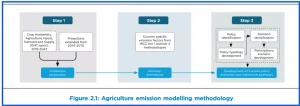
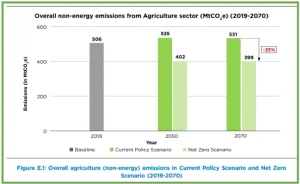
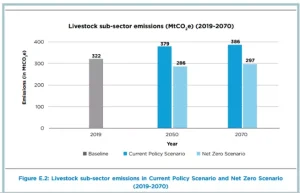
- Modeling Scenarios: The report analyzes two primary stakeholder-driven scenarios to project future outcomes:
- Current Policy Scenario (CPS): This scenario assumes the effective implementation of existing government agricultural policies at their current intended ambition levels.
- Net Zero Scenario (NZS): This represents a transformative path characterized by the Accelerated Adoption of both existing and new policies to drive deeper resource efficiency, higher farm productivity, and enhanced climate resilience.
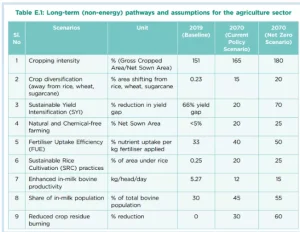
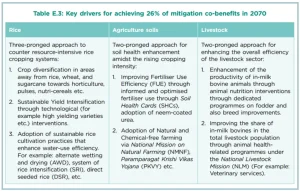
 Key Mitigation Interventions: Strategic scaling of nine core interventions in the NZS could unlock approximately 26% in mitigation co-benefits (non-energy) by 2070 compared to the CPS.
- Crop Diversification: Encouraging a shift in area (up to 20% by 2070) away from water-intensive crops like rice, wheat, and sugarcane toward Pulses, Oilseeds, and Millets.
- Natural and Chemical-Free Farming: Aiming to bring 25% of the Net Sown Area (NSA) under agroecological practices that replace synthetic chemicals with bio-based alternatives by 2070.
- Sustainable Rice Cultivation (SRC): Scaling practices like Direct Seeded Rice (DSR) and System of Rice Intensification (SRI) to reduce methane emissions by up to 59% from rice fields.
 Fertilizer Uptake Efficiency (FUE): Improving nutrient uptake to 50% by 2070 through technologies like neem-coated urea and AI-driven precision agriculture.
- Livestock Productivity: Enhancing In-Milk Bovine Productivity to 15 kg/head/day and increasing the share of the in-milk population to 55% through improved animal health and nutrition.
- Energy Transition Highlights:
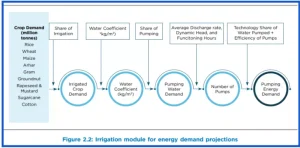
- Efficiency-First Strategy: The report emphasizes prioritizing resource-efficient practices like Micro-Irrigation (MI) and precision scheduling to curb rising total energy demand.
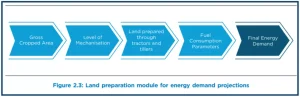
- Clean Energy Adoption: Proposing a major shift in the irrigation fuel mix, aiming for 60% Solar Pump share in the NZS by 2070, while transitioning land preparation toward nearly 99% Electric mechanization.
- Strategic Recommendations:
- Agri-Food Systems Approach: The report suggests moving beyond supply-side measures to include Demand-Side Shifts, such as integrating millets into the Public Distribution System (PDS) to stimulate market demand and incentivize cropping changes.
- Policy Integration: It calls for coordinated action across Land, Energy, and Water Systems to manage trade-offs, such as ensuring solar irrigation is coupled with groundwater governance to prevent resource depletion.
- Circular Bioeconomy: Scaling efforts to reduce Agricultural Waste Burning (AWB) by 60% by 2070 through ex-situ management and diversified farm income streams.
The Governance Nexus- Balancing Solarization and Groundwater
A pivotal recommendation in the NITI Aayog 2026 reports is the transition from “unrestricted resource access” to Regulated Resource Stewardship.
- The KUSUM Paradox- Energy vs. Water: While the PM-KUSUM (Kisan Urja Suraksha evam Utthaan Mahabhiyan) scheme is a masterstroke for decarbonizing the farm sector, it presents a significant governance challenge.
- The Risk of “Unlimited Pumping”: By providing farmers with “free” or highly subsidized solar power, the marginal cost of pumping water drops to near zero.
- Without strict Groundwater Governance, this could lead to the over-extraction of aquifers, as there is no longer a high electricity bill or a limited power-supply window to act as a natural constraint.
- The Policy Trade-off: NITI Aayog warns that solarization must not become an unintended driver of Hydro-Geological Exhaustion.
- Strategic Safeguards for Net Zero: To mitigate this risk, the following governance interventions are proposed:
- Mandatory Smart Metering: Transitioning to AI-enabled Smart Meters on all solar pumps to monitor extraction rates in real-time.
- This allows for “Energy Accounting” where the surplus power is only bought back by the grid if water extraction remains within sustainable limits.
- Separation of Feeders: Implementing a Feeder Level Solarization approach that allows for centralized control over the duration of power availability, ensuring it aligns with the actual crop water requirements.
- Incentivizing “Water Savings”: Treating Saved Water as a financial asset. Farmers who use micro-irrigation to consume less than their “Water Quota” could receive higher “Feed-in-Tariffs” for the surplus solar energy they sell back to the grid.
|
What is Net Zero?
- Refers: Net Zero refers to a state of Climate Neutrality where the amount of greenhouse gases (GHGs) produced by human activity is perfectly balanced by the amount removed from the atmosphere.
- It is not “Zero Emissions” (which implies no pollution at all), but rather a Net-Neutral state.
- Think of it as a financial ledger- your “spending” (carbon output) must not exceed your “earnings” (carbon removal).
- To keep global warming below 1.5°C, the world must reach this balance by 2050.
- In agriculture, Net Zero implies reducing emissions from rice, livestock, fertilisers, and energy use, while enhancing soil and biomass carbon sinks.
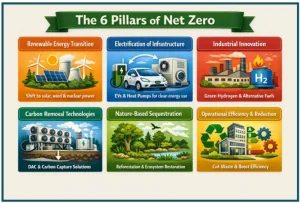 The 6 Pillars of Net Zero:
- Renewable Energy Transition: The foundation of Net Zero is the total shift of the power sector.
- This requires replacing fossil fuel combustion with Zero-Carbon Sources—primarily solar, wind, and nuclear—to ensure the electricity we use doesn’t add new carbon to the sky.
- Electrification of Infrastructure: Once the grid is clean, we must move all possible machinery to run on it.
- This focuses on Electric Vehicles (EVs) for transport and Heat Pumps for buildings, effectively “plugging” our daily lives into the renewable energy grid.
- Industrial Innovation: Certain sectors like steel, cement, and chemicals cannot easily run on electricity.
- These require Green Hydrogen and alternative fuels to eliminate “process emissions” that occur during high-heat manufacturing.
- Carbon Removal Technologies: To balance out the emissions we cannot eliminate, we must use Negative Emissions tech.
- This includes Direct Air Capture (DAC)—machines that filter CO2 from ambient air—and Carbon Capture and Storage (CCS) at the source.
- Nature-Based Sequestration: This pillar utilizes the Earth’s natural ability to store carbon.
- It involves massive reforestation, protecting existing biodiversity, and restoring wetlands and peatlands, which act as highly efficient biological carbon sponges.
- Operational Efficiency & Reduction: The most direct path to Net Zero is reducing the total energy demand.
- This involves Circular Economy practices (recycling and reusing materials) and Energy Efficiency upgrades in architecture to ensure we aren’t wasting the clean energy we produce.
The Agriculture Scenario in India
- The Livelihood Backbone: Agriculture remains the primary economic activity of the nation, directly or indirectly supporting approximately 66% of the Indian population and serving as the fundamental producer of food, fiber, and industrial raw materials.
 Economic Survey 2025-26: Agriculture and allied activities contribute nearly one-fifth of India’s national income while providing employment to about 46.1% of the workforce, highlighting the sector’s critical role in inclusive and balanced economic growth.
- Over the last five years, the agriculture and allied sector has recorded an average annual growth rate of around 4.4% at constant prices, which is the highest decadal growth compared to earlier periods.
- Horticulture Performance:
- The horticulture sector has emerged as a bright spot, contributing about one-third of agricultural GVA and surpassing foodgrain production in volume.
- Global Standing:
- India has become the world’s largest producer of dry onions.
- Second-largest producer of fruits, vegetables, and potatoes, indicating diversification towards high-value crops.
- A High-Tech Convergence of Art and Science: By 2026, Indian agriculture has transcended traditional soil cultivation to become a sophisticated “Art and Science” that balances high-yield productivity with aggressive environmental restoration.
- Evolution toward Entrepreneurship: There is a visible structural shift from subsistence farming toward Commercial Agriculture, where crops like Tea (Assam), Coffee (Karnataka), and Coconut (Kerala) are integrated into high-value global supply chains.
Key Features of the 2025–26 Agricultural Landscape
- Digital Public Infrastructure (DPI): The launch of AgriStack and the Bharat-VISTAAR AI advisory has revolutionized the field, providing over 8.48 crore farmers with unique Digital IDs for seamless access to credit and localized crop advice.
- Mechanization and Precision Farming: India has reached a 47% mechanization level and stands as the world’s largest tractor market, though the current focus has shifted toward precision tools like drones under the “Namo Drone Didi” initiative.
- The Transition to Organic Leadership: Sikkim continues to be recognized globally as the first 100% organic state, while states like Uttarakhand are rapidly adopting similar frameworks to capture the premium organic market.
- Energy Consumption and Transition: Agriculture consumes roughly 18% of India’s total electricity, creating a massive opportunity for the KUSUM Scheme to replace carbon-heavy power with solarized irrigation pumps.
|
Emissions Profile and the “Two-Way” Climate Relationship
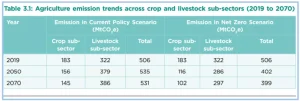
- The Greenhouse Gas Contribution: The sector currently contributes approximately 13–15% of India’s total GHG emissions, driven primarily by methane from livestock and rice cultivation, alongside nitrous oxide (N2O) from fertilizer use.
- A Unique Paradox of Vulnerability: Unlike industrial sectors, agriculture is uniquely “two-way” because it is severely impacted by the emissions it helps produce, with 40% of Indian districts now classified as “high climate risk” areas.
- Livestock and Methane Challenges: As the world’s largest milk producer (contributing 25% of global output), India faces a significant hurdle in managing enteric fermentation, with livestock emissions projected to rise if mitigation strategies are not accelerated.
Significance of the Agricultural Sector
The sector has transitioned from a mere provider of calories to the “anchor” of the national economy and a pillar of global trade.
- Economic & Livelihood Pillar: Contributes 18–20% of India’s GVA and remains the primary employer for 46.1% of the workforce. It acts as a critical “shock absorber” during global industrial uncertainty.
- Production Leadership: India is the world’s largest producer of milk (25% of global output) and a leader in pulses, spices, and millets.
- Clean Energy Contributor: Agriculture is now a key feedstock provider for biofuels, essential for meeting national ethanol blending targets and reducing crude oil dependency.
- Strategic Global Influence: Beyond domestic food security, India is positioning itself as a reliable global supplier of marine products, tea, and organic produce, utilizing agriculture as a tool of soft power.
- Mitigation Potential: Strategic policy scaling is estimated to deliver ~25% climate mitigation co-benefits by 2070 while simultaneously enhancing national yields.
Important Initiatives by the Indian Government Related to Agriculture
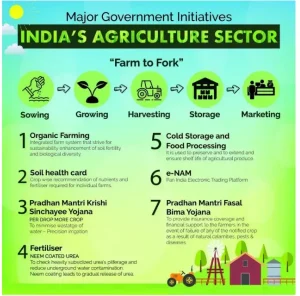
- E-NAM National Agriculture Market (eNAM): It is a pan-India electronic trading portal which networks the existing APMC mandis to create a unified national market for agricultural commodities.
- National Mission For Sustainable Agriculture (NMSA): It has been formulated to enhance agricultural productivity, especially in rainfed areas, by focusing on integrated farming, water use efficiency, soil health management, and synergizing resource conservation.
- Prime Minister Krishi Sinchayee Yojana (PMKSY): It has been formulated with the vision of extending the coverage of irrigation ‘Har Khet ko pani’ and improving water use efficiency ‘More crop per drop’ in a focused manner with end to end solution on source creation, distribution, management, field application and extension activities.
- The Paramparagat Krishi Vikas Yojana (PKVY): It was launched in 2015. It is an extended component of Soil Health Management (SHM) under the Centrally Sponsored Scheme (CSS), National Mission on Sustainable Agriculture (NMSA).
- PKVY aims to support and promote organic farming, which will improve soil health.
- Pradhan Mantri Fasal Bima Yojana (PMFBY): It is a government-sponsored crop insurance scheme that integrates multiple stakeholders on a single platform.
- Micro Irrigation Fund (MIF): The government approved a dedicated Rs5,000 crore fund (set up under NABARD) to bring more land under micro-irrigation as part of its objective to boost agriculture production and farmers’ incomes.
- Digital Agriculture: It aims to improve the existing National e-Governance Plan in Agriculture (NeGPA) by developing a digital public infrastructure for agriculture to enable inclusive, farmer-centric solutions through relevant information services.
- New Agriculture Export Policy: It aims to double agricultural exports from present ~US$ 30+ Billion to ~US$ 60+ Billion by 2022 and reach US$ 100 Billion in the next few years thereafter, with a stable trade policy regime.
- To diversify the export basket and destinations and boost high-value and value-added agricultural exports, with a focus on perishables.
|
Major Challenges & Systemic Barriers
The sector currently faces “atomized” structural issues—where individual problems are small but their cumulative effect creates massive barriers to national development.
- Climate Vulnerability & Water Stress:
- High-Risk Districts: Approximately 40% of Indian districts face high climate risks, with 65% of farmland remaining rain-dependent and vulnerable to erratic monsoons.
- Virtual Water Export: India currently exports 20 million tonnes (mt) of water-intensive rice annually. This is effectively “exporting” billions of liters of groundwater from a water-stressed nation, risking long-term Hydro-Geological Depletion.
- Land Fragmentation & Shrinking Arable Land:
- Urban Encroachment: Industrialization and urbanization are reducing total arable land from 180 million hectares (mha) to 176 mha.
 Diminishing Returns: Average landholdings have shrunk to 0.6–1.08 hectares (ha). This fragmentation prevents Economies of Scale, making the adoption of heavy machinery or Artificial Intelligence (AI) financially unviable for individual smallholders.
- The Yield & Productivity Gap:
- Underutilized Assets: A massive 66% yield gap persists compared to global benchmarks. Despite having 12 million hectares (mha) of Rice-Fallow Land (land left uncropped after the monsoon rice harvest), India remains heavily reliant on imports for pulses and oilseeds.
- Specific Gaps: Yield gaps in Oilseeds (18–40%) and Pulses (31–37%) remain unaddressed, draining foreign exchange reserves and impacting national food security.
- Critical Underinvestment in R&D:
- Funding Deficit: Agricultural Research and Development (R&D) remains underfunded at just ₹11,600 crore (0.5% of Agriculture-GDP).
- In contrast, developed nations typically spend 1.5% to 3%, allowing them to lead in Biotechnology and Climate-Resilient Seeds.
- Post-Harvest Losses & Market Inefficiency:
- Value Erosion: Inadequate cold chains and “farm-to-fork” logistics result in an annual loss of over ₹92,000 crore, particularly in perishables like fruits and vegetables.
- Nutritional Shift: While consumer demand is shifting toward high-value Dairy, Poultry, and Horticulture, policy frameworks remain outdated and focused primarily on cereal staples.
Global Actions & Strategic Initiatives
- International Collaborative Frameworks: India leverages global platforms to set standards for sustainable and resilient food systems.
- G20 Agriculture Working Group (AWG): Under India’s presidency and beyond, the AWG focuses on the “One Earth, One Family, One Future” theme, pushing for the Deccan High-Level Principles on food security and nutrition.
- This includes global commitments to reduce Food Loss and Waste by 50% by 2030.
- COP30 & the Belém Declaration: Strategic alignment with United Nations Climate Change Conferences to move agriculture to the center of the climate agenda.
- This involves tying Concessional Finance to measurable outcomes like hectares of land restored or carbon sequestered.
- The Quad’s AI-ENGAGE Initiative: A partnership between India, Australia, Japan, and the U.S. (Advancing Innovations for Empowering NextGen Agriculture) that uses Artificial Intelligence (AI) for real-time crop disease detection and pest management across the Indo-Pacific.
- Global Technology & R&D Partnerships: Bridging the ₹11,600 crore R&D gap requires collaboration with international research bodies.
- Consultative Group on International Agricultural Research (CGIAR): India partners with the CGIAR network (including ICRISAT and IRRI) to develop Biofortified and Climate-Resilient Seeds.
- For example, the launch of 109 climate-resilient crop varieties in 2024 was a direct result of such global-local research synergies.
- AIM for Scale (Agriculture Innovation Mission): A global initiative aiming to reach 100 million farmers with digital climate advisory services.
- India contributes by sharing its Agri-Stack and Digital Public Infrastructure (DPI) models with other developing nations in Africa and Asia.
- One Country One Priority Product (OCOP): A program by the Food and Agriculture Organization (FAO) that helps India promote special agricultural products with unique geographic identities (like Moringa or Millets) in global markets.
- Sustainability & Resource Stewardship: International initiatives focus on restoring the global commons—soil, water, and air.
- Global Alliance Against Hunger and Poverty: Launched at the G20, this platform supports 100 million small-scale farmers worldwide.
- India contributes via its Lakhpati Didi model, which empowers women in the rural economy to become self-reliant entrepreneurs.
- World Bank’s Climate-Smart Agriculture (CSA): India utilizes CSA Investment Plans to mainstream practices that simultaneously increase productivity and reduce Greenhouse Gas (GHG) Emissions, particularly in rice and livestock farming.
- The “Waste to Wealth” Circular Economy: International partnerships in Bio-fertilizer Production aim to convert biogas slurry and crop residues (like rice straw) into resources, preventing environmental hazards like stubble burning.
|
Way Forward
To achieve a developed India, the agricultural sector must transition from a “Production-Centric” model to a “Sustainable Income-Centric” ecosystem. This requires a paradigm shift from input subsidies to long-term Investment-led Infrastructure.
- Diversification & Resource Stewardship:
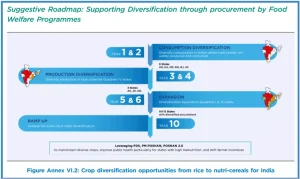
- Aatmanirbharta (Self-Reliance) via Re-alignment: Transition from water-intensive rice-wheat cycles to high-value Pulses, Oilseeds, and Millets. Mission-mode programs like NMEO-Oilseeds will reduce import dependence while indigenous seed varieties improve yields in dryland regions.
 Water Neutrality & The “Per Drop More Crop” Mandate: Scale the PMKSY to decouple production from groundwater depletion. This includes scaling Sustainable Rice Cultivation (SRC) techniques like Direct Seeded Rice (DSR) to slash methane emissions by ~59% and conserve billions of liters of water.
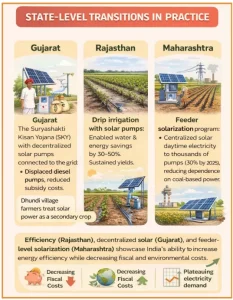
- The SKY Model & Groundwater Governance: Expand the KUSUM Scheme to treat solar energy as a “secondary crop.”
- The Trade-off: To prevent “unlimited pumping” caused by free solar power, NITI Aayog emphasizes Smart Metering and Feed-in-Tariffs to incentivize farmers to sell surplus power back to the grid rather than over-extracting water.
- Innovation & Tech-Led Intensification:
- Digital Public Infrastructure (Agri-Stack): Leverage DPI and AI-powered advisory to provide real-time data on soil health and weather, bridging the “phygital” divide for over 8 crore farmers.
- Doubling R&D Investment: Increase R&D spending from 0.5% to 1.5% of Agriculture-GDP. Focus on High-Yielding Varieties (HYV) and Climate-Resilient Seeds capable of withstanding the heat-stress projected for 2047.
- The “Sink” Potential of Soil: Expand Natural Farming to 25% of the Net Sown Area. By replacing synthetic chemicals with bio-inputs, agriculture can act as a massive Carbon Sink, improving Nitrogen Use Efficiency (NUE) and generating new revenue via Carbon Credits.
- Institutional & Structural Reform:
- Extension 2.0 & Knowledge Equity: Revitalize Krishi Vigyan Kendras (KVKs) to bridge the lab-to-land gap. (Note: Every ₹1 invested here yields a ₹7 return in farm productivity).
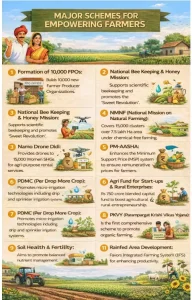
- Collective Bargaining (FPOs): Scale the 10,000 FPO scheme to aggregate smallholders. This transforms farmers from “price takers” into “Price Makers,” ensuring they capture a higher share of the global value chain.
- Allied Sector Synergy: Prioritize Livestock, Fisheries, and Poultry. Increasing milk productivity to 15 kg/head/day provides a crucial financial buffer and nutritional security against crop failures.
- The Investment & Adaptation Reality: Achieving this dual vision of Food Security and Carbon Neutrality requires a staggering cumulative investment of $22.7 trillion by 2070. NITI Aayog’s Adaptation-First Approach ensures that every dollar spent prioritizes the livelihoods of small and marginal farmers, treating carbon mitigation as a vital “co-benefit” of a prosperous rural economy.
Conclusion
NITI Aayog’s 2026 report clarifies that India’s Net Zero journey is not a trade-off with development, but a prerequisite for it. For the agriculture sector, the goal is not just “decarbonization” but “Green Growth”—where mitigation is a co-benefit of improved yields, higher farmer incomes, and a resilient rural economy.


 13 Feb 2026








.png)






 Current Affairs




 GS Foundation
 Optional Course
 Combo Courses
 Degree Program