Books

Krishna River is one of India’s major east flowing rivers, originating from Mahabaleshwar in Maharashtra. Spanning about 1,400 km, it supports irrigation, hydropower, agriculture, and regional development through key dams, tributaries, and a fertile delta, while also facing environmental and water-sharing challenges.
Krishna River is a major east flowing river in India, originating from Mahabaleshwar, Maharashtra, and flowing through Karnataka, Telangana, and Andhra Pradesh before draining into the Bay of Bengal. Spanning about 1,400 km, it supports irrigation, hydropower, and agriculture across its basin.
Key dams like Nagarjuna Sagar, Srisailam, and Almatti regulate water for farming and electricity. Its tributaries, delta, and irrigation projects make it vital for regional development. The river also faces environmental challenges and inter-state water disputes, highlighting its economic and ecological significance.
Explore UPSC Foundation Courses

Explore UPSC Foundation Courses
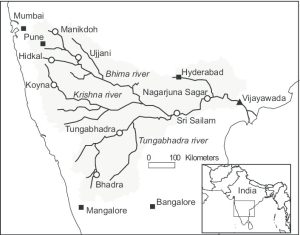
The Krishna River is an east flowing river in India. It begins in the Western Ghats and flows eastwards, draining into the Bay of Bengal. It plays a crucial role in irrigation, hydropower, and supporting ecosystems along its banks. The Krishna river system includes its main river, tributaries like Bhima, Tungabhadra, Musi, and Veena, forming a complex network supporting irrigation and hydropower
| Feature | Details |
| Origin | Mahabaleshwar, Maharashtra |
| Length | Approx. 1,400 km |
| Basin Area | 258,948 km² |
| States Covered | Maharashtra, Karnataka, Telangana, Andhra Pradesh |
| Delta | Krishna River Delta in Andhra Pradesh |
| Major Dams | Nagarjuna Sagar Dam, Srisailam Dam, Almatti Dam |
| Tributaries | Bhima, Tungabhadra, Musi, Veena, Panchganga |
| Drains Into | Bay of Bengal |
The Krishna River originates from Mahabaleshwar, a hill station in the Western Ghats of Maharashtra. The river starts as a small stream and gathers volume from tributaries along its journey.
The Krishna River course passes through four major states in India. It begins in Maharashtra, flows into Karnataka, touches Telangana, and finally enters Andhra Pradesh, forming a fertile delta before joining the Bay of Bengal.
| State | Major Cities | Key Tributaries |
| Maharashtra | Satara, Sangli, Solapur | Bhima, Panchganga |
| Karnataka | Raichur, Vijayapura | Tungabhadra, Ghataprabha, Malaprabha |
| Telangana | Nalgonda, Krishna | Musi, Dindi |
| Andhra Pradesh | Krishna, Guntur | Munneru, Paleru |
The Krishna river basin covers a vast area of 2,58,948 square kilometers. This is about 8% of India’s total geographical area. The basin extends across Maharashtra (69,425 sq km), Karnataka (113,271 sq km), and Andhra Pradesh/Telangana (76,252 sq km).
Explore UPSC Prarambh Course

Explore UPSC Prarambh Course
The basin’s geology includes Deccan Traps in the northwest and unclassified crystallines in the central part. The Western Ghats form its western boundary.
The Krishna River delta is located in Andhra Pradesh where the river meets the Bay of Bengal. This delta is fertile and supports a large population with agriculture.
The Krishna River receives water from many tributaries. These rivers increase its flow and contribute to its drainage basin.
| Type | Tributary Name | Description
|
|---|---|---|
| Right-Bank | Ghataprabha | Joins Krishna in Karnataka. |
| Malaprabha | Important for irrigation in Karnataka. | |
| Tungabhadra | Formed by Tunga and Bhadra rivers; vital for irrigation and power. | |
| Left-Bank | Bhima | The longest tributary; originates near Bhimashankar. |
| Musi | Flows through Hyderabad. | |
| Munneru | Joins Krishna near its delta. |
Many dams and projects are built on the Krishna River to manage water resources. Key Krishna river dams and projects include Nagarjuna Sagar Dam, Srisailam Dam, Almatti Dam, Koyna Dam, and Prakasam Barrage.
The Krishna River plays a vital role in supporting the economy of southern India, especially in agriculture and energy production. Its waters sustain livelihoods across multiple states through irrigation, farming, and power generation.
The Krishna River flows through multiple Indian states, playing a significant role in water supply, agriculture, and regional development.
Krishna River is one of the east flowing rivers of India, along with Godavari, Mahanadi, and Kaveri. These rivers flow from the Western Ghats to the Bay of Bengal and are important for irrigation and electricity.
The Krishna river dispute between basin states like Maharashtra, Karnataka, and Andhra Pradesh/Telangana is a long-standing issue, with tribunals set up to resolve inter-state water allocation. Tribunals are set up to resolve these complex inter-state disputes.
The Krishna River is not just a river but a lifeline for millions in Maharashtra, Karnataka, Telangana, and Andhra Pradesh. Its dams and irrigation projects support agriculture, electricity, and water supply. Understanding the river, its tributaries, delta, and the Krishna water dispute helps students and citizens appreciate the importance of this major Indian river.
Check Out UPSC CSE Books
Visit PW Store
Explore UPSC Test Series

The Krishna River originates near Mahabaleshwar in the Western Ghats, Maharashtra.
It flows through Maharashtra, Karnataka, Telangana, and Andhra Pradesh.
The Krishna River has a total length of approximately 1,400 km.
Major tributaries include the Bhima and Tungabhadra rivers.
The Krishna River drains into the Bay of Bengal, forming a delta.



Explore SRIJAN Prelims Crash Course


Connect with our experts to get free counselling & start preparing
Books
Udaan (Prelims Wallah)
Prahaar (Mains Wallah)
Q&A Bank (Prelims & Mains)
Budget & Economic Survey
NCERT Wallah
Marks Booster
हिंदी माध्यम विशेष शृंखला
 Current Affairs
Monthly Current Wallah
Subject Wise Current Affairs
Editorial Analysis
Editorial PDFs
News of The Day
Download Our App



Download Our App
<div class="new-fform">
</div>

 GS Foundation
 Optional Course
 Combo Courses
 Degree Program