In the Union Budget 2026-27, the Gender Budget Statement (GBS) reached a record ₹5.01 lakh crore (an 11.55% increase over last year), raising its share to 9.37% of total expenditure (from 8.86%), with 53 Ministries and five UTs reporting allocations, reaffirming commitment to Nari Shakti.
Fiscal Composition of the 2026-27 Gender Budget
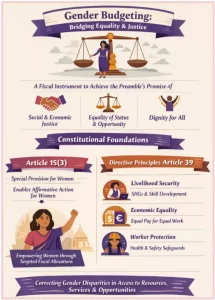
- Part A – Direct Empowerment (100% Women-Specific): This category, which accounts for approximately 21.49% of the gender budget (over ₹1.07 lakh crore), is dedicated exclusively to women.
- It includes flagship safety and empowerment initiatives like Mission Shakti and the Lakhpati Didi scheme.
- Notably, the LPG Scheme saw a significant increase of ₹9,200 crore this year after having no specific allocation in 2025.
- Part B- Majoritarian Impact (30–99% Women-Specific): Taking the largest share at 72.56% (over ₹3.63 lakh crore), this segment covers massive infrastructure and social schemes where women are the primary beneficiaries.
- High-impact programs like the Jal Jeevan Mission, which saw a budget increase of ₹12,500 crore, and the PMAY-G (Rural Housing) fall under this category.
- Part C- Fringe Benefits (Below 30% Women-Specific): This newer category tracks the secondary benefits of mainstream infrastructure projects.
- It ensures that general investments, such as rural road construction, are evaluated through the lens of female mobility and safety.
Key Strategic Pillars of the 2026-27 Budget
- From Credit-Led Survival to Business Ownership: A cornerstone of this budget is the launch of SHE-Marts (Self-Help Entrepreneur Marts).
- This initiative seeks to transition the 10 crore women currently organized into Self-Help Groups (SHGs) from basic micro-credit users into professional business owners.
- By providing digital marketplaces and innovative financial instruments, the government aims to bridge the “last-mile” marketing gap that often prevents rural women from scaling their enterprises.
- The Care Economy and Reducing “Time Poverty”: Recognizing that unpaid domestic labor is a major barrier to workforce participation, the budget introduces a “Care Economy” framework.
- Significant funding has been directed toward the expansion of the Palna (crèche) scheme and the training of 1.5 lakh caregivers for geriatric services.
- This is intended to alleviate the “time poverty” of women, allowing them more freedom to pursue economic opportunities.
- STEM Inclusion and Digital Parity: To dismantle the gendered digital divide, the 2026-27 budget prioritizes women in Science, Technology, Engineering, and Math (STEM).
- The government has committed to establishing girls’ hostels in every district, specifically targeting Tier-2 and Tier-3 cities.
- This infrastructure is designed to reduce commuting barriers and provide the secure environment necessary for the intensive laboratory and study hours required in STEM fields.
- Rural Resilience and Asset Ownership: The Pradhan Mantri Awas Yojana (PMAY) continues to serve as a vehicle for social security by encouraging sole or joint ownership of houses by women.
- This shift from “beneficiary” to “owner” provides rural women with essential collateral and a sense of permanent financial security.
- Additionally, the budget links women to the “Blue Economy” by promoting women-led groups in the fisheries sector and the development of 500 reservoirs.
About Gender Budgeting
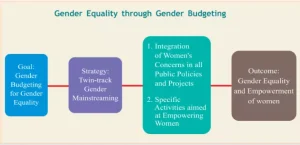
- Gender is a tool for gender mainstreaming which uses the budget as an entry point to apply a gender lens to the entire policy process.
- Gender Budget is not a separate Budget and also not about spending the same on women and men
- Gender Budget covers analyzing various economic policies of the Government from a gender perspective.
- Function: It is a separate statement (not a separate budget) of the Union budget, it provides an estimate of budgetary allocations and expenditure targeted towards women and girls.
 It covers analyzing various economic policies of the Government from a gender perspective.
- Rationale behind Gender Budgeting (GB):
- Equality and Efficiency: Apart from the basic principle of promoting equality among citizens, GB can benefit the economy through efficiency gains.
- Keep in Mind the Systemic Differences across Gender: Men and women frequently have different priorities for budgetary policies and a Gender responsive budget can be of great help in addressing women’s concerns from a gender perspective.
- Expectations: When implemented effectively, gender budgeting helps expose how gender inequalities may have inadvertently become embedded in public policies so that resources can be allocated more equally.
- It also helps prioritise budget measures that will support the achievement of key gender objectives.
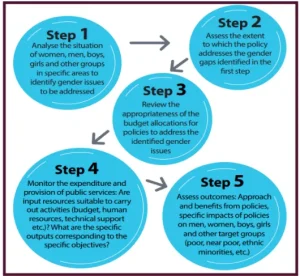
- The Five-Step Framework for Gender Budgeting by UN Women (refer image)
Difference between Women-led development and Women-Centric Development
Women-led development and women-centric development are both approaches to development that focus on women, but they differ in their focus and approach:
- Women-led Development: It focuses on women taking on leading roles and actively participating in shaping the economic, social, and political progress of a community or society.
- Some of its goals include promoting education, skill development, and entrepreneurship, and bridging the gender digital divide.
- Women-centric Development: It focuses on acknowledging women as an important force in society and integrating them into development programs.
- Some of its goals include improving quality of life, reducing hardship, and building capacity.
|
Evolution of Gender Budgeting
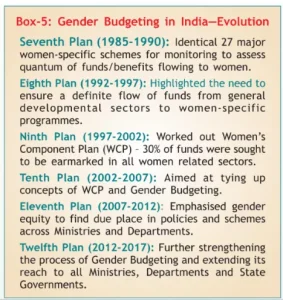
- It was first introduced in 1984 in Australia to evaluate the impact of the national budget on females and the approach was adopted by other countries including Canada, South Africa and Philippines etc.
- United Nations Beijing Platform for Action: In 1995, it called for integrating a gender perspective into government budget processes.
- United Nations Sustainable Development Goals (SDGs): In 2015, it called for adequate resources and tools to track budget allocations for gender equality (SDG 5).
- Addis Ababa Action Agenda for Development: In 2015, it recognised the importance of tracking resource allocations for gender equality and strengthening capacity for Gender Budgeting.
- Women 20 (W20) (an official engagement group to the G20): Founded in Australia in 2014, and it officially began operations in Turkey in 2015.
- In 2020, it called for greater investment in Gender Budgeting to ensure that fiscal policies advance gender equality in the recovery from the COVID-19 pandemic.
- Millennium Development Goals (MDGs): The eight MDGs to which the Government of India is a signatory which includes “Goal 3: Promote Gender Equality and Empower Women”.
Gender Budgeting in India
- The Ministry of Women and Child Development (MWCD) recognized gender budgeting as a tool for women’s empowerment in 2004.
- The Ministry of Finance mandated the establishment of GB cells in all ministries by January 2005.
- The charter on Gender Budgeting cells was issued in 2007.
- CEDAW Ratification: India ratified the Convention on the Elimination of All Forms of Discrimination Against Women (CEDAW) in 1993.
- The first Gender Budget Statement (GBS) was published in the Union Budget of 2005-06.
- Different Stakeholders: There are a range of different actors who can be involved in Gender Budgeting.
- Central Level: Ministry of Women and Child Development (MWCD).
- State Level: Departments of Women and Child Development, Social Welfare, Finance, and Planning.
- District Level: Hub for Empowerment of Women (HEW) coordinates gender budgeting, with at least one gender specialist.
- Role: The gender budgeting framework has helped the gender-neutral ministries to design new programs for women.
- Over the past two decades, India’s GBS has evolved into a comprehensive document that provides item-wise allocation and expenditure details in a clear, predictable format.
Significance of Gender Budgeting
- Promotes Gender Equality: Gender Budgeting (GB) ensures that financial allocations address gender disparities, supporting Sustainable Development Goal (SDG) 5 on gender equality.
- Informed Policy Choices: GB helps policymakers consider the gendered impact of policies, ensuring that women’s concerns are integrated into financial planning.
- Better Utilization of Resources: A well-designed GB framework enables optimal utilization of resources to bridge gender gaps in education, health, employment, and social security.
- Strengthening Legal Frameworks: It aligns with women-specific laws such as the Criminal Law Amendment Act, 2013, and the Sexual Harassment of Women at Workplace Act, 2013, by ensuring financial backing for implementation.
- Wider Societal Impact: Studies, including an IMF working paper on G20 countries, have shown that GB leads to gender-responsive programming, positively influencing economic growth and social development.
- Addressing Gender-Neutral Budgeting Pitfalls: Traditional budgeting often ignores gendered impacts. GB ensures that all major budgetary allocations consider women’s specific needs and roles in the economy.
- Transparency and Accountability: GB fosters transparency in fund allocation for women-focused schemes, ensuring accountability in implementation and impact assessment.
Challenges with Gender Budgeting in India
While the record-breaking numbers are a bold statement of intent, several structural challenges remain for the effective implementation of these policies:
- Structural and Reporting Flaws: While the ₹5.01 lakh crore allocation is a milestone, the framework suffers from “notional” rather than “transformative” accounting.
-
- The “Accounting Exercise” Trap: A dominant proportion of the budget remains in Part B (schemes where 30–99% of beneficiaries are women).
- Critics argue this is often a post-facto reporting exercise where ministries apply flat percentages (e.g., a 30% “pro-woman” tag) without empirical proof that the benefits actually reach women.
- Sectoral Concentration: Approximately 90% of the GB is concentrated in just five or six ministries (Rural Development, Health, Education).
- This leaves “gender-neutral” sectors like Power, Transport, and Commerce with minimal accountability, despite their critical role in women’s safety and economic mobility.
- Part B Dilution: In Part B, specific female needs often get subsumed under general household benefits, leading to a lack of targeted interventions.
- The “Hardware vs. Software” Dilemma: There is a significant disconnect between creating physical assets (Outlays) and ensuring their functional utility (Outcomes).
- Lack of Convergence: Schemes like PMAY (Housing) provide the “hardware” (a house), but without reliable “software” (functional Jal Jeevan water connections or affordable LPG refills), the labor burden shifts back to the woman.
- The Maintenance Gap: If infrastructure fails or is incomplete, women face “Time Poverty,” spending hours fetching water or fuel instead of engaging in the formal workforce.
- The Care Economy & Urban Neglect: Current policies lean heavily toward rural settings, leaving the growing urban female workforce underserved.
- The Urban Infrastructure Gap: Most flagship schemes (MGNREGA, PMAY-G) are rural-centric. Urban areas lack specific allocations for affordable childcare, safe public transport, and female-only housing, which are essential for increasing Urban Female Labour Force Participation (UFLFP).
- Under-functional Care Services: The Palna (Crèche) scheme is a prime example of implementation failure; only about 3,000 of 14,600 approved centers are operational due to low worker remuneration and poor infrastructure.
- Data Deficits & Institutional Weakness: Without granular data, gender budgeting remains a “blind” fiscal tool.
- Invisibility of Beneficiaries: The absence of real-time, sex-disaggregated data at the block level makes it impossible to conduct a Gender Impact Assessment (GIA) or track if a woman’s daily labor has actually decreased.
- Weak Institutional Architecture: Gender Budgeting Cells (GBCs) within ministries often lack the technical expertise and dedicated staff to move beyond tracking “money spent” to measuring “lives changed.”
- Stagnant Safety Funding: Despite the correlation between safety and work, flagship safety initiatives like Mission Sambal (One Stop Centres) have seen only marginal increases, insufficient to meet the needs of a growing population.
Initiatives by India towards Promoting Gender Budgeting:
- The Samarthya Framework- Universal Coverage: Gender Budgeting is now an operational pillar of the ‘Samarthya’ sub-scheme under the Mission Shakti umbrella.
- The Vision of 100%: This scheme has shifted the goalpost to achieve universal adoption of GB across all Central and State Ministries, including urban and rural local bodies (Panchayats and Municipalities).
- Financial Support: To achieve this, the Ministry of Women and Child Development (MWCD) provides 100% financial assistance to departments and training institutes for conducting specialized workshops and capacity-building programs.
- Digital Transformation- The Knowledge Hub (2025): Launched in mid-2025, the Gender Budgeting Knowledge Hub serves as India’s primary digital repository for gender-responsive governance.
-
- Centralized Intelligence: It hosts policy briefs, gender-disaggregated data, and sector-specific tools to help policymakers integrate a gender lens during the initial planning phase of a budget.
- Standardized Training: The portal also features a Training Manual that provides a step-by-step practical guide for officials to move from tracking “outlays” to assessing “impact.”
- Sub-National Leadership- Best Practices: While the Union Government sets the framework, Indian states have pioneered unique models for “deepening” GB:
- Odisha (The Early Adopter): Odisha was a frontrunner, adopting Gender Responsive Budgeting in 2004-05 through its Women Component Plan.
- This plan mandated that a specific portion of funds across various departments be explicitly earmarked for women’s welfare, ensuring sectoral accountability.
- Karnataka (The Audit Specialist): Karnataka has focused on the “end-of-cycle” accountability by developing a comprehensive Gender Audit Manual.
- This tool allows the state to monitor whether the allocated funds truly reached the intended beneficiaries and led to the desired social changes.
- Kerala (The Local Governance Model): Kerala remains a leader in “engendering” local budgets, where a significant percentage of the Plan Fund at the Panchayat level is reserved specifically for women-led projects.
|
Way Forward
- Refining the Accounting Framework: The current “Part B” dominance (schemes with 30-99% women beneficiaries) often leads to vague estimations.
- Standardize Part B Reporting: Instead of applying a flat 30% percentage to general schemes, ministries should be required to provide an empirical rationale based on actual beneficiary data.
- Incentivize Part A Growth: Encourage ministries to design 100% women-specific sub-schemes (moving them to Part A) to ensure funds are not subsumed by general household needs.
- Mandatory Gender Impact Assessments (GIA): Link future budget increases for a department to the successful completion of a GIA for their existing gender-tagged schemes.
- Bridging the Urban and Care Gap: As India urbanizes, the budget must pivot to support the specific constraints of the urban female workforce.
- Urban Infrastructure “Software”: Shift focus toward “safe mobility” by funding last-mile connectivity (E-rickshaws, better lighting) and urban working women’s hostels in Tier-2 and Tier-3 cities.
- Revitalizing the Care Economy: Scale the Palna (Crèche) scheme by increasing remuneration for workers and integrating crèches into public infrastructure like metro stations and industrial hubs.
- Gender-Inclusive Urban Planning: Mandate that at least 30% of members in urban planning committees be women to ensure city designs reflect female safety and accessibility needs.
- Strengthening Institutional Architecture: The “brain” of gender budgeting—the Gender Budgeting Cells (GBCs)—needs more than just a nameplate.
- Professionalize GBCs: Staff GBCs with technical gender experts and economists rather than over-burdened general administrators.
- Real-time Data Integration: Use the Sakhi Dashboard and other digital tools to collect sex-disaggregated data at the block level. This data should inform the Budget Call Circular for the following year.
- Outcome-Based Monitoring: Transition from tracking expenditure to tracking impact indicators such as:
- Hours saved in unpaid domestic labor.
- Increase in female labor force participation in a specific district.
- Reduction in wait times at One Stop Centres (OSCs).
- Expanding the “Gender Lens” to New Sectors: Gender budgeting must move beyond “traditional” ministries like Health and Education.
- Engendering “Neutral” Sectors: Ministries like Power, Petroleum, and Transport should report on how their infrastructure (e.g., street lighting or LPG availability) specifically reduces a woman’s “Time Poverty.”
- Digital Suraksha Fund: Establish a dedicated fund under Mission Shakti to combat AI-driven cybercrimes and harassment, which are emerging barriers to women’s participation in the digital economy.
Conclusion
The ₹5.01 lakh crore allocation is a bold milestone, yet success hinges on shifting from notional outlays to tangible outcomes. As Dr. B.R. Ambedkar said, “I measure the progress of a community by the degree of progress which women have achieved.” Real growth requires bridging the urban-rural divide and dismantling the structural barriers of “time poverty.”


 20 Feb 2026








.png)






 Current Affairs




 GS Foundation
 Optional Course
 Combo Courses
 Degree Program