Prediction Markets: Regulation, Risks & Rise of Kalshi and Polymarket

24 Feb 2026

English

हिन्दी

Prediction Markets: Regulation, Risks & Rise of Kalshi and Polymarket

Prediction markets came under scrutiny in 2025 after political advisory and investment links involving Kalshi and Polymarket raised concerns over insider influence in event-based trading.

  • Prediction markets have transitioned into a multi-billion dollar financial asset class in 2026, with total notional trading volume exceeding $44 billion in 2025.
  • Kalshi and Polymarket both claim to be the largest prediction market platforms globally.

About Prediction Markets

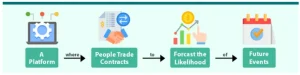
  • A prediction market is a platform where users buy units of a ‘probable event’ to make a profit when that event happens (or not).

How Prediction Markets Work?

  • A question about a future event is posted (e.g., “Will X win the election?”)
  • Users buy “Yes” or “No” shares
  • Price reflects probability (higher price = higher chance)
  • If correct → payout; if wrong → loss.

Prediction Markets

  • Funding Mechanism: Users can fund their trading accounts through:
    • crypto, credit/debit cards, or bank transfers. 
  • Platform Charges: A platform fee may or may not be charged. 
  • Digital Payment Mechanism: Polymarket conducts transactions using the USDC stablecoin (pegged to the US Dollar).
    • Transactions are executed via the Polygon blockchain network.
  • Scope of Events: Users can browse and trade on events across domains such as:
    • Science
    • Sports
    • Culture
    • Finance
    • Politics and public affairs

Types of Prediction Markets

  • Public Prediction Markets:  Open platforms where anyone trades on public events like elections, e.g., PredictIt and Polymarket.
  • Internal (Corporate) Prediction Markets: Company-run markets where employees forecast business outcomes, used by Google and Hewlett-Packard.
  • Event Derivative Markets: Platforms trading on measurable events like inflation or oil prices, e.g., contracts on Kalshi.

Reasons for Rising Popularity of Prediction Markets

  • Efficient Information Aggregation: Prediction markets aggregate dispersed information through price discovery, often producing accurate forecasts, as demonstrated by the Iowa Electronic Markets in U.S. elections.
  • Real-Time Updating of Probabilities: Prediction market prices adjust immediately when new information becomes available.
  • Declining Trust in Opinion Polls: Forecasting errors in traditional opinion polls have encouraged greater reliance on market-based probability estimates.
  • Expansion Beyond Political Forecasting: Prediction markets have expanded into areas such as economic indicators, sports outcomes, and public health forecasting, thereby broadening participation and relevance.

Why Are Prediction Markets Being Criticised?

  • Promotion of Irresponsible Gambling: Critics argue that prediction markets resemble speculative betting and may promote gambling behaviour under the guise of financial trading, particularly on platforms such as Kalshi and Polymarket.
  • Betting on Violence and Sensitive Events: Opponents contend that allowing contracts on wars, assassinations, or disasters creates ethical concerns by incentivising people to profit from violence and instability
  • Insider Trading Risks: Critics warn that powerful individuals with access to privileged information may influence or profit from event-based contracts in sensitive markets.
    • For example:  In January 2025, Kalshi announced that Donald Trump Jr. had joined as a strategic advisor, raising concerns about potential access to insider political information.
  • Political Influence and Perception Manipulation: Critics argue that presenting users’ bets as “statistical truths” may shape public perception and potentially influence electoral narratives.
    • For Example:  Trump Jr. claimed on social media platform X that insiders used Kalshi to know election results hours before mainstream media projections, raising concerns about narrative shaping.

Are Prediction Markets Regulated?

  • Prediction markets operate in a regulatory grey area globally, as they are permitted and regulated in some countries while banned or restricted in others.
    • For Example: Kalshi reported it was regulated by the U.S. Commodity Futures Trading Commission (CFTC), but it faces restrictions and legal challenges in multiple U.S. states.
      • Further, 33 countries are completely restricted from accessing Polymarket, including the U.S., Germany, UK, and Singapore.

Prediction Markets in India: A Regulatory Grey Area

  • Prediction markets are not formally recognised under Indian securities law and are generally treated under the broader framework of betting and gambling, which is a State subject (Entry 34, State List, Seventh Schedule) of the Constitution.
  • There is no explicit legislation in India that directly regulates “prediction markets” as a separate financial category.

Way Forward

  • Clear Legal Classification: A clear distinction should be made between gambling and information-based event contracts by defining prediction markets within financial law frameworks.
    • For example, the regulated event-trading platform Kalshi operates under oversight of the Commodity Futures Trading Commission, providing a model for structured regulation instead of blanket bans.
  • Stronger Information Controls: Regulations must prevent politically exposed persons or corporate insiders from exploiting privileged information in sensitive markets.
    • For Example: Public debate emerged when Donald Trump Jr. joined Kalshi as a strategic advisor, highlighting concerns about insider influence.
  • International Coordination: Given cross-border digital access, global coordination is needed to regulate platforms that operate across jurisdictions, especially where access is restricted in multiple countries, as in the case of Polymarket.

Check Out UPSC CSE Books

Visit PW Store

online store 1

Prediction Markets vs Betting Markets

Aspect Prediction Market Betting Market
Purpose Forecasting and probability estimation of real-world events Entertainment or gambling on outcomes
Outcome Basis Real-world events such as elections, economic indicators, or policy decisions Games, sports competitions, races, or chance-based outcomes
Participants Analysts, traders, researchers, and informed individuals Bettors primarily seeking monetary gain
Objective Information aggregation through price discovery Wagering for personal profit
Economic Principle Based on collective intelligence and market efficiency Based on odds-setting and risk management by bookmakers
Legal Standing Often treated as research tools or financial instruments in some jurisdictions; legally ambiguous in others Clearly regulated under gambling laws in most countries
Regulatory Oversight (Example) Iowa Electronic Markets (academic) Regulated betting operators like Bet365
Platform Examples Augur, PredictIt, Iowa Electronic Markets Bet365, DraftKings

Need help preparing for UPSC or State PSCs?

Connect with our experts to get free counselling & start preparing

Aiming for UPSC?

Download Our App

      
Quick Revise Now !
AVAILABLE FOR DOWNLOAD SOON
UDAAN PRELIMS WALLAH
Comprehensive coverage with a concise format
Integration of PYQ within the booklet
Designed as per recent trends of Prelims questions
हिंदी में भी उपलब्ध
Quick Revise Now !
UDAAN PRELIMS WALLAH
Comprehensive coverage with a concise format
Integration of PYQ within the booklet
Designed as per recent trends of Prelims questions
हिंदी में भी उपलब्ध

<div class="new-fform">


    </div>

    Subscribe our Newsletter
    Sign up now for our exclusive newsletter and be the first to know about our latest Initiatives, Quality Content, and much more.
    *Promise! We won't spam you.
    Yes! I want to Subscribe.