The Union Cabinet approved a proposal to alter the name of the State of Kerala to “Keralam,” setting in motion the constitutional process required for the change.
- Following Cabinet approval, the President will refer the Kerala (Alteration of Name) Bill, 2026 to the Kerala Legislative Assembly for its views, as required under Article 3 of the Constitution.
Factors Considered While Renaming a Place
The Central Government considers factors such as:
- Historical significance
- Public sentiment
- Linguistic affinity
- Administrative convenience
- National integration
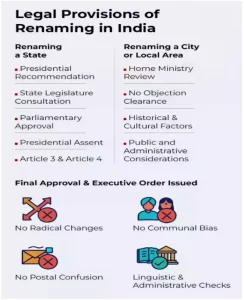
Guidelines for Renaming of Places (1953)
- The change should not involve a radical alteration but may allow phonetic correction or transliteration.
- It should not be based on communal or sectarian considerations.
- It should not create confusion for postal, railway or other services.
- It should not adversely affect the interests of any other state or union territory.
Article 3 of the constitution
- Formation of new States and alteration of areas, boundaries or names of existing States:
- Parliament may by law, Form a new State by separation of territory from any State or by uniting two or more States or parts of States or by uniting any territory to a part of any State
- Increase the area of any State
- Diminish the area of any State
- Alter the boundaries of any State
- Alter the name of any State
Article 4 of the constitution
- Laws made under articles 2 and 3 to provide for the amendment of the First and the Fourth Schedules and supplemental, incidental and consequential matters provides that law made under Article 2 and 3 shall not be deemed to be an amendment of this Constitution for the purposes of article 368.
|
Background for Renaming Kerala as ‘Keralam’
- Unanimous Assembly Resolution: The Kerala Legislative Assembly passed a unanimous resolution on June 24, 2024, seeking to change the State’s name from “Kerala” to “Keralam.”
- Recognition of Linguistic Identity: The resolution stated that the State is referred to as “Keralam” in Malayalam, reflecting its linguistic and cultural identity.
- Basis in Linguistic Reorganisation: It emphasised that linguistic identity was the basis for the reorganisation of States.
- Historical Context ‘Kerala Piravi’: November 1, 1956, the day Kerala was formed after the States Reorganisation is celebrated as Kerala Piravi.
Procedure for Renaming a State
- Constitutional Requirement for Renaming a State: Unlike the renaming of cities, changing the name of a state requires a constitutional amendment, and the proposal must originate from the state government.
- Examination by the Ministry of Home Affairs: The Union Ministry of Home Affairs examines the request and seeks No Objection Certificates (NOCs) from agencies such as:
- The Ministry of Railways, Intelligence Bureau, Department of Posts, Survey of India, and the Registrar General of India.
- Introduction of Bill in Parliament: If cleared, the proposal is introduced in Parliament as a Bill.
- Final Approval and Notification: Once passed by Parliament and officially notified, the new name comes into effect.
Rationale Behind the Renaming of Places in India
- Urbanisation and Administrative Reorganisation: Rapid urbanisation requires new administrative units and updated nomenclature to reflect emerging urban realities, with India projected to add nearly 416 million urban residents by 2050.
- For Example: The creation of Navi Mumbai as a planned satellite city illustrates such functional and administrative differentiation from Mumbai.
- Commemoration of National Leaders and Icons: Places are renamed to honour prominent leaders or cultural figures, embedding collective memory in public spaces
- For Example: Mughalsarai Railway Junction has been renamed as Deen Dayal Upadhyaya Junction.
- Assertion of Linguistic and Regional Identity: In a multilingual federal polity like India, place names often become markers of linguistic and regional assertion.
- For Example: Orissa became Odisha (2011) corrected the colonial-era spelling to reflect the Odia pronunciation.
 Political Repositioning and Symbolic Reframing of Public Memory: Renaming can function as a political instrument to reshape historical narratives and signal ideological shifts.
 -
- For Example: The change from Faizabad to Ayodhya (2018) reflects how nomenclature may be tied to broader cultural and political symbolism.
Challenges
- Global Recognition and Brand Confusion: When a city or State has established strong international recognition, renaming can create confusion in trade, diplomacy, tourism, and global branding.
- For Example: Bombay was renamed Mumbai in 1995. While domestically accepted, “Bombay” continues to be used in global business references (e.g., Bombay Stock Exchange), leading to dual usage.
- Administrative Inconvenience and Documentation Burden: Renaming requires extensive updates in official records, maps, educational certificates, property documents, government websites, and legal instruments.
- For Example: After Allahabad was renamed Prayagraj, changes were required across railway tickets, court records, university certificates, and government databases.
- Emotional and Cultural Resistance: Residents often develop emotional attachment to older names, which may reflect shared memories and lived experiences.
- For Example: The renaming of Calcutta to Kolkata saw mixed reactions, with some sections continuing to use the older name informally.
- Risk of Social Division and Political Polarisation: Renaming initiatives can become politically sensitive, sometimes framed as identity-based or ideological moves.
- For Example: Changes like Allahabad to Prayagraj sparked political debates over historical legacy and cultural narratives.
Way Forward
- Promote National Integration: Changes should strengthen federal harmony rather than deepen regional divides (e.g., linguistic reorganisation under the States Reorganisation Act, 1956).
- Cost–Benefit Assessment: Evaluate financial and administrative costs (updates to records, maps, signage) before approval.
- Stakeholder Consultation: Engage civil society, tribal groups, minority communities, business bodies, and academia to ensure inclusivity
- For Example: Jharkhand formation reflected tribal aspirations.
- Time-Bound Expert Committee: Constitute a neutral commission of historians, linguists, constitutional experts, and administrators to examine proposals objectively.
| Previous Examples of Renaming
State-Level Changes:
- Madhya Pradesh (1956): Formed after reorganization, including integration of Madhya Bharat.
- Tamil Nadu (1969): Madras State renamed to reflect Tamil identity.
- Karnataka (1973): Mysore State renamed to represent the broader Kannada-speaking region.
- Uttarakhand (2007): Uttaranchal renamed Uttarakhand to reflect cultural and historical identity.
Supreme Court on Renaming Commission (2023)
- In 2023, the Supreme Court dismissed a Public Interest Litigation seeking the formation of a renaming commission focused on “ancient India” and restoration of names allegedly altered by “barbaric invaders”.
- The bench made it clear that the “country cannot remain a prisoner of the past.”
- It observed that selectively invoking history could create divisions.
|


 25 Feb 2026






.png)






 Current Affairs




 GS Foundation
 Optional Course
 Combo Courses
 Degree Program