A recent study published in Nature Geoscience has explained the sharp rise in global temperatures since 2023, attributed to Earth’s energy imbalance and the shift from a prolonged La Niña phase to El Niño, alongside long-term human-induced climate change.
- Revision in El Niño–La Niña Classification
- Scientists are updating the way El Niño and La Niña are labelled due to rapid warming caused by climate change.
- Rising global ocean temperatures have shifted the baseline, making earlier thresholds less accurate.
- The National Oceanic and Atmospheric Administration has revised its calculation method to determine when ENSO phases begin or end.
- Under the new criteria, more events may be classified as La Niña, while fewer may qualify as El Niño despite warmer tropical waters.
Key Findings of Study
- Unusual Triple Dip: From 2020 to 2023, Earth had an unusual “triple dip” La Nina without an El Nino in between.
- In a La Nina, warm water sticks to a deeper depth, resulting in a cooler surface. And that reduces how much energy goes out into space.
- Causes of Increase in Earth’s Energy Imbalance:
- About 23% of the recent increase in Earth’s energy imbalance is attributed to the unusually prolonged La Niña (2020–2023) phase.
- Slightly more than 50% of the imbalance is linked to greenhouse gas emissions from the burning of coal, oil, and natural gas.
- Insights on Earth’s Energy Imbalance:
- An increase in Earth’s energy imbalance means more heat is trapped, leading to higher global temperatures.
- Around 75% of the recent rise in energy imbalance is attributed to the combined effect of:
- Long-term human-induced climate change, and
- The shift from a prolonged three-year La Niña (cooling phase) to a warming El Niño phase.
- Rise in Average Monthly Temperature: Earth’s average monthly temperature took a noticeable jump up from the long-term upward trend connected to human-caused climate change in early 2023, and that increase continued through 2025.
About El Nino
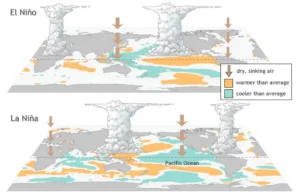
- El Nino, meaning “the little boy” in Spanish, is commonly known, refers to an abnormal warming of surface waters in equatorial Pacific Ocean.
- It is known to suppress monsoon rainfall.
- It was first noticed by scientists in the 1920s.
- It occurs on average every two to seven years, and episodes usually last nine to 12 months.
- Formation:
- It forms when the trade winds blowing east-to-west along the equatorial Pacific slow down or reverse as air pressure changes, although scientists are not entirely sure what kicks off the cycle.
- Because the trade winds affect the sun-warmed surface waters, a weakening causes these warm western Pacific waters to slosh back into the colder central and eastern Pacific basins.

La Nina
- La Niña means Little Girl in Spanish. La Niña is also sometimes called El Viejo, anti-El Niño, or simply a cold event.
- It is the opposite of El Niño, which is the abnormal cooling of sea surface waters in the same region, and is known to aid rainfall over India.
- The La Niña phenomenon was discovered only in the 1980s.