Recently, the Indian PM visited Israel, reaffirmed India’s De-hyphenated West Asia Policy, highlighting Strategic Autonomy, Continuity in Defence Cooperation, and deepening Technology & Security Partnerships.
Key Highlights of the 2026 PM Visit
- Strategic Elevation & Governance:
- New Partnership Level: Both countries officially elevated ties to a “Special Strategic Partnership,” recognizing Israel as a global innovation powerhouse and India as a global hub for talent and manufacturing.
 Institutional Frameworks: New mechanisms were launched to move policy into action across Government-to-Government (G2G), Business-to-Business (B2B), and People-to-People (P2P) domains.
- Parliamentary Ties: Established the India-Israel Parliamentary Friendship Group to deepen legislative cooperation.
- Digital & Financial Integration (Fintech Diplomacy):
- UPI-Israel Linkage: In a landmark move, an MOU was signed between NPCI International and Israel’s fast payment system (Masav) to link India’s Unified Payments Interface (UPI) with Israel’s payment system.
- This facilitates seamless cross-border transactions for businesses and tourists.
- Financial Cybersecurity: Launched a strategic partnership to protect the financial ecosystem through intelligence exchange and joint “cyber-simulations” between national response teams.
- Frontier Technologies & Innovation:
- Artificial Intelligence (AI): Signed a comprehensive MOU on Cooperation in AI, focusing on the use of AI in education, health, and national welfare.
- Critical and Emerging Technology (iCET): Launched a new initiative led by the National Security Advisors (NSAs) to synergize strengths in semiconductors, quantum computing, and biotechnology.
- Space Exploration: Strengthened ties between ISRO and the Israel Space Agency (ISA), specifically encouraging Israeli space startups to integrate with the Indian space industry.
- I4F & Research Funding: Increased the joint research budget for the India-Israel Joint Research Calls from $1 million to $1.5 million each to boost university-level collaboration.
- Labor Mobility & Migration:
- Workforce Expansion: Agreed to the arrival of up to 50,000 additional Indian workers in Israel over the next five years.
- Sector Diversification: New protocols were signed to expand Indian labor beyond construction and caregiving into Manufacturing, Restaurants, and the Commerce & Services sectors.
- High-Skill Mobility: Emphasized creating pathways for Indian professionals in Data Science and High-Tech industries.
- Agriculture, Water, and Environment:
- Innovation in Farming: Launched the India-Israel Innovation Centre for Agriculture (IINCA) and the Villages of Excellence (VoE) model, which has already trained over one million Indian farmers.
- Fisheries & Aquaculture: Established a Joint Centre of Excellence to modernize India’s “Blue Economy.”
- Sustainability: Pledged cooperation in Circular Economy practices and the cleaning of the Ganges and other rivers using advanced Israeli water recycling tech.
- Defense, Security, and Counter-Terrorism:
- Defense Roadmap: Validated the November 2025 MOU on Defense Cooperation, shifting focus toward co-development of advanced platforms.
- Cyber Centre of Excellence: Signed a Letter of Intent to establish a dedicated Indo-Israel Centre of Excellence in Cybersecurity in India for capacity building and “Security by Design” principles.
- Zero Tolerance for Terror: Both leaders unequivocally condemned the October 7, 2023 attacks on Israel, as well as the 2025 terror attacks in Pahalgam and New Delhi, reaffirming a collective resolve against cross-border terrorism.
 Connectivity & Global Trade:
- FTA Momentum: Confirmed the Terms of Reference for the Free Trade Area (FTA) negotiations and tasked teams to fast-track the signing of the agreement.
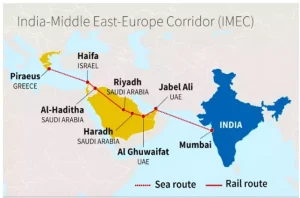
- IMEC & I2U2: Reaffirmed commitment to the India-Middle East-Europe Economic Corridor (IMEC), viewing Israel as a critical gateway for regional trade and connectivity.
- Maritime Heritage: Signed an MOU to involve Israeli expertise in developing the National Maritime Heritage Complex in Lothal, Gujarat.
Why Does Israel Matter to India?
India’s outreach to Israel is not merely diplomatic; it is a foundational necessity for India’s rise as a global power.
- The Security Gap: Israel is the only major defense partner willing to share “black box” technologies and source codes.
- India has imported military hardware worth $2.9 billion from Israel over the last decade, including radars, surveillance and combat drones, and missiles. Israel is the fourth largest supplier of military hardware to India.
- This allows India to customize and integrate advanced electronic warfare systems into indigenous platforms.
- Military Modernization: Israel provides high-end sensors and Heron drones that enhance situational awareness along the LAC and LOC.
- Reliability in Crisis: Historically, Israel has been a “no-strings-attached” supporter.
- Whether during the 1971 war or the 1999 Kargil conflict, Israel provided critical military hardware when other traditional allies hesitated.
- Survival Technologies: With India facing acute water stress, Israeli breakthroughs in desalination and precision agriculture are vital for India’s food security.
- Agricultural Resilience: Through the Indo-Israel Agricultural Project (IIAP), Israeli drip irrigation has helped Indian farmers increase yields while reducing water consumption by 40%.
- Strategic Leverage: A strong bond with Israel gives India a significant seat at the table in West Asian geopolitics, allowing it to play a balancing role between the Arab world and the West.
- The Peace Dividend (IMEC): India is positioning itself as the “anchor” of the India-Middle East-Europe Economic Corridor (IMEC), using Israeli ports like Haifa as the primary gateway to Europe, bypassing traditional maritime chokepoints.
About India-Israel Relations
- Historical Evolution:
-
- The Era of Hesitation (1948–1992): India officially recognized Israel in 1950 but kept the relationship at a “consular level” in Mumbai due to Cold War dynamics and the Palestinian cause.
- However, even then, Israel provided discreet military aid during India’s 1962, 1965, and 1971 wars.
- The Arafat Pivot (1992): Full ties were established after Palestinian leader Yasser Arafat indicated that an Indian embassy in Israel would give New Delhi direct influence to help the Palestinian cause.
- The Kargil Lifeline (1999): During the Kargil conflict, Israel acted as a “lender of last resort,” providing laser-guided missile kits and UAVs from its emergency stockpiles at lightning speed.
Timeline of India-Israel Relations
- 1947: India opposed the partition of Palestine at the UN, rejecting the idea of creating separate nations based on religious criteria.
- 1950: India officially recognized the existence of Israel.
- 1953: Israel opened a consulate in Mumbai, mainly for trade and visa services.
- 1950s–1980s: India maintained a pro-Arab policy under the Non-Aligned Movement (NAM) and in support of the Palestinian cause.
- Due to Cold War dynamics and a commitment to the Non-Aligned Movement (NAM), it did not establish full diplomatic relations
- Despite this, covert defence and intelligence contacts gradually developed, especially after the 1962 Sino-Indian War and the 1971 Indo-Pak war.
- 1992: India and Israel established full diplomatic relations.
De-Hyphenation Policy
India explicitly adopted a “de-hyphenation” policy, asserting that its relationship with Israel is independent of its historical relationship with the Palestinians. |
- 2017: A major shift in India-Israel relations occurred with the Indian Prime Minister’s state visit to Israel, becoming the first Indian Prime Minister to do so.
- 2018: India voted in favor of a resolution presented by Turkey and Yemen at the UN, opposing the US decision to recognize Jerusalem as Israel’s capital.
- 2021: India abstained from voting on a resolution at the UN Human Rights Council to create a permanent commission to investigate human rights violations in Gaza, the West Bank, and Palestine.
- 2021: I2U2 Partnership:
- Formed in 2021, includes India, Israel, UAE, and the US.
- It aimed at promoting economic development, scientific innovation, and regional stability.
- 2023: IMEC Launch: Announced at the G20 Summit in New Delhi.
- A Memorandum of Understanding (MoU) was signed between India, the USA, UAE, Saudi Arabia, France, Germany, Italy, and the EU.
- Strategic Objective: Designed to stimulate economic development through enhanced connectivity and economic integration between Asia, the Arabian Gulf, and Europe.
- The “Two Pillars”: Consists of two separate corridors:
- East Corridor: Connecting India to the Arabian Gulf.
- Northern Corridor: Connecting the Arabian Gulf to Europe via rail and ship.
- Multimodal Integration: Beyond transit, it includes electricity cables, high-speed data links, and a clean hydrogen pipeline, positioning India as a central hub in the global supply chain.
- 2025: In September 2025, the Government of India and the Government of the State of Israel signed a Bilateral Investment Agreement (BIA).
- Israel becomes the first OECD (Organisation for Economic Co-operation and Development) country to adopt India’s updated investment-treaty model.
- Bilateral investments between India and Israel currently stand around US $800 million.
- It marks a strategic milestone in India–Israel economic ties, signalling a move from primarily defence/technology partnership to broader commercial integration.
|
- Economic & Strategic Pillars:
- Trade Trajectory: Merchandise trade peaked at $10.77 billion in FY23 but dropped to $3.75 billion in 2024-25 due to Red Sea shipping disruptions.
- India is Israel’s second-largest country partner in Asia for merchandise trade.
- Major Exports: Pearls and precious stones, automotive diesel, chemical and mineral products, machinery and electrical equipment, plastics, textile and apparel products, base metals and transport equipment, agricultural products.
- Major Imports: Pearls and precious stones, chemical and mineral/fertilizer products, machinery and electrical equipment, petroleum oils, defense, machinery and transport equipment.
- Defense & “Operation Sindoor”: The May 2025 Operation Sindoor validated the “Special Strategic Partnership.”
- It used SkyStriker suicide drones and SPYDER air defense systems to neutralize assets within 23 minutes, proving the effectiveness of Real-time Intelligence Fusion.
- Semiconductor & Deep-Tech: The 2026 visit shifted the focus to co-creation. Both nations are now integrating Israel’s chip design prowess with India’s “Semicon India” manufacturing incentives.
- The Mobility and Migration Pillar: A standout achievement of the 2026 visit was the Large-scale Labor Agreement:
- Workforce Expansion: A protocol was signed to allow 50,000 Indian workers to move to Israel over five years.
- Sector Diversification: Moving beyond caregiving, the deal opens doors in manufacturing, food services, and high-tech sectors like AI and Data Science, filling Israel’s labor vacuum while providing high-wage opportunities for Indians.
- Agricultural Cooperation: In 1993, the first Agreement on Cooperation in Agriculture was signed.
- 2006: Comprehensive Work Plan on Agriculture launched (3-year cycles) which is implemented through MASHAV (Israel’s Agency for International Development Cooperation).
Focus Areas of Agriculture Cooperation Agreement and Work Plan in the Horticulture Sector:
- Collaboration on food security, technology transfer, and quality seed development.
- Expansion of Centers of Excellence (CoEs) and implementation of the Villages of Excellence (VoE) model.
- Launch of a proposed Five-Year Seed Improvement Plan (FYSIP) to boost productivity and sustainability.
- Cooperation on pest management, capacity building, and post-harvest technologies.
- Strategic Vision: Both sides reaffirmed a shared goal to leverage innovation and R&D for agricultural resilience amid climate challenges.
- Israel showed keen interest in India’s Digital Agriculture Mission for farmer empowerment.
- Institutional Mechanism: Establishment of a Joint Working Group (JWG) to ensure continuous dialogue, goal setting, and monitoring of progress.
|
-
- 2025: A new Agriculture Cooperation Agreement and Work Plan in the Horticulture Sector were signed to strengthen bilateral ties in Soil and water management, Horticultural and agricultural production, Post-harvest and processing technology, Agricultural mechanization, Animal husbandry and Research & Development.
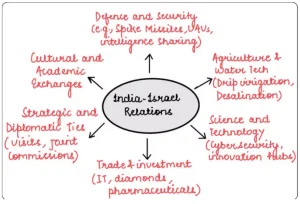 Science & Technology: India-Israel cooperation in Science & Technology (S&T) is overseen by the Joint Committee on S&T, established under the Agreement of Science & Technology cooperation signed in 1993.
 -
- I4F Fund promotes industrial R&D between India and Israel.
- The US$40 million India-Israel Industrial R&D and Technological Innovation Fund (I4F) was established in 2017 to foster joint industrial research and development projects between companies from both countries.
- Energy: India actively bids for exploration licenses in Israel’s Tamar and Leviathan gas fields. Indian firms ONGC Videsh and Indian Oil awarded exploration licenses.
Challenges & Concerns
- The Middle East Balancing Act: India must manage a difficult “balancing act” between its partner Israel and other regional powers:
- The Palestine Issue: India continues to support the Two-State Solution (an independent Palestine living peacefully alongside Israel). Israeli expansion into Palestinian territories remains a point of diplomatic disagreement.
- The Iran Connection: Israel sees Iran as a major threat, but India views Iran as a vital partner for energy and a gateway to the Chabahar Port (a key sea route for trade with Central Asia).
- Safety of Indian Citizens: Over 9 million Indians live and work in the Gulf countries (such as the United Arab Emirates and Saudi Arabia). If India appears too close to Israel during a war, it could risk the safety, jobs, and money sent home by these Indian workers.
- Trade and Global Competition:
- The China Factor: China is a major trading partner for Israel. India is concerned about Israel sharing sensitive technology with Beijing, especially since India and China have their own border tensions.
- Lack of a Free Trade Agreement: Even though trade is strong, there is no Free Trade Agreement (a deal to reduce taxes on imports and exports) yet. This keeps most business limited to only diamonds and military equipment.
- Cyber-Security and Privacy: Past incidents involving spyware (software used for secret surveillance) have created concerns about trust and the privacy of Indian citizens.
- Energy and Transport Risks:
- Disrupted Supply Lines: Conflicts in the Red Sea or Persian Gulf can block ships. This puts India’s Energy Security (the steady supply of oil and gas) at risk and delays projects like the India–Middle East–Europe Economic Corridor.
Way Forward
- Moving Beyond “Buyer and Seller”:
- Joint Manufacturing: Instead of just buying equipment from Israel, India wants to move toward Co-Development (making products together).
- This supports the Atmanirbhar Bharat (Self-Reliant India) initiative by bringing high-tech manufacturing to Indian soil.
- Expanding the Trade Basket: Both nations should finalize the Free Trade Agreement by 2026 to encourage trade in new areas like Agriculture, Green Energy, and Health Technology.
- Building “Knowledge Corridors”:
- Academic Links: India should connect its Indian Institutes of Technology with Israel’s top research centers.
- Focusing on Quantum Computing (next-generation super-fast computers) and Artificial Intelligence will create a partnership that lasts longer than just military deals.
- Strategic Independence:
- Independent Diplomacy: India must maintain its Strategic Autonomy, which means it keeps the freedom to talk to the United States, Russia, and Iran at the same time without being forced to join one side’s military alliance.
- People-to-People Ties: Increasing travel, student exchanges, and business meetings between ordinary citizens will help build a stronger, more transparent relationship based on mutual trust.
Conclusion
India-Israel relations have matured into a “Strategic Axis” based on mutual necessity. The 2026 visit proves that for New Delhi, the path to a “Viksit Bharat” (Developed India) runs through a deep, pragmatic partnership with Israel, balancing high-tech co-creation with regional stability.


 27 Feb 2026







.png)





 Current Affairs






 GS Foundation
 Optional Course
 Combo Courses
 Degree Program