The 16th Finance Commission (16th FC), acting as the constitutional fiscal arbiter, has recalibrated India’s tax-sharing formula for 2026–2031.
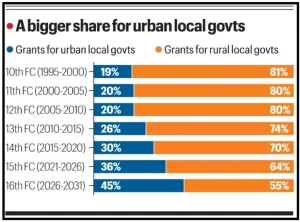
- Amidst a rapid peri-urban transition—where rural areas are fast becoming urban clusters—the Commission has significantly upscaled the financial empowerment of Urban Local Bodies (ULBs).
About 16th FC Grants for Urban Local Governments
The 16th FC has moved away from giving a single “lump sum” of money and has instead created a structured system of outcome-based fiscal decentralization (linking money to actual results). The total grant of ₹3.56 lakh crore is broken down into specific parts:
- Basic Grants (₹2,32,125 cr): These are predictable transfers of money that cities can rely on for their daily essential services, like keeping streets clean.
- Special Infrastructure Grants (₹56,100 cr): This money is set aside for big, expensive projects that cities often struggle to fund, such as wastewater management systems and stormwater drains to prevent the massive urban flooding seen in recent years.
- Performance Component: A portion of the money is only given if the city proves it is improving, such as by doing a better job of collecting its own local taxes.
- Urbanization Premium (₹10,000 cr): This is a special “bonus” for states that are seeing very fast population growth, helping them manage the sudden pressure on their housing and transport.
States that gained the most (in % terms)
| State |
15th FC Grants (₹ cr) |
16th FC Grants (₹ cr) |
Change (%) |
| Kerala |
3,242 |
16,683 |
415% |
| Goa |
149 |
726 |
387% |
| Maharashtra |
11,611 |
46,803 |
303% |
| Gujarat |
6,367 |
23,764 |
273% |
| Tamil Nadu |
7,187 |
25,069 |
249% |
| Telangana |
3,682 |
11,548 |
214% |
| Karnataka |
6,409 |
18,483 |
188% |
States that gained the least (in % terms) or saw cuts (absolute terms)
| State |
15th FC Grants (₹ cr) |
16th FC Grants (₹ cr) |
Change (%) |
| Himachal Pradesh |
855 |
435 |
-49% |
| Arunachal Pradesh |
459 |
233 |
-49% |
| Bihar |
9,999 |
9,169 |
-8% |
| Assam |
3,197 |
3,249 |
2% |
| Meghalaya |
363 |
377 |
4% |
| Odisha |
4,498 |
5,078 |
13% |
| Rajasthan |
7,696 |
12,680 |
65% |
About Urban Local Governments
Urban local governments are the third tier of India’s democracy, sitting right below the Union and State levels. They were given official power by the 74th Constitutional Amendment Act (CAA), 1992.
- Constitutional Mandate: They are legally responsible for 18 specific functions (listed in the 12th Schedule), ranging from planning how land is used to providing public health services.
- The “3 Fs” Concept: For a city to work well, it needs the “3 Fs”:
- Funds (money),
- Functions (clear duties), and
- Functionaries (trained staff).
- Historically, cities had the duties but lacked the money and the people to carry them out.
Significance of Urban Local Governments
- Economic Productivity: Cities are the engines of growth for India. When a city has good roads and reliable power, it attracts businesses, which creates more jobs for everyone.
- Resilience Financing: Because cities are often hit hardest by climate change (like heatwaves or floods), local governments are the ones who need the money to build “climate-proof” infrastructure.
- Subsidiarity: This is the fancy term for a simple idea: problems should be solved at the local level whenever possible because local leaders understand their neighbors’ needs better than someone in a distant capital.
Why the Need for High Grants?
- The Census Gap: For a long time, funding was based on 2011 data when only 31% of Indians lived in cities.
- The 16th FC’s move to a 45% share finally acknowledges that millions more people have moved to cities in the last 15 years.
- Infrastructure Deficit: Most Indian cities have a huge “backlog” of work.
- They need massive investment in solid waste management (trash disposal) and public transport just to keep up with the current population.
- Peri-urban Transition: Many “villages” on the edges of big cities are turning into towns almost overnight.
- These peri-urban areas need immediate funding for pipes and roads before they become overcrowded slums.
Critical Challenges that need to be addressed
- The Parastatal Trap: Often, State governments give the money to “special agencies” (parastatals) that they control, rather than giving it to the elected Mayor.
- This reduces local accountability because the people can’t vote out a state agency if they do a bad job.
- Municipal Capacity: Giving a city billions of rupees doesn’t help if they don’t have enough trained engineers or urban planners to design a proper sewage system or a smart traffic network.
- Fiscal Laziness: If the Central government gives too much “free” money, some cities might stop trying to collect their own-source revenue (like property taxes), which makes them dependent on others forever.
India’s Strategic Initiatives for Urban Transformation
While the 16th Finance Commission provides the fiscal fuel, the Government of India has launched several “missions” to provide the structural engine for urban growth. These initiatives focus on making cities “smart,” “clean,” and “liveable.”
- PM-eBus Sewa (2024–2026): This is a major step toward green mobility in cities.
- Deployment of 10,000 electric buses in 169 cities under a Public-Private Partnership (PPP) model.
- This initiative addresses urban pollution and reduces the carbon footprint of the transport sector, aligning with India’s Net Zero 2070 goals.
- AMRUT 2.0 (Atal Mission for Rejuvenation and Urban Transformation): This mission focuses on the “basics” of urban life with a massive budget.
- The Goal: Providing 100% water supply coverage to all households in around 4,700 urban local bodies.
- Circular Economy: It encourages wastewater recycling (treating sewage water to use it again for factories or gardening), which is a key focus area of the 16th FC’s Special Infrastructure Grants.
- Swachh Bharat Mission-Urban 2.0 (SBM-U): Moving beyond just building toilets, the second phase focuses on Waste-to-Wealth.
- Action Taken: Creating “Garbage Free Cities” through 100% source segregation (separating wet and dry waste) and scientific processing of all municipal solid waste.
- Remediation: It aims to “clear” all legacy dumpsites (huge mountains of old trash) in Indian cities by 2026.
- The Smart Cities Mission (SCM): This is the “technology layer” of India’s urban governance.
- Integrated Command and Control Centers (ICCCs): These act as the “brain” of the city, using CCTV cameras and sensors to manage traffic, monitor crime, and coordinate emergency responses in real-time.
- Data-Driven Governance: It encourages cities to use data to decide where to build new parks or how to fix water leakages.
- Prime Minister Awas Yojana-Urban (PMAY-U) 2.0: Announced to provide housing for the urban poor and middle class.
- The Focus: Moving away from just “giving houses” to creating vibrant urban neighborhoods with electricity, water, and gas connections.
- Rental Housing: A new focus on Affordable Rental Housing Complexes (ARHCs) for migrant laborers who move to cities for work.
- Recent Policy Shifts (2025–2026):
- Urban Infrastructure Development Fund (UIDF): Managed by the National Housing Bank, this fund helps Tier-2 and Tier-3 cities get cheap loans for infrastructure, ensuring that development is not just limited to big metros like Delhi or Mumbai.
- Municipal Bond Market Support: The Central government is now providing subsidies to cities that issue “Municipal Bonds.” This encourages cities to raise their own money from the market instead of always waiting for fiscal transfers.
- National Urban Digital Mission (NUDM): A push to create a “shared digital infrastructure” so that every city doesn’t have to build its own software from scratch for things like paying property tax online.
| PWOnlyIAS Extra Edge:
Global Best Practices in Urban Governance: These models serve as a benchmark for what “successful” cities look like internationally:
- The Powerful Mayor Model (London & New York): Unlike Indian cities where an appointed bureaucrat often holds the power, these cities have a Directly Elected Mayor.
- This leader has full executive power and is directly accountable to the citizens, making them a “face” for the city’s progress.
- Participatory Budgeting (Brazil): In cities like Porto Alegre, a portion of the city budget is decided by the residents themselves through public meetings.
- This ensures that the money is spent on what the people actually need, rather than what officials think they need.
- Integrated Planning (Singapore): Singapore is the gold standard for compact city design.
- They perfectly sync their transport, housing, and green spaces so that almost everyone lives within a short walk of a train station or a park.
- The Scandinavian Tax Share (Sweden/Norway): In these countries, a large chunk of the income tax paid by a citizen goes directly to their local city government.
- This gives cities a predictable transfer of wealth and makes them less dependent on the central government.
Global Actions Taken (2024–2026): International organizations and city networks are currently taking big steps to redefine urban life:
- The Urban Planning Accelerator (2025): Launched by UN-Habitat and C40 Cities, this is a global commitment to help cities become “climate-responsive” by 2035.
- The Goal: Moving away from “urban sprawl” (cities spreading out too thin) toward compact, polycentric models (cities with multiple small hubs) to reduce pollution and travel time.
- World Bank’s Sustainable Cities Program (2026): The World Bank has recently launched the next phase of its program, supporting 40 additional cities globally with over $5 billion annually.
- Focus: It specifically targets resilience financing—giving cities the money to build infrastructure that can survive extreme heat and flooding.
- COP30 Action Agenda (Rio de Janeiro): Leading up to the COP30 climate summit, global leaders have introduced the SHIFT Initiative.
- Focus: It helps small and medium-sized cities (not just the “mega-cities”) get access to green finance so they can create eco-friendly jobs and sustainable housing.
|
Way Forward
- Empowering the Mayor: Greater executive authority must be vested in the Mayor to ensure clear accountability in the utilization of new grants.
- Incentivizing Reform: Grants can be linked to performance milestones, such as improvements in air quality or the initiation of water recycling systems.
- Digital Transparency: Cities should use GPS mapping to find every property and ensure everyone pays their fair share of tax, making the city more self-reliant over time.
- Building a Local Cadre: India needs a dedicated group of professional city managers who move from city to city, bringing their expertise in handling large infrastructure budgets.
Conclusion
The 16th Finance Commission’s decision is a landmark in fiscal federalism (the financial relationship between different levels of government). By shifting the share to 45%, it has provided the “fuel” for India’s urban engines. However, for our cities to become truly liveable, this predictable transfer of money must be supported by the political will of States to let go of control and allow local leaders to truly govern.
About Finance Commission
The Finance Commission is a constitutional body under Article 280 of the Indian Constitution.
- Appointing Authority: The President of India constitutes a Finance Commission every fifth year or at such a time that is considered necessary.
- Composition: The Finance commission composition consists of a chairman and four other members.
- Tenure: For the duration specified in Presidential order. The Commission is reconstituted typically every five years and usually takes a couple of years to make its recommendations.
- Members are eligible for reappointment.
- Qualifications: The Parliament has been authorized by the constitution to determine the qualifications of the members and the manner in which they are to be appointed.
- Specifications: Based on these powers, the Parliament has given the following specifications for appointing the members.
- The chairman must have experience in public affairs while the other four members should be selected from amongst the following criteria:
- A High Court judge or one qualified to become one
- An individual having specialised knowledge of finance and accounts of the government
- A person who possesses experience in financial matters and administration
- A person who has special knowledge of economics
- Powers: Based on the Code of Civil Procedure 1908, the Finance Commission of India has all the powers of a Civil Court.
- Evidence Demand: The commission has powers to call witnesses, and ask for the production of a public document or record from any office or court.
- Mandates:
- Tax Distribution: Distributing shares of net proceeds of tax between the Union and the States and the allocation between the States of the respective shares of such proceeds.
- The Centre, however, is not legally bound to implement the suggestions made by the Finance Commission.
- Rules for Grants-in-Aid: The rules that govern grant-in-aid to the states by the Centre from Consolidated Fund of India.
- Tax Devolution at State Level: Augmenting the consolidated fund of the state to supply resources to panchayats and municipalities based on recommendations of the State Finance Commission.
- Since the 10th FC, which was the first one after India adopted a third tier of government — urban local bodies and the rural panchayats — each FC has provided grants to these government structures.
- Miscellaneous Matter: Any other matter referred by the President to the Commission in the interests of sound finance.
- Submit Report: A report is submitted to the President, who lays it before both houses of the Parliament. The report is followed by an explanatory memorandum on the actions taken on its recommendations.
|


 28 Feb 2026








.png)





 Current Affairs






 GS Foundation
 Optional Course
 Combo Courses
 Degree Program