Ladakh Magmatic Arc: Subduction, Neo-Tethys and Himalayan Formation

18 Mar 2026

Ladakh Magmatic Arc: Subduction, Neo-Tethys and Himalayan Formation

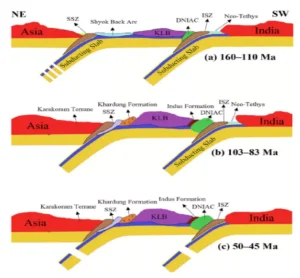
Scientists from the Wadia Institute of Himalayan Geology have decoded the 130-million-year evolution of the Ladakh Magmatic Arc.

  • The study provides new insights into subduction processes and the collision between the Indian Plate and Eurasian Plate.

About Subduction

  • Subduction is a geological process in which one tectonic plate moves beneath another and sinks into the Earth’s mantle at a convergent plate boundary.
  • Mechanism: It occurs when an oceanic plate, being denser, collides with a lighter continental or oceanic plate and is forced downward into the mantle.
  • Key Features:
    • Formation of deep oceanic trenches at the plate boundary.
    • Generation of volcanic arcs due to melting of mantle above the subducting plate.
    • Earthquakes occur along the subduction zone due to plate friction and stress.
  • Significance:
    • Drives plate tectonics and mountain building.
    • Responsible for the formation of magmatic arcs, such as the Ladakh Magmatic Arc.
    • Plays a major role in the recycling of crustal materials back into the mantle.
  • Example: The northward subduction of the Neo-Tethys Ocean beneath the Eurasian Plate led to the formation of the Ladakh Magmatic Arc.

Also Read | UPSC Result 2025

Key Findings of Study

  • Subduction Mechanism: The Ladakh Magmatic Arc was formed due to the northward subduction of the Neo-Tethys Ocean oceanic plate beneath the Eurasian Plate margin.
  • Methodology: The study used geochemical and isotopic analysis of rocks to reconstruct tectonic and magmatic history.
  • Comparative Analysis: Researchers compared data from:
    • Dras–Nidar Island Arc Complex (DNIAC) (pre-collisional stage)
    • Ladakh Batholith (LB) (pre- to syn-collisional stage; part of Kohistan-Ladakh Batholith)
    • Post-collisional mafic dykes
  • Magmatic Control: The long-term magmatic evolution was controlled by the geodynamics of the Neo-Tethys Ocean.
  • Magmatic Episodes: Three major phases of magmatism were identified:
    • 160–110 Ma: Early arc (pre-collisional) magmatism
    • 103–45 Ma: Active arc (syn-collisional) magmatism
    • < 45 Ma: Post-collisional magmatism
  • Geochemical Signatures: Each phase shows distinct geochemical characteristics, reflecting changing tectonic conditions.

About Jurassic to Eocene Period

  • Timeframe: The Jurassic to Eocene spans from 201.3 million years ago (Ma) to 33.9 Ma.
  • Jurassic Period (201.3–145 Ma):
    • Characterized by the breakup of Gondwanaland and the opening of Neo-Tethys Ocean.
    • Extensive volcanic and magmatic activity occurred in island arcs.
    • Major marine sedimentation took place, preserving fossil-rich strata.
  • Cretaceous Period (145–66 Ma):
    • Continued northward drift of the Indian Plate.
    • Formation of subduction-related magmatic arcs such as the pre-collisional Ladakh Arc.
    • Widespread deposition of limestone, sandstone, and shale in the Tethys region.
  • Paleogene Period (66–33.9 Ma), including Eocene:
    • Marks the collision of the Indian and Eurasian plates.
    • Closure of the Neo-Tethys Ocean.
    • Formation of batholiths, syn-collisional magmatism, and the initial uplift of the Himalayas.
  • Significance: This interval preserves the complete record of subduction, arc magmatism, and continental collision in the NW Himalaya.

  • Slab Dynamics: The evolution is closely linked to subducting slab dynamics, involving interaction between:
    • Subducting oceanic slab
    • Sub-arc mantle wedge
    • Overlying continental crust
  • Conclusion: The study establishes a continuous record of subduction to collision processes, explaining the formation and evolution of the Ladakh Magmatic Arc.

About Ladakh Magmatic Arc (LMA)

  • LMA is a belt of igneous rocks in the Trans-Himalaya formed in the period Jurassic to Eocene- 201.3 million years ago to 33.9 Million Year (Ma).
  • Location: Situated in the Ladakh region, extending along the Indus Suture Zone in the Himalayas.
  • Formation: It was formed due to the northward subduction of the Neo-Tethys Ocean oceanic plate beneath the Eurasian margin.
    • In the earliest phase, the region resembled a chain of volcanic islands rising from the Neo-Tethys Ocean. 
      • Rocks from the Dras–Nidar Island Arc Complex preserve evidence of this stage. 
      • Their chemical fingerprints suggest that the magma mainly emerged from the mantle with only a small contribution from sediments dragged down by the subducting oceanic plate.
  • Rock Types: Composed mainly of granites, diorites, and volcanic rocks, indicating past magmatic activity.
  • Tectonic Significance: Marks an ancient subduction zone and provides evidence for plate tectonic processes.
  • Mineral Potential: Associated with metallic mineral deposits like copper and gold.
  • Scientific Importance: Helps in understanding the evolution of the Himalayas and continental collision processes.

Evolution Of The Ladakh Magmatic Arc

Earliest Phase: Island Arc Stage

  • The region resembled a chain of volcanic islands rising from the Neo-Tethys Ocean.
  • Rocks from the Dras–Nidar Island Arc Complex preserve evidence of this stage.
  • Their chemical fingerprints suggest that the magma mainly emerged from the mantle.
  • There was only a small contribution from sediments dragged down by the subducting oceanic plate.

Evolution During Plate Convergence

Ladakh Magmatic Arc

  • The arc evolved as tectonic plates continued to converge.
  • Large bodies of granite known as the Ladakh Batholith formed deep below the ground.
  • These rocks show stronger chemical signals from continental materials.
  • This implies that sediments and crustal fragments were being recycled into the magma.

Effect of Approaching Collision

  • The approaching collision between the Indian Plate and Eurasian Plate began to reshape the entire system.
  • The subducting plate carried more sediments into the mantle.
  • This led to enrichment of magma and changes in its chemistry.

Collision And Himalayan Uplift

  • The two plates eventually collided and the Neo-Tethys Ocean closed.
  • The collision resulted in the uplift of the Himalaya.

Post-Collision Magmatism

  • Even after the main collision, molten rock forced its way upward through cracks.
  • This led to the formation of mafic dykes (narrow sheets of dark volcanic rock cutting through older formations).
  • These later magmas came from a mantle source enriched by earlier tectonic processes.

Check Out UPSC CSE Books

Visit PW Store

online store 1

About Neo-Tethys Ocean

  • The Neo-Tethys Ocean was an ancient ocean located between the Indian Plate and the Eurasian Plate during the Mesozoic to early Cenozoic eras.
  • Origin: It originated after the breakup of Gondwanaland, when the Indian Plate drifted northward, forming a new oceanic crust.
  • Expansion: The ocean expanded significantly during the Jurassic and Cretaceous periods, acting as a major marine basin.
  • Subduction: Its oceanic lithosphere subducted beneath the Eurasian Plate, leading to the formation of magmatic arcs such as the Ladakh Magmatic Arc.
  • Closure: Continuous convergence resulted in the gradual narrowing and eventual closure of the ocean around 55–50 million years ago.
  • Collision: The collision between the Indian and Eurasian plates marked the complete disappearance of the Neo-Tethys Ocean.
  • Evidence: Geological evidence includes ophiolites, marine sediments, and the Indus-Tsangpo Suture Zone.
  • Significance: Its closure played a crucial role in the uplift and formation of the Himalayas.

Explore SRIJAN Prelims Crash Course

Need help preparing for UPSC or State PSCs?

Connect with our experts to get free counselling & start preparing

Aiming for UPSC?

Download Our App

      
Quick Revise Now !
AVAILABLE FOR DOWNLOAD SOON
UDAAN PRELIMS WALLAH
Comprehensive coverage with a concise format
Integration of PYQ within the booklet
Designed as per recent trends of Prelims questions
हिंदी में भी उपलब्ध
Quick Revise Now !
UDAAN PRELIMS WALLAH
Comprehensive coverage with a concise format
Integration of PYQ within the booklet
Designed as per recent trends of Prelims questions
हिंदी में भी उपलब्ध

<div class="new-fform">


    </div>

    Subscribe our Newsletter
    Sign up now for our exclusive newsletter and be the first to know about our latest Initiatives, Quality Content, and much more.
    *Promise! We won't spam you.
    Yes! I want to Subscribe.