Books

India's Three-Stage Nuclear Power Programme leverages vast Thorium reserves to ensure long-term energy security. With the SHANTI Act 2025 and the Bharat Nuclear Mission, India aims for 100 GW capacity by 2047, focusing on PHWRs, Fast Breeder Reactors (PFBR), and indigenous Thorium-based reactors.
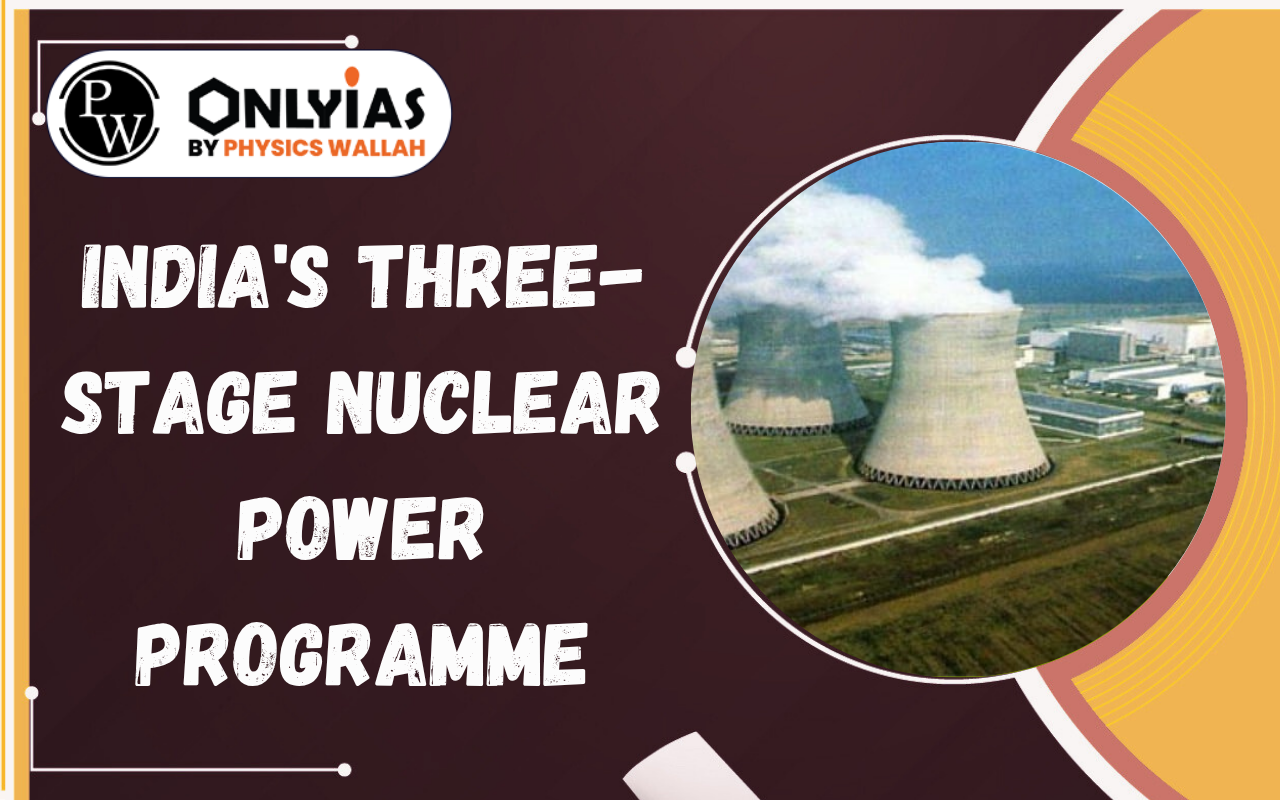
India’s Three-Stage Nuclear Power Programme is a long-term strategy developed by the Department of Atomic Energy under Homi Jehangir Bhabha to ensure energy security using limited uranium and abundant thorium.
It operates in three stages—PHWRs producing Plutonium, fast breeder reactors generating more fuel, and Thorium-based reactors for sustainable energy. A major milestone was achieved when the 500 MWe PFBR Kalpakkam attained first criticality on 6 April 2026, marking India’s entry into Stage 2 of the programme.
This programme supports clean energy, reduces carbon emissions, and strengthens energy independence. With advancements by the Bhabha Atomic Research Centre and goals under Nuclear Energy Mission 2047, India aims to expand nuclear capacity while overcoming challenges like cost and technology barriers.
India’s Three-Stage Nuclear Power Programme is a long-term nuclear strategy developed by the Department of Atomic Energy under the leadership of Homi Jehangir Bhabha. It aims to utilize India’s limited uranium and vast thorium reserves efficiently.
This three-stage nuclear programme includes:
| Stage | Reactor Type | Fuel Used | Output |
| Stage 1 | Pressurized Heavy Water Reactor (PHWR) | Natural Uranium | Produces Plutonium |
| Stage 2 | Fast Breeder Reactor (FBR) | Plutonium + Uranium | Produces more fuel |
| Stage 3 | Advanced Reactors | Thorium | Sustainable energy |
This structure forms the backbone of the Indian nuclear energy programme and supports long-term energy independence.
India’s nuclear energy programme unfolds in three distinct stages. Each stage uses different fuels and reactor types. They are linked to progressively using India’s natural resources.
This is the first stage of the programme. PHWRs use natural uranium as fuel. They produce electricity. The spent fuel from these reactors contains plutonium. This plutonium is essential for the next stage. This stage forms the base of the nuclear fuel cycle India follows.
The second stage involves Fast Breeder Reactors (FBRs). These reactors use plutonium from Stage 1 as fuel. FBRs produce more fuel than they consume. They create new fissile material, primarily uranium-233, from thorium. This step is critical for moving towards a thorium-based fuel cycle. The Prototype Fast Breeder Reactor (PFBR Kalpakkam) is a major milestone here.
This final stage will use India’s vast thorium reserves. Thorium-based reactors will run on uranium-233, produced in Stage 2. This stage promises long-term energy security for India. These thorium-based reactors will ensure self-sufficiency in nuclear power.
The Bhabha Atomic Research Centre plays a major role in research and development.
Their innovations are essential for the success of the Bharat nuclear mission.
India is steadily increasing its nuclear energy capacity through multiple projects.
These steps align with the Nuclear Energy Mission 2047, aiming for energy independence.
India has strengthened its civil nuclear cooperation with several countries for technology and fuel supply.
Recent policy discussions like the SHANTI Act 2025 aim to boost private participation and innovation in nuclear energy.
India’s Three-Stage Nuclear Power Programme is crucial for achieving sustainable development.
This programme is a cornerstone of India’s transition toward green energy.
Despite its benefits, India’s Three-Stage Nuclear Power Programme faces several challenges:
However, continued innovation and policy support can overcome these barriers.
To accelerate this vision, the government launched the Bharat nuclear mission and enacted the SHANTI Act 2025 nuclear legislation. This act modernizes the legal framework, enabling private sector participation and strengthening civil nuclear cooperation in India.
Check Out UPSC CSE Books
Visit PW Store
With the integration of small modular reactors in India and the scaling of the Kalpakkam nuclear complex, the nuclear energy programme is set for exponential growth. The shift towards a thorium-based reactor model in India ensures that India’s Three-Stage Nuclear Power Programme remains the most viable path toward a carbon-free, energy-independent future.
India’s Three-Stage Nuclear Power Programme is a visionary approach to achieving energy security using indigenous resources. By efficiently utilizing uranium and thorium, India is building a sustainable and self-reliant nuclear future. With advancements in reactor technology and policy support, the programme will play a key role in India’s energy landscape.
UPSC Offline Centres List
City
UPSC Offline Centres
Pantna
UPSC Coaching in Patna
Delhi
UPSC Coaching in Delhi
Lucknow
UPSC Coaching in Lucknow
Indore
UPSC Coaching in Indore
Jaipur
UPSC Coaching in Jaipur
Chandigarh
UPSC Coaching in Chandigarh
Bengaluru
UPSC Coaching in Bengaluru
Muzaffarpur
UPSC Coaching in Muzaffarpur
Prayagraj
UPSC Coaching in Prayagraj
Explore UPSC Test Series

It is India's strategy to achieve energy independence. The programme uses its limited uranium and large thorium reserves for nuclear power generation.
India has limited uranium but vast thorium reserves. The programme allows India to use its thorium to fuel reactors in the long term.
The PFBR is a key part of Stage 2. It uses plutonium to produce electricity and create new fissile material (uranium-233) from thorium for the next stage.
The Nuclear Energy Mission 2047 aims to achieve 100 Gigawatts of nuclear power generation capacity by the year 2047.



Explore SRIJAN Prelims Crash Course


Connect with our experts to get free counselling & start preparing
Books
Udaan (Prelims Wallah)
Prahaar (Mains Wallah)
Q&A Bank (Prelims & Mains)
Budget & Economic Survey
NCERT Wallah
Marks Booster
हिंदी माध्यम विशेष शृंखला
 Current Affairs
Monthly Current Wallah
Subject Wise Current Affairs
Editorial Analysis
Editorial PDFs
News of The Day
Download Our App



Download Our App
<div class="new-fform">
</div>

 GS Foundation
 Optional Course
 Combo Courses
 Degree Program