Books

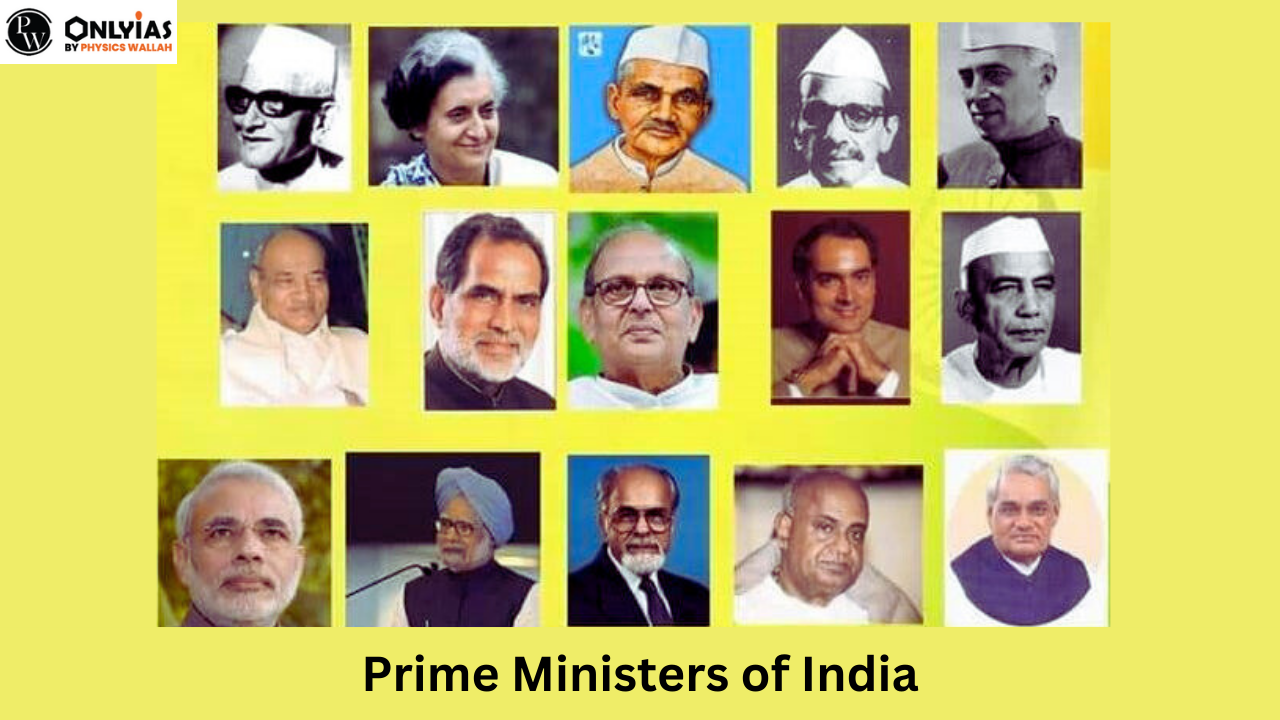
This article provides comprehensive information about the list of Prime Ministers of India since Independence. It covers details about Prime Ministers of India from 1947 to 2023, including their tenures and significant facts.
In India, the head of the state is the President, but their powers is mostly nominal and ceremonial. In India, the Prime Minister is the head of the government and is chosen by the President of India after the general elections. If the candidate nominated by a political party wins the general elections and gathers the most votes, that candidate becomes the Prime Minister of India.
Jawahar Lal Nehru, was the first Prime Minister of India in 1947. Presently, Narendra Damodardas Modi holds the position of Prime Minister of India. Refer to the table below for a chronological list of Prime Ministers of India from 1947 to 2023.
| Prime Minister of India from 1947 to 2023 | ||||
|---|---|---|---|---|
| S.No. | Prime Minister Name | Birth Date | Period | Interesting Facts |
| 1. | Jawahar Lal Nehru | (1889–1964) | 15 Aug 1947 to 27-May-1964 | The first and longest-serving Prime Minister of independent India. |
| 2. | Gulzarilal Nanda | (1898–1998) | 27 May 1964 to 9 June 1964 | After Nehru’s untimely demise, the nation’s first acting Prime Minister took charge.
|
| 3. | Lal Bahadur Shastri | (1904–1966) | 9 June 1964 to 11 January 1966 | During Indo-Pak war in 1965, he coined the iconic slogan “Jai Jawan Jai Kisan.”
|
| 4. | Gulzarilal Nanda | (1898-1998) | 11 January 1966, 24 January 1966 | Only man to have twice served as acting prime minister of India. |
| 5. | Indira Gandhi | (1917–1984) | 24 January 1966 to 24 March 1977 | India’s first woman Prime Minister of India.
She ordered Operation Blue Star, a military operation to remove Sikh separatists who had fortified the Golden Temple in Amritsar. |
| 6. | Morarji Desai | (1896–1995) | 24 March 1977 – 28 July 1979 | The first Prime Minister after the Emergency in 1977, he held office briefly before resigning despite being 81 years old. His unique birthdate on February 29 meant his birthday was celebrated every four years due to the leap year.
|
| 7. | Charan Singh | (1902–1987) | 28 July 1979 to 14 January 1980 | The only Prime Minister who has never spoken before the legislative body.
|
| 8. | Indira Gandhi | (1917–1984) | 14 Jan 1980 to 31 Oct 1984 | After the disaster in 1977, the initial Prime Minister reclaimed power in 1980. Like her father, she also passed away during her time in office.
|
| 9. | Rajiv Gandhi | (1944–1991) | 31 Oct 1984 to 2 Dec 1989 | India’s youngest Prime Minister at the age of 40. |
| 10. | V.P. Singh | (1931–2008) | 2 Dec 1989 to 10 Nov 1990 | The first Prime Minister to leave from office due to a vote of no-confidence.
|
| 11. | Chandra Shekhar | (1927–2007) | 10 Nov 1990 to 21 June 1991 | Never held a position of minister in any ministry. |
| 12. | P. V. Narasimha Rao | (1921–2004) | 21 June 1991 to 16 May 1996 | The 1991 economic reforms were brought under his tenure as the PM.
|
| 13. | Atal Bihari Vajpayee | (1924-2018) | 16 May 1996 to 1 June 1996 | The shortest tenure as an Indian Prime Minister is 16 days.
|
| 14. | H. D. Deve Gowda | (born 1933) | 1 June 1996 to 21 April 1997 | He succeeded as the second Prime Minister from South India and hailed from Karnataka. Despite his roots in Karnataka, he didn’t serve there for more than a year.
|
| 15. | Inder Kumar Gujral | (1919–2012) | 21 April 1997 to 19 March 1998 | After Indira Gandhi and Deve Gowda, the third Prime Minister to come from the Upper House of Parliament.
|
| 16. | Atal Bihari Vajpayee | (born 1924-2018) | 19 March 1998 to 22 May 2004 | First non-Congress Prime Minister of independent India to complete his entire term in office.
|
| 17. | Manmohan Singh | (born 1932) | 22 May 2004 to 26 May 2014 | First Prime Minister of India belonging to the minority community.
|
| 18. | Narendra Modi | (born 1950) | 2014-Present | Before Modi, three Prime Ministers had already served two or more terms. In 2019, he also joined this coveted list.
|
To be eligible to become the Prime Minister of India, a person needs to meet certain criteria :-
As Head of Council of Ministers:
In Relation to the President:
Parliamentary Role:
Role in International affairs:
Other Powers and Functions of PM:
Within the Indian Constitution, there are a few articles that deal with the relationship between the Prime Minister and the President. These articles are:
| Articles | Relationship between the Prime Minister and the President of India |
|---|---|
| Article 74 | Describes the relationship between the president and the council of ministers. The Prime Minister leading the council that offers counsel to the president on diverse subjects.
|
| Article 75 | Three key aspects are highlighted:
|
| Article 78 | The Prime Minister informs the President about the decisions made by the council of members. The President may also refer matters to the council of members for consideration.
|
Prime Minister of India Salary
The annual salary of the Prime Minister of India is 19,20,000 INR. So the monthly salary of Prime Minister of India will be 1,60,000 INR. The salary structure comprises a basic pay of Rs. 50,000, along with sumptuary and MP allowances of Rs. 6,000 and Rs. 3,000, respectively. Notably, there is a 30% reduction from the basic salary every month. This reduced amount is redirected to consolidated funds such as the Provident Fund (PF), pension, and insurance. This breakdown offers a comprehensive understanding of the Prime Minister’s salary in India.
| Longest-serving Prime Minister of India | Jawaharlal Nehru (1947 – 1964) |
|---|---|
| Second Longest-Serving Indian Prime Minister | Indira Gandhi |
| Serving twice as the acting Prime Minister | Gulzari Lal Nanda |
| The first female Prime Minister to be honored with the Bharat Ratna award.
|
Indira Gandhi |
| The first Prime Minister of India who did not belong to the Congress party
|
Morarji Desai |
| Indian Prime Minister received Pakistan’s highest civilian honor.
|
Morarji Desai |
| First Prime Minister from South India | P.V. Narasimha Rao |
| Youngest Prime Minister of India | Rajiv Gandhi |
| First Prime Minister of India who was a member of the Rajya Sabha | Indira Gandhi |

Jawaharlal Nehru is the longest-serving Prime Minister of India. He served as Prime Minister for a total of 16 years and 286 days.
The 15th Prime Minister of India is Narendra Modi.
Born on December 19, 1934, Pratibha Devisingh Patil is an Indian politician and lawyer who held the position of the 12th President of India from 2007 to 2012. Notably, she was the first woman to become the President of India.
Mamata Banerjee of West Bengal is the only female chief minister in India.
The head of the government in India is the Prime Minister. The Prime Minister is responsible for leading the executive branch of the government and overseeing the administration of the country.






Connect with our experts to get free counselling & start preparing
Books
Udaan (Prelims Wallah)
Prahaar (Mains Wallah)
Q&A Bank (Prelims & Mains)
Budget & Economic Survey
NCERT Wallah
Marks Booster
हिंदी माध्यम विशेष शृंखला
 Current Affairs
Monthly Current Wallah
Subject Wise Current Affairs
Editorial Analysis
Editorial PDFs
News of The Day
Download Our App



Download Our App
<div class="new-fform">
</div>



 GS Foundation
 Optional Course
 Combo Courses
 Degree Program