Udaan, Prahaar, Q&A Bank etc.
CA Magazines & Editorials
Agricultural Schemes in India aim to improve farmer income, crop insurance coverage, irrigation facilities, agricultural infrastructure, market access, organic farming, and digital agriculture. Important schemes such as PM-KISAN, PMFBY, PM-KMY, AIF, e-NAM, NFSM, and Soil Health Card Scheme are frequently relevant for UPSC Prelims and Mains under agriculture, rural development, and government policy topics.
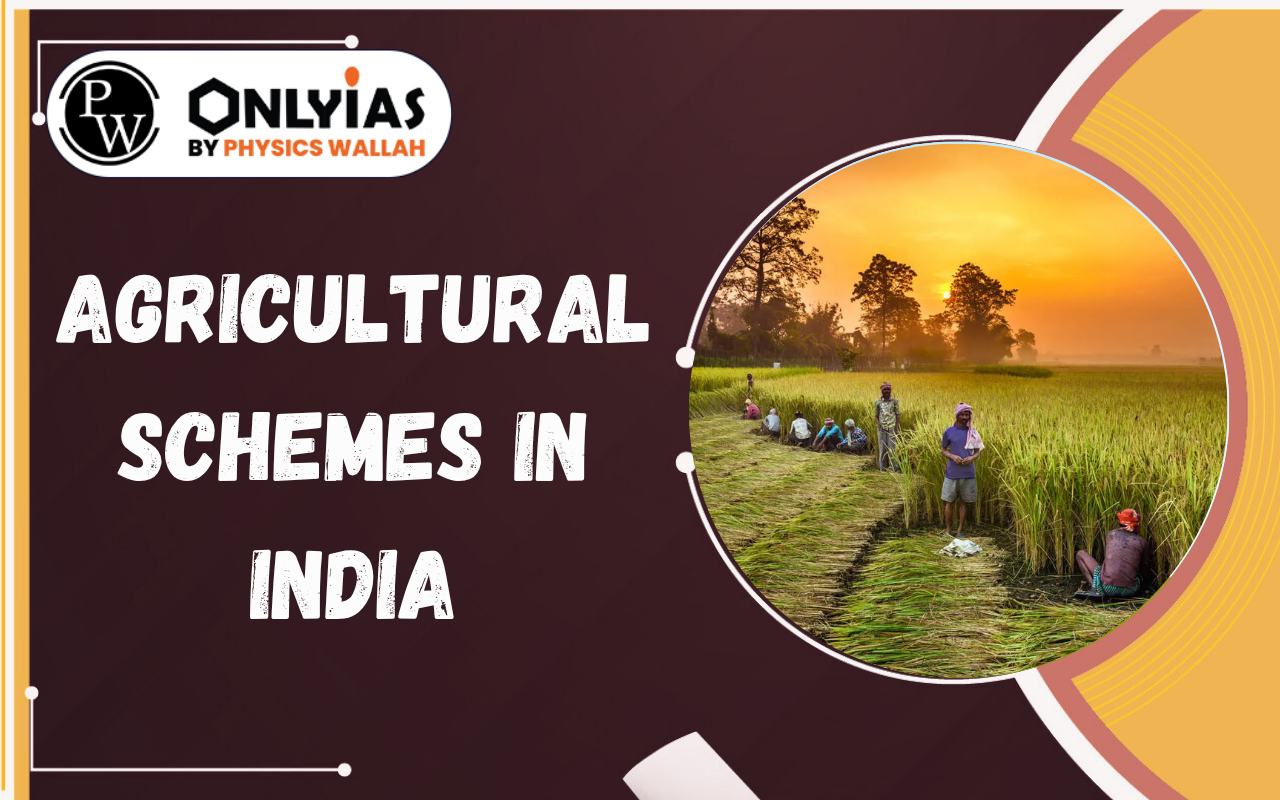
Agricultural Schemes in India reflect the government’s consistent effort to address the challenges faced by one of the country’s most critical sectors. Agriculture supports the livelihoods of a large share of India’s population, and the Government of India, through the Department of Agriculture and Farmers’ Welfare, has launched a wide range of schemes to improve farmer income, expand irrigation access, provide crop insurance, build agricultural infrastructure, and promote sustainable farming practices.
This topic of ‘Agricultural Schemes in India’ is important from the perspective of the UPSC IAS Examination, particularly under General Studies Paper II (Government Policies and Interventions) and General Studies Paper III (Agriculture and Economy).
The Department of Agriculture and Farmers’ Welfare runs the following major schemes for the welfare of farmers and for increasing their incomes:
Launch Year: 24th February 2019
Nodal Ministry: Ministry of Agriculture and Farmers’ Welfare
Objective:
Key Features:
Benefits:
Launch Year: 12th September 2019
Nodal Ministry: Ministry of Agriculture and Farmers’ Welfare
Objective:
Key Features:
Benefits:
Launch Year: 2016
Nodal Ministry: Ministry of Agriculture and Farmers’ Welfare
Objective:
Key Features:
Benefits:
Nodal Ministry: Ministry of Agriculture and Farmers’ Welfare / Ministry of Finance
Objective:
Key Features:
Benefits:
Explore UPSC Foundation Courses

Explore UPSC Foundation Courses

Launch Year: 2020 (under Aatmanirbhar Bharat Package)
Nodal Ministry: Ministry of Agriculture and Farmers’ Welfare
Objective:
Key Features:
Benefits:
Launch Year: 2020
Nodal Ministry: Ministry of Agriculture and Farmers’ Welfare
Objective:
Key Features:
Benefits:
Launch Year: 2020 (under Atma Nirbhar Bharat Abhiyan)
Nodal Ministry: Ministry of Agriculture and Farmers’ Welfare
Objective:
Key Features:
Benefits:
Launch Year: Long-standing scheme; operational under current Ministry framework
Nodal Ministry: Ministry of Agriculture and Farmers’ Welfare
Objective:
Key Features:
Benefits:
Launch Year: 2024-25 (approved by Government recently)
Nodal Ministry: Ministry of Agriculture and Farmers’ Welfare / Ministry of Rural Development
Objective:
Key Features:
Benefits:
Launch Year: 2007 (restructured subsequently)
Nodal Ministry: Ministry of Agriculture and Farmers’ Welfare
Objective:
Key Features:
Benefits:
Launch Year: 2015
Nodal Ministry: Ministry of Agriculture and Farmers’ Welfare
Objective:
Key Features:
Benefits:
Launch Year: 2014-15
Nodal Ministry: Ministry of Agriculture and Farmers’ Welfare
Objective:
Key Features:
Benefits:
Explore Prarambh Course

Explore Prarambh Course

Launch Year: 2015-16
Nodal Ministry: Ministry of Jal Shakti / Ministry of Agriculture and Farmers’ Welfare
Objective:
Key Features:
Benefits:
Launch Year: 2018-19 (corpus created with NABARD)
Nodal Ministry: Ministry of Agriculture and Farmers’ Welfare / Ministry of Jal Shakti
Objective:
Key Features:
Benefits:
Launch Year: 2015
Nodal Ministry: Ministry of Agriculture and Farmers’ Welfare
Objective:
Key Features:
Benefits:
Launch Year: April 2014
Nodal Ministry: Ministry of Agriculture and Farmers’ Welfare
Objective:
Key Features:
Benefits:
Launch Year: 2018-19
Nodal Ministry: Ministry of Agriculture and Farmers’ Welfare
Objective:
Key Features:
Benefits:
Launch Year: Conceived under National Agro-forestry Policy 2014; restructured under RKVY
Nodal Ministry: Ministry of Agriculture and Farmers’ Welfare
Objective:
Key Features:
Benefits:
Launch Year: 2007
Nodal Ministry: Ministry of Agriculture and Farmers’ Welfare
Objective:
Key Features:
Benefits:
Launch Year: Operational under Krishonnati Yojana framework
Nodal Ministry: Ministry of Agriculture and Farmers’ Welfare
Objective:
Key Features:
Benefits:
Explore UPSC Optional Courses

Explore UPSC Optional Courses

Launch Year: 2021
Nodal Ministry: Ministry of Agriculture and Farmers’ Welfare
Objective:
Key Features:
Benefits:
Launch Year: 2014-15
Nodal Ministry: Ministry of Agriculture and Farmers’ Welfare
Objective:
Key Features:
Benefits:
Launch Year: Restructured under current scheme framework
Nodal Ministry: Ministry of Agriculture and Farmers’ Welfare
Objective:
Key Features:
Benefits:
Launch Year: ISAM operational under Krishonnati Yojana; e-NAM integrated in 2017-18
Nodal Ministry: Ministry of Agriculture and Farmers’ Welfare
Objective:
Key Features:
Benefits:
Launch Year: 2015-16
Nodal Ministry: Ministry of Agriculture and Farmers’ Welfare
Objective:
Key Features:
Benefits:
Launch Year: Operational under Krishonnati Yojana framework
Nodal Ministry: Ministry of Agriculture and Farmers’ Welfare
Objective:
Key Features:
Benefits:
Launch Year: Ongoing under current Krishonnati Yojana framework
Nodal Ministry: Ministry of Agriculture and Farmers’ Welfare
Objective:
Key Features:
Benefits:
Agricultural Schemes in India cover a wide spectrum, from direct income support through PM-KISAN and pension security through PM-KMY, to crop insurance via PMFBY, infrastructure development through AIF, organic farming promotion under PKVY, and digital transformation through the Digital Agriculture initiative.
For UPSC aspirants, understanding not just the features but also the achievements, limitations, and policy context of these schemes is essential for both Prelims factual recall and Mains analytical answers under GS Paper 2 and GS Paper 3.
Check Out UPSC CSE Books
Visit PW Store
PM-KISAN provides financial assistance of ₹6,000 per year to eligible farmer families through Direct Benefit Transfer (DBT) in three installments.
PMFBY provides crop insurance coverage against natural calamities, pests, diseases, and post-harvest losses to protect farmers from financial risks.
The Soil Health Card Scheme helps farmers understand the nutrient status of their soil and recommends appropriate fertilizer use to improve productivity and soil health.
e-NAM (National Agriculture Market) is an online trading platform that connects APMC mandis across India to provide transparent price discovery and better market access for farmers.
Agricultural Schemes are important for UPSC because they are frequently asked in Prelims and Mains under topics related to agriculture, rural development, government policies, food security, and farmer welfare.






Connect with our experts to get free counselling & start preparing
Join India’s trusted platform for expert guidance, quality content, proven success.
Learn anytime, anywhere.



India's leading UPSC coaching platform helping aspirants prepare for IAS, IPS, IFS and other Civil Services examinations with the best faculty and proven strategies.
<div class="new-fform">
</div>