Books

Atal Bihari Vajpayee was a prominent Indian statesman, three-time Prime Minister, and Bharat Ratna recipient. His career spanned over four decades, marking him as a skilled parliamentarian, orator, and diplomat. He shaped India's post-independence domestic and foreign policy with significant contributions in infrastructure, social schemes, and international relations.
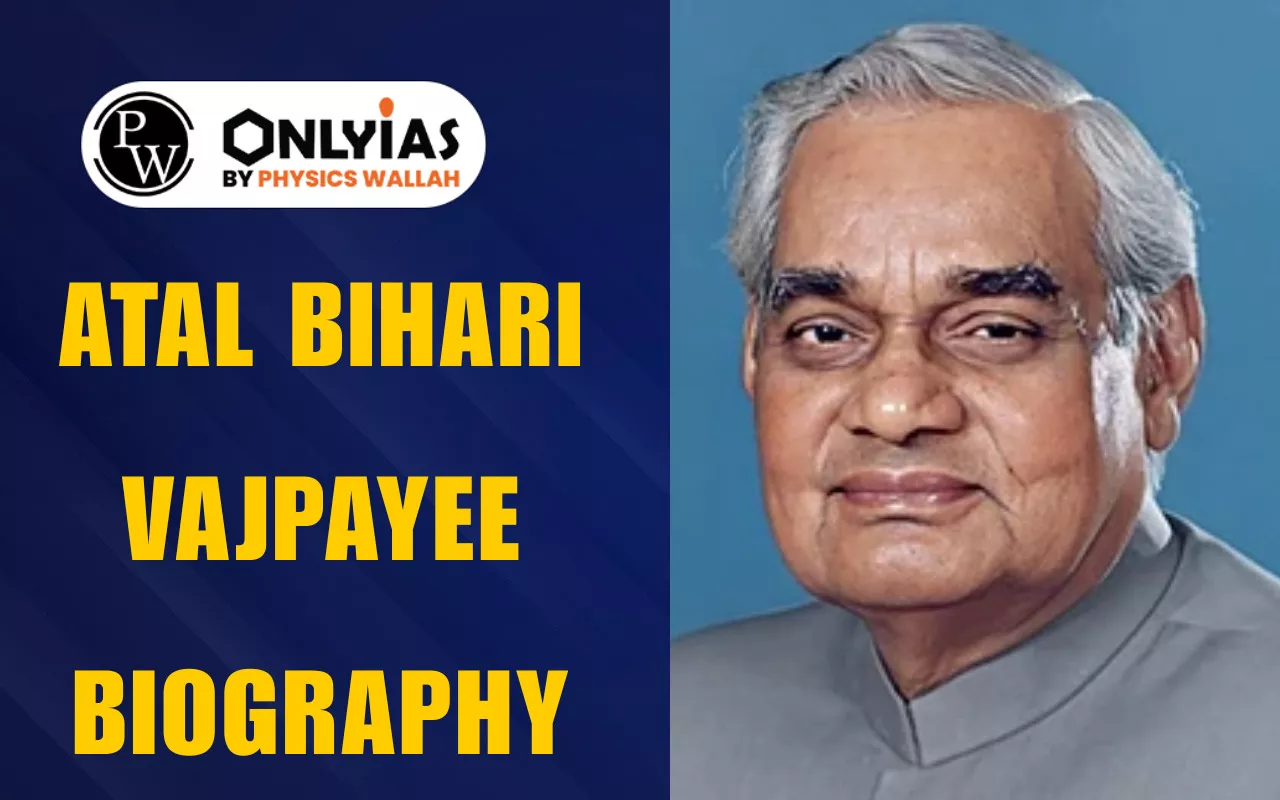
Atal Bihari Vajpayee was one of India’s most respected leaders. He served as the Prime Minister of India three times and was a central figure in the Bharatiya Janata Party (BJP). He was known for his calm nature, powerful speeches, and strong democratic values. A poet at heart and a politician by duty, Vajpayee shaped modern India through vision, dialogue, and decisive leadership. His life journey inspires students, civil service aspirants, and citizens alike.
Atal Bihari Vajpayee’s birth anniversary is celebrated every year on 25 December. His birth anniversary is observed annually to honor his legacy of leadership, statesmanship, and public service. On the 101st birth anniversary, Prime Minister Shri Narendra Modi visited Lucknow, Uttar Pradesh, to pay tribute and inaugurate the Rashtra Prerna Sthal, a memorial dedicated to Vajpayee’s life and ideals. The site features 65-foot bronze statues and a modern museum celebrating the contributions of national leaders, reflecting Vajpayee’s enduring impact on the nation.
Born in 1924, Vajpayee belonged to a generation that witnessed colonial rule, the freedom movement, and the birth of independent India. His birth anniversary is remembered not just to honor a former Prime Minister, but to reflect on values like integrity, dialogue, and democratic spirit.
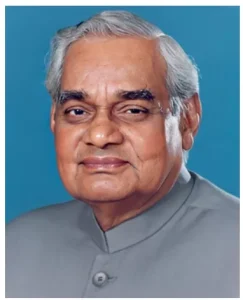
Atal Bihari Vajpayee was an Indian politician, poet, and statesman. He served as the Prime Minister of India three times, including a full five-year term from 1999 to 2004. He was one of the founding leaders of the Bharatiya Janata Party (BJP).
Vajpayee was admired across party lines. Even his political opponents respected his honesty and oratory skills. He received India’s highest civilian honor, the Bharat Ratna. His political career spanned over 40 years, making him a veteran parliamentarian.
Apart from politics, he loved literature and poetry. His Hindi poems reflect nationalism, human emotions, and hope. For many Indians, Vajpayee symbolized mature leadership and democratic values during a time of coalition politics.
Atal Bihari Vajpayee was born on 25 December 1924 in Gwalior, Madhya Pradesh. His father, Krishna Bihari Vajpayee, was a school teacher and poet. Vajpayee grew up in an environment that valued education and culture.
He completed his graduation from Victoria College, Gwalior, and later earned a Master’s degree in Political Science from DAV College, Kanpur. During his student days, he was influenced by nationalist ideas. He joined the Rashtriya Swayamsevak Sangh (RSS) at a young age.
He also worked as a journalist for Hindi publications like Rashtradharma and Panchjanya. Vajpayee never married and dedicated his entire life to public service. He lived a simple life, away from luxury. Here is a brief overview of his biography:
Atal Bihari Vajpayee was born into a middle-class Brahmin family.
Atal Bihari Vajpayee never married and devoted his life to public service.
Vajpayee served as Prime Minister of India on three occasions:
He led the National Democratic Alliance (NDA) government for his second and third terms. He was the first Prime Minister since Jawaharlal Nehru to have two successive mandates
His tenure as Prime Minister saw significant policy initiatives:
Check Out UPSC CSE Books
Visit PW Store
Vajpayee received several honors for his public service.
Atal Bihari Vajpayee passed away on 16 August 2018 at the age of 93. He had been suffering from health issues for several years. His death marked the end of an era in Indian politics. The nation mourned his loss deeply. Leaders from all parties paid tribute to him. He was given a state funeral with full honors. Vajpayee was remembered not just as a Prime Minister, but as a statesman who rose above politics.
Ready to boost your UPSC 2026 preparation? Join PW’s UPSC online courses today!

Atal Bihari Vajpayee was born in Gwalior city on 25 December 1924.
Atal Bihari Vajpayee was born in Madhya Pradesh.
He served as Prime Minister of India three times.
The National Highways Development Project, including the Golden Quadrilateral, was a major project.
He received the Bharat Ratna, India's highest civilian honor, in 2015.
He passed away on August 16, 2018.






Connect with our experts to get free counselling & start preparing
Books
Udaan (Prelims Wallah)
Prahaar (Mains Wallah)
Q&A Bank (Prelims & Mains)
Budget & Economic Survey
NCERT Wallah
Marks Booster
हिंदी माध्यम विशेष शृंखला
 Current Affairs
Monthly Current Wallah
Subject Wise Current Affairs
Editorial Analysis
Editorial PDFs
News of The Day
Download Our App



Download Our App
<div class="new-fform">
</div>



 GS Foundation
 Optional Course
 Combo Courses
 Degree Program