A significant scientific breakthrough has been made by researchers at the Jawaharlal Nehru Centre for Advanced Scientific Research (JNCASR), where they discovered a new form of magnetism in neodymium nitride (NdN).
What is Rare-earth magnetism?
- Rare-earth magnetism refers to the magnetic properties exhibited by rare-earth elements, particularly those from the lanthanide series like neodymium (Nd), samarium (Sm), and dysprosium (Dy), which are used to create high-strength permanent magnets.
Traditional spin-based magnetism
- It refers to the phenomenon where magnetic properties of materials arise due to the spins of electrons within atoms or molecules.
|
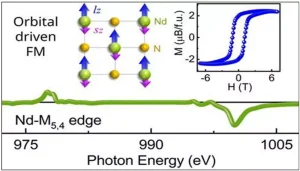
About the Discovery of Orbital-Driven Magnetism
- New Magnetic Behavior in NdN: Researchers found that single-crystal thin films of NdN exhibit ferromagnetism driven by the electron’s orbital angular momentum, rather than the electron spin, which governs traditional magnetism.
- This orbital-driven magnetism represents a paradigm shift in the understanding of magnetic properties in rare-earth materials, diverging from conventional theories based on electron spin.
- Significance in Quantum Technologies: The study opens doors to the emerging field of orbitronics, which seeks to leverage the orbital motion of electrons for next-generation quantum and magnetic devices.
About Orbitronics
- Orbitronics is an emerging field of spintronics that exploits the orbital angular momentum of electrons in addition to their spin to store, process, and manipulate information in electronic devices.
- Orbitronics is expected to provide greater efficiency in energy consumption, higher data storage capacity, and faster processing speeds compared to traditional spintronics or classical electronics.
Applications
- Quantum Computing: Orbitronics can be used to develop quantum bits (qubits) that leverage both the spin and orbital properties of electrons for advanced quantum computing systems.
- Data Storage and Processing: Orbitronic-based devices can potentially revolutionize hard drives and memory devices by offering more compact and faster storage solutions.
- Magnetic Devices: Orbitronics holds potential for creating more efficient magnetic sensors and memory devices by utilizing both spin and orbital degrees of freedom.
|
About Neodymium
- Neodymium (Nd) is a chemical element in the lanthanide series of the periodic table, symbolized as Nd with atomic number 60.
- Physical Properties:
- Neodymium is a rare-earth metal characterized by its silvery-white appearance.
- It is relatively soft, malleable, and has a high melting point of about 1,024°C.
- Magnetism:
- Neodymium is most renowned for its role in creating high-strength permanent magnets, known as Neodymium-Iron-Boron (NdFeB) magnets.
- These magnets are among the strongest commercially available, with applications in electric motors, wind turbines, and hard drives.
- Occurrence:
- Neodymium is found in various minerals, notably in monazite and bastnäsite, which are typically extracted through mining.
- However, neodymium is rarely found in isolation and is often extracted along with other rare-earth elements.
- Applications:
- High-performance magnets: NdFeB magnets are used in electronics, computers, mobile devices, and clean energy technologies like electric vehicles (EVs) and wind turbines.
- Laser technology: Neodymium is used in neodymium-doped lasers (Nd:YAG), employed in medical treatments, material processing, and defense applications.
Implications for Future Technologies
- Designing Orbitronic Devices: The discovery of orbital-driven magnetism could lead to the development of materials with strong orbital contributions, essential for future orbitronic devices.
- Advancing Quantum and Magnetic Technologies: By tuning both spin and orbital moments, researchers can design more efficient quantum and magnetic devices, which could overcome the limitations of existing spin-based information and memory technologies.
- Boosting Efficiency in Quantum Devices: This discovery may help develop faster, more energy-efficient technologies in the fields of quantum computing, spintronics, and data storage.


 20 Nov 2025






.png)






 Current Affairs




 GS Foundation
 Optional Course
 Combo Courses
 Degree Program