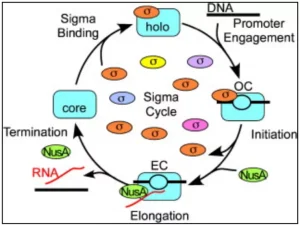
“Sigma Cycle”

22 Nov 2025

“Sigma Cycle”

A new India–US study challenges the long-accepted “sigma cycle” model of bacterial transcription by showing that sigma factors can remain attached throughout transcription.
Key Findings of the Research

  • Continuous Sigma Attachment: Researchers found that the principal sigma factor σA in Bacillus subtilis remains attached to RNA polymerase during the entire transcription process.
  • Evidence Against Universal Sigma Cycle: A modified E. coli σ70 similarly stayed bound, indicating that sigma release after initiation is not a universal rule.
  • Advanced Tracking Techniques: The team used biochemical assays, chromatin immunoprecipitation and fluorescence imaging to monitor sigma factor behaviour in real time.
  • Revised Understanding of Gene Regulation: The findings show that different bacteria use distinct transcription mechanisms, reshaping textbook explanations of bacterial gene regulation.

About the “Sigma Cycle”

Sigma Cycle

  • The sigma cycle describes how sigma (σ) factors bind RNA polymerase (RNAP) to initiate transcription and then detach after RNA synthesis begins.
  • Sigma factors are subunits of bacterial RNA polymerase (RNAP) that are essential for recognizing promoter DNA sequences and initiating transcription. 
  • They bind to the core RNAP to form a holoenzyme, which then directs the polymerase to the correct start sites of genes
  • Role of Sigma Factor
    • Competition for RNAP: Multiple sigma factors compete to bind the RNAP core, determining which gene sets will be transcribed.
    • Promoter Specificity: Sigma factor type dictates promoter recognition, enabling environmental or stress-specific gene expression responses.
    • Initiation and Release: Only the holoenzyme (RNAP + sigma) initiates transcription, after which sigma typically releases once the RNA chain reaches 8–9 nucleotides.
    • Reprogramming and Regulation: Sigma release allows new sigma factors to bind, with anti-sigma factors further regulating access and transcription timing.

Check Out UPSC CSE Books

Visit PW Store

online store 1

Potential Applications of the Findings

  • The discovery may enable new antibiotic strategies targeting previously unknown transcription mechanisms.
  • The findings can support synthetic biology innovations by engineering bacteria with altered transcriptional control.
  • The results may improve understanding of bacterial evolution and stress responses.

Significance

  • The study fundamentally revises a five-decade biological model, offering deeper insight into bacterial gene regulation across species.

Enroll in SRIJAN Prelims Crash Course

Need help preparing for UPSC or State PSCs?

Connect with our experts to get free counselling & start preparing

Aiming for UPSC?

Download Our App

      
Quick Revise Now !
AVAILABLE FOR DOWNLOAD SOON
UDAAN PRELIMS WALLAH
Comprehensive coverage with a concise format
Integration of PYQ within the booklet
Designed as per recent trends of Prelims questions
हिंदी में भी उपलब्ध
Quick Revise Now !
UDAAN PRELIMS WALLAH
Comprehensive coverage with a concise format
Integration of PYQ within the booklet
Designed as per recent trends of Prelims questions
हिंदी में भी उपलब्ध

<div class="new-fform">


    </div>

    Subscribe our Newsletter
    Sign up now for our exclusive newsletter and be the first to know about our latest Initiatives, Quality Content, and much more.
    *Promise! We won't spam you.
    Yes! I want to Subscribe.