The World Health Organization (WHO) has released its first-ever global guideline on the prevention, diagnosis, and treatment of infertility, calling for safer, fairer, and more affordable fertility care worldwide.
What is Infertility?
- WHO defines infertility as the failure to achieve pregnancy after 12 months or more of regular, unprotected sexual intercourse.
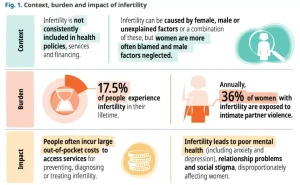
- Prevalence of Infertility: 1 in 6 people of reproductive age experience infertility at some point in their lives
- High Financial Burden: Infertility treatments, such as in vitro fertilization (IVF), are often out-of-pocket expenses, sometimes costing double the average annual household income.
|
Key Features of WHO Guidelines
- Comprehensive Framework: The guidelines include 40 recommendations aimed at strengthening infertility care across prevention, diagnosis, and treatment stages.
- Health Promotion: WHO advocates for lifestyle interventions, such as healthy diet, physical activity, and tobacco cessation, as preventive measures for infertility.
- Fertility Education: The guideline stresses the importance of educating individuals about fertility and infertility early, to assist in reproductive planning.
- Male Infertility Focus: WHO stresses the under-investigation of male infertility and calls for comprehensive diagnostic approaches. Initial management should include advice before progressing to active treatments.
- Stepwise Approach: The guidelines provide a stepwise clinical management approach ranging from basic advice on fertility periods and promotion to complex treatments like intrauterine insemination (IUI) and IVF.
- Holistic Care: The guidelines call for psychosocial support alongside medical treatments, addressing the emotional toll of infertility, which can lead to depression, anxiety, and social isolation.
- Increased Investment in Prevention: A key recommendation is to invest more in preventive measures, such as addressing sexually transmitted infections (STIs) and smoking—two leading causes of infertility.
- Integration into Health Systems: The WHO calls for fertility care to be integrated into national health strategies, services, and funding, ensuring broader access to fertility-related health services.
- Contextual Implementation: WHO encourages countries to adapt the guidelines to local contexts, ensuring they align with comprehensive, rights-based approaches to sexual and reproductive health.
India’s Fertility Trends
- Declining Fertility Rate: India’s Total Fertility Rate (TFR) has decreased from 6.18 in the 1950s to 1.9 in 2021, which is below the replacement fertility level of 2.1.
- Projected Future Decline: The Global Burden of Diseases (GBD) 2021 study forecasts India’s TFR could fall to 1.04 by 2100, indicating an even steeper decline.
- Total Fertility Rate (TFR): TFR refers to the average number of children a woman is expected to bear during her reproductive years (usually 15–49 years) under current fertility patterns, and without accounting for mortality. It is expressed as children per woman.
- National Family Health Survey (NFHS-5) (2019-21): According to NFHS-5, India’s TFR has decreased to 2.0 children per woman, down from 2.2 children per woman in NFHS-4 (2015-16).
- Replacement Level: A TFR of 2.1 children per woman is considered the replacement level, which is necessary to maintain a stable population (considering mortality rates).
- If the TFR falls below 2.1, it can result in negative population growth.
|


 29 Nov 2025






.png)






 Current Affairs




 GS Foundation
 Optional Course
 Combo Courses
 Degree Program