Udaan, Prahaar, Q&A Bank etc.
CA Magazines & Editorials
Classical Music in India originated from Vedic traditions and evolved into Hindustani and Carnatic systems. Key concepts include Raga and Tala. Important topics include Dhrupad, Khayal, Thumri, Carnatic Trinity, gharanas, instruments, musicians, cultural significance, and UPSC PYQs.
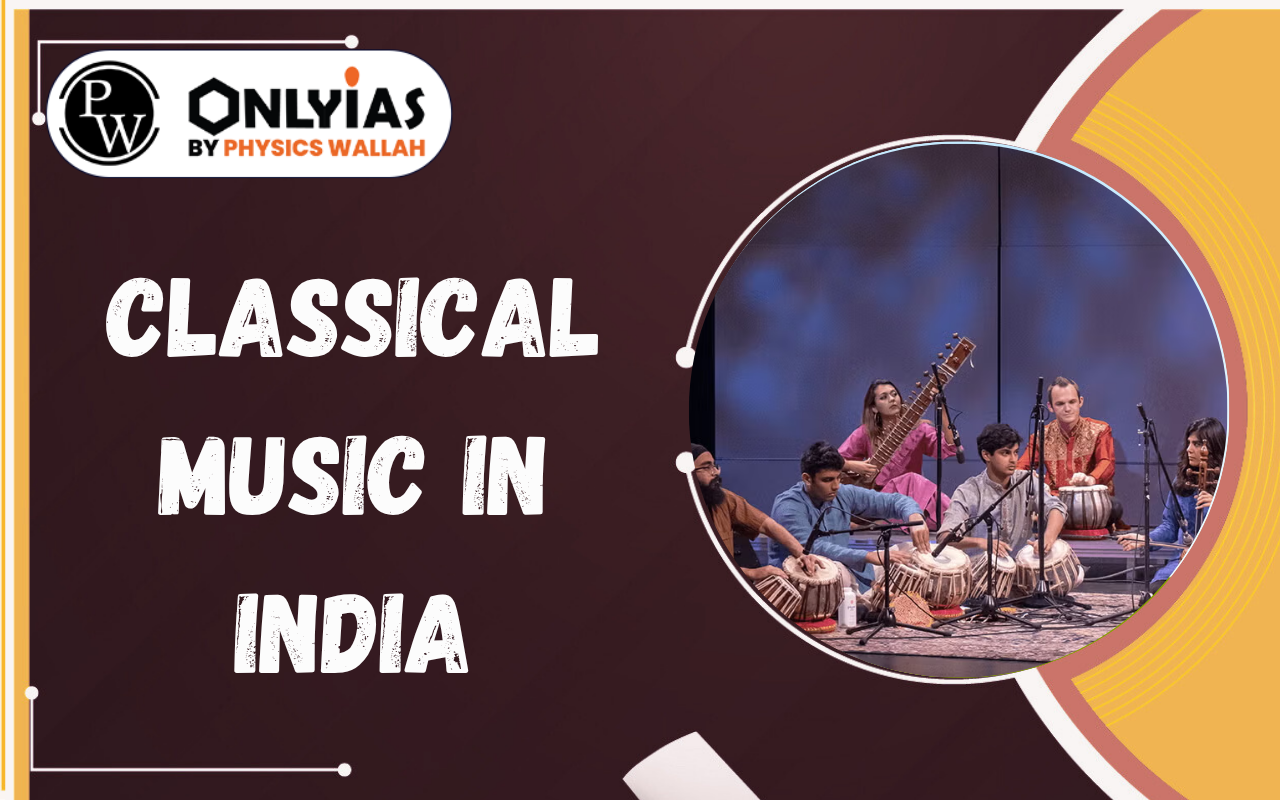
India possesses one of the oldest and richest musical traditions in the world. Classical Music in India has evolved over several centuries through the contributions of sages, scholars, composers, and musicians.
It forms an important part of the country’s cultural and spiritual life. The two major traditions of Classical Music in India are Hindustani music and Carnatic music, both of which share a common origin but have developed differently over time.
This topic of ‘Classical Music in India’ is important from the perspective of the UPSC IAS Examination, particularly under General Studies Paper I (Indian Heritage and Culture), Art and Culture, and UPSC Prelims.
Classical Music in India refers to the highly developed musical tradition based on established principles of melody, rhythm, and performance. It is rooted in ancient scriptures, cultural practices, and spiritual traditions.
Indian music developed from Vedic chants and gradually evolved into a structured art form. It has always maintained a close connection with religion, philosophy, and society. Music is considered a medium for expressing emotions and attaining spiritual harmony.
Indian Classical Music is one of the world’s oldest surviving musical traditions. Its roots can be traced to the Vedic period. Over time, music evolved through contributions from ancient texts, saints, scholars, and royal patrons.
| Period / Timeline | Major Developments | Key Sources / Personalities | Significance |
| Vedic Period (1500 BCE–500 BCE) | Origin of music from Vedic chanting | Sama Veda | Foundation of Indian music |
| Ancient Period (500 BCE–200 CE) | Development of Swara, Shruti, Grama, and Rasa concepts | Vedas, Upanishads, Puranas | Established theoretical foundations |
| 2nd Century CE | Codification of music and performing arts | Bharata Muni – Natyashastra | Classification of instruments and 22 Shrutis |
| 1st–7th Century CE | Growth of regional traditions and early ragas | Silappadikaram, Kudumiyamalai Inscriptions | Development of South Indian music |
| 7th–13th Century CE | Expansion of musicological literature | Matanga, Narada | Strengthened music theory |
| 13th Century CE | Compilation of Sangita Ratnakara | Sharngadeva | Last major treatise before division |
| 13th–14th Century CE | Division into two streams | Hindustani and Carnatic traditions | Separate northern and southern systems emerged |
| Medieval Period | Persian influence in North India | Muslim courts and Hindu kingdoms | Distinct evolution of music systems |
| Bhakti Movement | Devotional compositions in regional languages | Purandaradasa, Mirabai, Kabir, Surdas | Popularized music among people |
| 16th–17th Century | Classification of ragas and melas | Ramamatya, Venkatamakhi | Foundation of the Melakarta system |
| 18th Century | Growth of ragas, talas, and compositions | Musical Trinity | Golden age of Carnatic music |
| 18th–19th Century | Growth of vocal forms and gharanas | Bhatkhande and major gharanas | Standardization of Hindustani music |
The Classical Music in India that we see today is the result of this long historical development.
Classical Music in India is broadly divided into two major traditions. Both originated from the same ancient heritage but evolved differently after the medieval period.
| Branch | Region | Key Features | Major Forms |
| Hindustani Classical Music | North India | Improvisation, melodic expansion, emphasis on swara | Dhrupad, Khayal, Thumri, Tarana |
| Carnatic Music | South India | Structured compositions, purity of notes, and devotional focus | Kriti, Kirtanam, Jawali, Tillana |
Both traditions are based on the concepts of Raga and Tala, which form the foundation of Indian music.
The two systems differ in style, language, and presentation while sharing the same roots.
| Feature | Hindustani Classical Music | Carnatic Classical Music |
| Region | North India | South India |
| Origin | Indian, Persian, and Central Asian influences | Ancient Indian traditions |
| Language | Hindi, Urdu, Braj, Sanskrit | Telugu, Tamil, Kannada, Sanskrit |
| Main Focus | Improvisation and expansion of ragas | Structured compositions |
| Major Vocal Forms | Dhrupad, Khayal, Thumri, Tarana | Kriti, Varnam, Tillana, Kirtanam |
| Instruments | Sitar, Sarod, Tabla, Santoor | Veena, Violin, Mridangam, Nadaswaram |
| Music Schools | Gharanas | Guru-Shishya and Bani traditions |
| Performance Style | Flexible | Structured |
Hindustani Classical Music developed mainly in North India. It evolved under the influence of Indian, Persian, and Central Asian traditions. Its most important feature is improvisation. Musicians expand and develop ragas during performance. Melody receives greater emphasis than lyrics.
| Major Vocal Forms of Hindustani Music | |
| Form | Features |
| Dhrupad | Oldest vocal form, devotional and spiritual in nature |
| Khayal | The most popular form allows greater improvisation |
| Thumri | Expressive and romantic style with emotional appeal |
| Tappa | Fast-paced compositions with intricate patterns |
| Tarana | Uses syllables and rhythmic patterns instead of meaningful words |
The Gharanas of Hindustani Music represent different styles of musical training and performance.
| Gharana | Founder/Associated Artists | Features |
| Gwalior | Naththan Khan, Haddu Khan | Oldest Khayal tradition |
| Kirana | Abdul Karim Khan | Emphasis on swara purity |
| Agra | Ghagge Khuda Baksh | Strong voice production and rhythm |
| Jaipur-Atrauli | Alladiya Khan | Complex ragas and compositions |
| Patiala | Ali Baksh and Fateh Ali | Ornamentation and flexibility |
Carnatic Music is the classical music tradition of South India. It remained closer to ancient Indian musical practices and devotional traditions.
The Carnatic Music Tradition gives equal importance to melody and lyrics. Performances are generally composition-based with structured improvisation.
A major feature of this system is the use of devotional songs known as Carnatic Compositions. Most compositions are dedicated to Hindu deities and spiritual themes.
The Trinity of Carnatic Music played a major role in shaping modern Carnatic music.
| Musician | Contribution |
| Tyagaraja | Composed hundreds of kritis and enriched many ragas |
| Muthuswami Dikshitar | Composed scholarly Sanskrit compositions |
| Syama Sastri | Known for devotional compositions and rhythmic excellence |
Indian Musical Instruments are broadly classified into string, percussion, and wind instruments.
| Instrument | Category | Associated Tradition |
| Sitar | String | Hindustani |
| Sarod | String | Hindustani |
| Veena | String | Carnatic |
| Violin | String | Carnatic |
| Tabla | Percussion | Hindustani |
| Mridangam | Percussion | Carnatic |
| Flute | Wind | Both |
Several Famous Classical Musicians have contributed significantly to Indian music. Some notable names include:
Classical music represents an important component of global intangible cultural heritage. UNESCO launched the UNESCO Collection of Traditional Music of the World in 1961 to document and preserve traditional music from different countries.
The collection includes recordings from more than 70 countries, including the Anthology of North Indian Classical Music. This initiative helps preserve valuable musical traditions for future generations.
Classical Music in India continues to play an important role in society and culture. Major significance includes:
Q. The Sufi saint who maintained that devotional music was one way of coming close to God was (2021)
(a) Muin-ud-din Chishti
(b) Baba Farid
(c) Saiyid Mohammad Gesudaraz
(d) Shah Alam Bukhari
Q. With reference to the cultural history of India, consider the following statements: (2018)
Which of the statements given above are correct?
(a) 1 and 3 only
(b) 2 and 4 only
(c) 1, 2 and 3
(d) 2, 3 and 4
Answer: (b) 2 and 4 only
Q. With reference to Dhrupad, one of the major traditions of India that has been kept alive for centuries, which of the following statements are correct? (2012)
Select the correct answer using the codes given below:
Select an option to attempt
Classical Music in India reflects the country’s long cultural journey and artistic excellence. From Vedic chants to modern concert performances, it has evolved while preserving its spiritual and cultural roots. Hindustani and Carnatic traditions together represent the richness of India’s musical heritage. For UPSC aspirants, this topic remains highly important because it connects history, culture, philosophy, and performing arts in a comprehensive manner.
Check Out UPSC CSE Books
Visit PW Store
Hindustani Classical Music and Carnatic Music are the two major branches of Indian classical music.
Hindustani music emphasizes improvisation, while Carnatic music focuses more on structured compositions.
Tyagaraja, Muthuswami Dikshitar, and Syama Sastri are known as the Trinity of Carnatic Music.
Dhrupad, Khayal, Thumri, Tappa, and Tarana are the major vocal forms of Hindustani music.
It is an important topic under Indian Heritage and Culture in UPSC Prelims and GS Paper I of the Mains examination.


Connect with our experts to get free counselling & start preparing
Join India’s trusted platform for expert guidance, quality content, proven success.
Learn anytime, anywhere.



India's leading UPSC coaching platform helping aspirants prepare for IAS, IPS, IFS and other Civil Services examinations with the best faculty and proven strategies.
<div class="new-fform">
</div>