16th Finance Commission: Balancing Equity, Efficiency and Fiscal Federalism

12 Feb 2026

English

हिन्दी

16th Finance Commission: Balancing Equity, Efficiency and Fiscal Federalism

The Union Government has accepted 16th Finance Commission recommendations on the devolution of funds from the Centre to the States 2026–31.

About 16th Finance Commission

  • The 16th Finance Commission was constituted by the President of India under Article 280 of the Constitution of India
  • Tenure:
    • The 16th Finance Commission was constituted on 31 December 2023.
    • Period: It is responsible for recommending the distribution of financial resources for the five‑year award period from 1 April 2026 to 31 March 2031.
  • Nature: Finance Commission recommendations are advisory in nature, but are conventionally accepted by the Union Government.
  • Chairman: Dr. Arvind Panagariya (Chairman) – former Vice‑Chairman of NITI Aayog and distinguished economist.
  • Members:
    • Smt. Annie George Mathew – Full‑time Member.
    • Dr. Manoj Panda – Full‑time Member.
    • Shri Ajay Narayan Jha – Full‑time Member.
    • Dr. Soumya Kanti Ghosh

The Divisible Pool refers to the net proceeds of taxes referred to in Article 270 that are shareable with States.

Constitutional Framework

  • Article 270: Divisible pool of net tax proceeds (income tax, corporation tax, CGST, Centre’s IGST share).
  • Exclusion: Cess and surcharge not part of divisible pool (≈81% of gross tax revenue in 2025–26).
  • Article 275: Grants-in-aid (revenue deficit, local bodies, disaster management).
  • Article 280: Mandates Finance Commission.

Concept of Devolution

  • Vertical Devolution refers to the share of the divisible pool distributed between the Union and the States.
  • Horizontal Devolution refers to the distribution of States’ share among individual States based on a formula determined by the Finance Commission.

Past Trends in Vertical Devolution

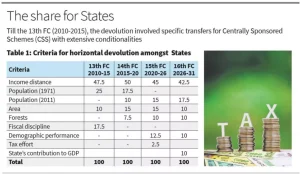
  • Before 14th FC: Till the 13th FC, States received specific transfers for Centrally Sponsored Schemes (CSS) with conditionalities, and the States’ share was fixed at 32%.
  • Increase under 14th FC: The 14th FC discontinued specific CSS transfers and raised States’ share to 42%.
  • Revision under 15th FC: The 15th FC reduced it slightly to 41% due to the reorganisation of Jammu and Kashmir into Union Territories.

States’ Key Demands Before the 16th FC

  • Higher Vertical Share: Many States (18) demanded raising the States’ share from 41% to 50%, while others sought an increase to 45–48%.
  • Inclusion of Cess and Surcharge: Many States demanded that cess and surcharge be included in the divisible pool or that a cap be imposed on their use.
  • Horizontal Devolution: Industrialised States such as Maharashtra, Gujarat, Tamil Nadu, Karnataka, and Telangana advocated inclusion of States’ contribution to GDP as a criterion.

16th FC Recommendations on Vertical Devolution

  • Retention at 41%: The Commission recommended maintaining the States’ share at the current level of 41%.
  • Rejection of Cess Inclusion: It held that under the constitutional scheme, inclusion of cess and surcharge in the divisible pool or fixing a cap is neither permissible nor desirable.
  • Rationale for Status Quo: The Commission cited three reasons:
    • States already receive a substantial share of total tax revenues.
    • Union spending through CSS ultimately reaches States.
    • Higher Union spending requirements on defence, infrastructure, and national priorities.

Horizontal Devolution

  • Guiding Principles: The FC followed two key principles
    • Changes in State shares should be gradual.
    • Efficiency and States’ contributions to growth should receive recognition
  • Equity Considerations: Traditional parameters such as income distance, population, and area continue to receive substantial weightage
  • New Criterion: A new criterion of State’s contribution to GDP has been introduced.

16th Finance Commission

Fiscal Impact on States

  • Marginal Southern Gain: Southern and western States witnessed a slight increase in their share.
  • Northern Share Dip: Large northern and central States saw marginal reductions.
  • Overall Outcome: The recommendations reflect broad status quo, while the overall fiscal transfers remain structurally similar to the 15th FC framework
  • State-wise Changes:
    • Andhra Pradesh: Increased to 4.217% from 4.047%.
    • Karnataka: Increased to 4.131% from 3.647%.
    • Kerala: Increased to 2.382% from 1.925%.
    • Tamil Nadu: Increased to 4.097% from 4.079%.
    • Telangana: Increased to 2.174% from 2.102%.
    • Uttar Pradesh: Reduced to 17.619% from 17.939%.
    • Bihar: Reduced to 9.948% from 10.058%.

Check Out UPSC CSE Books

Visit PW Store

online store 1

Grants to Urban Local Governments

  • 16th FC: The commission recommended ₹3.5 lakh crore for ULGs over five years, marking the highest-ever urban local body allocation.
  • 15th FC: The 15th FC had allocated ₹1.5 lakh crore (2021–26), making the 16th FC recommendation an increase of about 230%.
  • ULGs will receive 45% of total local body grants, up from 36% earlier, indicating stronger urban fiscal prioritisation.
  • Inter-State Distribution Trends:
    • Kerala recorded the sharpest increase, with allocations rising by over 400%.
    • Himachal Pradesh saw nearly a 50% reduction in urban grants.

Need help preparing for UPSC or State PSCs?

Connect with our experts to get free counselling & start preparing

Aiming for UPSC?

Download Our App

      
Quick Revise Now !
AVAILABLE FOR DOWNLOAD SOON
UDAAN PRELIMS WALLAH
Comprehensive coverage with a concise format
Integration of PYQ within the booklet
Designed as per recent trends of Prelims questions
हिंदी में भी उपलब्ध
Quick Revise Now !
UDAAN PRELIMS WALLAH
Comprehensive coverage with a concise format
Integration of PYQ within the booklet
Designed as per recent trends of Prelims questions
हिंदी में भी उपलब्ध

<div class="new-fform">


    </div>

    Subscribe our Newsletter
    Sign up now for our exclusive newsletter and be the first to know about our latest Initiatives, Quality Content, and much more.
    *Promise! We won't spam you.
    Yes! I want to Subscribe.