Doppler Weather Radars

20 Dec 2025

Doppler Weather Radars

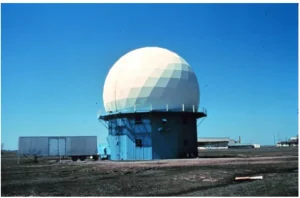
India now has 47 Doppler Weather Radars covering 87% of the country’s area, aiding in real-time tracking of extreme weather events like cyclones, heavy rainfall, and snowfall. 
About Doppler Radars

Doppler Weather Radars

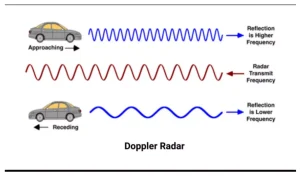
  • Doppler radars are radar systems that use the Doppler effect to measure the speed and direction of moving objects like rain droplets and wind.
  • They transmit radio waves and analyse the frequency shift in the reflected signal to detect motion.

How Doppler Weather Radars Work?

  • Transmission of radio waves: The radar emits short pulses of microwave radio waves into the atmosphere.
  • Scattering by precipitation: Raindrops, snow, or hail reflect part of the signal back to the radar as echoes.
  • Doppler effect: If these targets are moving, the frequency of the returned signal changes (higher if moving toward, lower if moving away).
  • Velocity calculation: The radar measures this frequency shift to determine wind speed and direction within storms.
  • Distance & intensity: Time delay of the echo gives distance, while signal strength indicates rainfall intensity.
  • Data display: Information is processed into colour-coded maps showing precipitation and storm movement.

Advantages of Doppler Radar

  • Unlike conventional radars, DWRs can also detect movement of weather targets.
  • They track the phase shift (change in wave pattern) between transmitted and received signals.
  • This allows calculation of speed and direction of rain or storm movement—toward or away from the radar.

Check Out UPSC CSE Books

Visit PW Store

online store 1

Doppler Effect

Doppler Weather Radars

  • Definition: The Doppler effect is the change in frequency or wavelength of a wave as the source and observer move relative to each other.
  • Named after Christian Doppler, a 19th-century Austrian physicist.
  • Towards observer: When the source moves closer, the observed frequency increases (waves compress).
  • Away from the observer: When the source moves away, the observed frequency decreases (waves stretch).
  • Applications: Used in Doppler radars, astronomy (red/blue shift), medical ultrasound, and speed detection.

Types of Doppler Radars Used in India

  • In India, DWR of varying frequencies — S-band, C-band and X-band — are commonly used by the IMD to track the movement of weather systems and cloud bands, and gauge rainfall
  • They normally have a coverage area of about 500 km.
  • Band Coverage & Use Case: 
    • S-band Long-range weather monitoring
    • C-band Cyclone tracking and rainfall measurement
    • X-band Detects thunderstorms, lightning, and local storms

Need help preparing for UPSC or State PSCs?

Connect with our experts to get free counselling & start preparing

Aiming for UPSC?

Download Our App

      
Quick Revise Now !
AVAILABLE FOR DOWNLOAD SOON
UDAAN PRELIMS WALLAH
Comprehensive coverage with a concise format
Integration of PYQ within the booklet
Designed as per recent trends of Prelims questions
हिंदी में भी उपलब्ध
Quick Revise Now !
UDAAN PRELIMS WALLAH
Comprehensive coverage with a concise format
Integration of PYQ within the booklet
Designed as per recent trends of Prelims questions
हिंदी में भी उपलब्ध

<div class="new-fform">


    </div>

    Subscribe our Newsletter
    Sign up now for our exclusive newsletter and be the first to know about our latest Initiatives, Quality Content, and much more.
    *Promise! We won't spam you.
    Yes! I want to Subscribe.