January 16, 2026, marks the 10th Anniversary (National Startup Day) of the Startup India Initiative.
About Startups
- Meaning: A startup is a newly established, innovation-driven business created to solve a specific problem with a scalable product or service, with the potential for rapid growth.
About National Startup Day
- National Startup Day Declaration: January 16 was officially designated as National Startup Day in 2022 to provide national recognition to entrepreneurs and innovators across India.
- Ten-Year Milestone: The 2026 observance marks the completion of a decade of this initiative, reflecting sustained policy continuity and the growing maturity of India’s startup ecosystem.
|
- Startups in India: In the Indian regulatory context, a Startup is an entity incorporated as a Private Limited Company, a Partnership Firm, or a Limited Liability Partnership (LLP).
- To be recognized by the Department for Promotion of Industry and Internal Trade (DPIIT), the entity must:
- Be within Ten Years of its date of incorporation.
- Have an annual turnover not exceeding ₹100 Crore in any previous financial year.
- Focus on the Innovation, Development, or Improvement of products or services, or possess a Scalable Business Model with a high potential for Employment Generation.
- Examples of Startups
- Tech: Flipkart, Paytm, Ola, Zomato (all began as startups in India).
- Global Unicorns: Airbnb, Uber, SpaceX.
- Sectors: Fintech, healthtech, agritech, edtech, clean energy.
- Key Features:
- Newly Established: Startups are typically in their early stages of development.
- Innovation-Oriented: They focus on solving problems in new ways, introducing unique products or services.
- Scalability: Designed to grow quickly, often targeting large markets.
- Funding Sources: Startups usually rely on various funding sources such as:
- Bootstrapping (self-funding)
- Angel investors (early-stage investors)
- Venture capital (funding provided by firms)
- Bank loans or credit
- Government schemes that support entrepreneurship
- Crowdfunding through online platforms
- Why Startups Matter: Startups play a significant role in promoting job creation, fostering innovation, increasing competition, encouraging the adoption of new technologies, and contributing to the overall economic growth of the country.
- They also cultivate a culture of entrepreneurship and bring fresh perspectives to traditional industries.
Terms Related to Startup Valuations:
- Unicorn: A startup valued at over $1 billion. The term was coined by Aileen Lee in 2013.
- Decacorn: Startup valued above $10 billion.
- Hectocorn: Extremely rare startups valued at over $100 billion.
- Mincorn: Startups valued at less than $1 billion.
- Soonicorn: Rapidly growing startups and has the potential to reach a valuation of $1 Bn.
|
About Startup India Initiative
- Startup India is a flagship initiative launched in 2016 to promote an inclusive ecosystem for innovation and entrepreneurship.
- Nodal Ministry: Led by the Department for Promotion of Industry and Internal Trade (DPIIT) under the Ministry of Commerce and Industry.
- Objective: To reduce the regulatory burden on Startups, thereby allowing them to focus on their core business and keep compliance costs low.
Benefits for Startups under Startup India
- Self-Certification: Startups can self-certify compliance with 6 labour laws and 3 environmental laws through a simple online process.
- Labour Laws:
- No inspections for 5 years from the date of incorporation.
- Inspections only if a credible, written complaint is received and approved by a senior officer.
- Environmental Laws:
- Startups in the ‘white category’ (low-pollution industries, as defined by CPCB) can self-certify compliance.
- Only random checks may be conducted in such cases.
- Tax Exemptions: Eligible startups can claim a three-year income tax holiday within their first ten years under Section 80-IAC of the Income Tax Act.
Key Features of the Startup India
- End-to-End Startup Lifecycle Support: Provides full-lifecycle assistance from ideation, incubation, market entry to scale-up, reducing early-stage risks and growth bottlenecks.
- Decentralised and Inclusive Entrepreneurship: Promotes entrepreneurship beyond Tier-I cities into Tier-II, Tier-III and rural regions, ensuring inclusive innovation and balanced regional development.
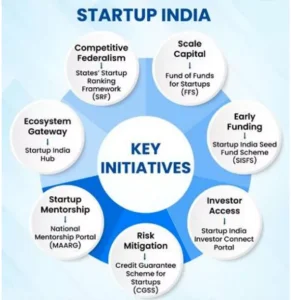
- Competitive Federalism via State Ranking Framework: The States’ Startup Ranking Framework (SRF) benchmarks States and UTs on policy support, institutional capacity and ecosystem maturity, fostering inter-State competition and policy innovation.
- Sectoral Focus and Ecosystem Capacity Building: Provides targeted support to priority sectors such as biotechnology, agri-tech, renewable energy and deep-tech, along with mentorship, training and ecosystem connectivity through the Startup India Hub.
Flagship Schemes under Startup India
- Fund of Funds for Startups (FFS): Managed by the Small Industries Development Bank of India (SIDBI), with a corpus of ₹10,000 Crore.
- As of early 2026, it has committed capital to over 140 Alternative Investment Funds (AIFs), which have collectively invested ₹25,500+ Crore in more than 1,370 Startups.
- Startup India Seed Fund Scheme (SISFS): With a corpus of ₹945 Crore, this scheme provides financial assistance for Proof of Concept (PoC), Prototyping, and Market Entry.
- Over 215 Incubators have been approved to channel these funds to early-stage ventures.
- Credit Guarantee Scheme for Startups (CGSS): Aimed at enabling Collateral-free Loans, the scheme has guaranteed over 330 Loans worth more than ₹800 Crore through the National Credit Guarantee Trustee Company (NCGTC) Limited.
- MAARG Portal: The Mentorship, Advisory, Assistance, Resilience, and Growth program connects entrepreneurs with experienced mentors to offer Strategic Guidance and Resilience.
- Startup India Investor Connect Portal: A digital platform developed in collaboration with SIDBI that allows entrepreneurs to reach multiple Venture Capital (VC) Funds through a single application.
Key Achievements under Startup India (2016–2026)
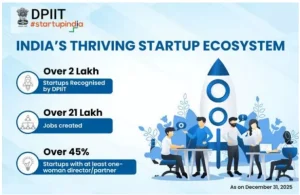
- Rapid Expansion of the Startup Ecosystem: India has crossed 2 lakh DPIIT–recognised startups as of December 2025, placing India among the largest startup ecosystems globally.
- Rise of Unicorn: The number of Unicorn startups increased from 4 in 2014 to over 120 by 2026, with a combined valuation exceeding USD 350 billion.
- Decentralisation and Democratisation of Entrepreneurship: Nearly 50% of DPIIT-recognised startups originate from Tier-II and Tier-III cities, indicating a shift towards decentralised, regionally balanced and inclusive entrepreneurship.
- Social Inclusion and Gender Equity: More than 45% of DPIIT-recognised startups have at least one woman director or partner, highlighting progress in women-led entrepreneurship, social equity, and inclusive economic participation.
- Strengthening Innovation and Intellectual Property (IP) Ecosystem: Innovation programmes such as the National Initiative for Developing and Harnessing Innovations (NIDHI) have generated 1,100+ Intellectual Property assets.
- Supported over 12,000 startups, strengthening India’s research, development and innovation (RDI) base.
Other Government Schemes Supporting Startups in India
- Atal Innovation Mission (AIM) 2.0 – NITI Aayog, AIM 2.0: Focuses on piloting initiatives for ecosystem gaps.
- Atal Tinkering Labs (ATLs): Over 10,000 Labs across 733 districts engaging 1.1 Crore Students.
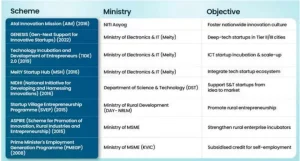 Language Inclusive Program of Innovation (LIPI): Establishing 30 Vernacular Innovation Centres to reduce barriers for non-English speakers in 22 Scheduled Languages.
- MeitY Startup Hub (MSH): Supports over 6,148 Startups and 517 Incubators, specifically focusing on Information and Communication Technology (ICT) and emerging technologies like AI (Artificial Intelligence) and Blockchain through TIDE 2.0 (Technology Incubation and Development of Entrepreneurs).
- NIDHI (National Initiative for Developing and Harnessing Innovations): An umbrella program by the Department of Science and Technology (DST) that has generated 1,30,000+ Jobs and provides support from idea to prototype through NIDHI-PRAYAS (Promotion and Acceleration of Young and Aspiring Technology Entrepreneurs).
- Grassroots & Rural Programs:
- SVEP (Startup Village Entrepreneurship Program): A sub-scheme under DAY-NRLM (Deendayal Antyodaya Yojana – National Rural Livelihoods Mission) that has supported 3.74 Lakh Enterprises.
- ASPIRE (A Scheme for Promotion of Innovation, Rural Industries and Entrepreneurship): Promotes innovation in rural areas through Livelihood Business Incubators (LBIs).
- PMEGP (Prime Minister’s Employment Generation Programme): A credit-linked subsidy scheme implemented through KVIC (Khadi and Village Industries Commission).
- National Campaign on Entrepreneurship (Launched Jan 2026): A new initiative under DAY-NRLM (Deendayal Antyodaya Yojana – National Rural Livelihoods Mission) titled “Har Ghar Udyam, Har Gaon Samriddh.”
- Objective: To train 50,000 Community Resource Persons (CRPs) on enterprise promotion.
- Impact: Aims to impart Entrepreneurship Development Programme (EDP) training to 50 Lakh SHG Members to enable 3 Crore “Lakhpati Didis” (women earning ₹1 Lakh+ annually).
Challenges to the Startup Ecosystem in India
- Funding and Financial Access: Startups continue to face challenges in securing adequate early-stage funding and venture capital, especially during funding slowdowns or global market shifts.
- Example: India’s tech startup equity funding declined to $10.5 billion in 2025, down 17 % year-on-year from 2024, and also 4 % lower than the $11 billion raised in 2023.
- Regulatory Complexity and Compliance: Startups in India grapple with complex regulatory frameworks, particularly with evolving tax laws (e.g., GST) and labor codes.
- Example: Fintech startups like Navi and Jupiter face challenges with RBI compliance, and telemedicine platforms struggle with unclear data protection regulations.
- Infrastructure and Talent Gaps: While major cities offer better infrastructure, Tier-II and Tier-III cities still face connectivity issues and lack access to co-working spaces and skilled talent.
- Example: Agri-tech startups like CropIn and DeHaat in rural areas face poor internet connectivity, and AI/ML startups compete with global tech giants for talent.
- Market Access and Competition: Startups struggle with fierce competition from established corporates that have more financial power and market dominance.
- The price war tactics and subsidized services employed by large firms often make it difficult for startups to sustain in the market.
- Intellectual Property and Legal Barriers: Startups face difficulty in securing intellectual property protection due to high costs and delays in filing patents and trademarks.
- Example: Biotech startups in healthcare face delays in patent approval, impacting their ability to commercialize products on time.
- Deep-Tech Commercialization: Deep-tech startups face high gestation periods for product development, requiring long-term patient capital.
- Example: Space-tech startups like Skyroot Aerospace and Agnikul Cosmos face long timelines and high upfront costs, needing more patient investors.
- Others:
- Rural-Urban Divide: Rural startups face digital literacy gaps and poor infrastructure.
- Talent Retention: Startups struggle with talent retention due to competition with larger firms and international opportunities.
- Gender Bias: Gender bias in funding and cultural risk aversion continue to limit the participation of women and individuals from non‑metro regions.
- Only about 7.5% of active startups are led by women founders, and declining capital raised has been highlighted for these ventures.
Way Forward
- Strengthening Funding Access and Support Systems:
- Increase Domestic Investment: Expand domestic venture capital, angel investment, and crowdfunding platforms to reduce reliance on foreign capital.
- Regional Focus: Create state-led funds and incentives for Tier-II/Tier-III and rural startups to decentralize growth.
- States are actively creating their own fund-of-funds (e.g., Tamil Nadu’s ₹100 crore co-creating fund) to boost private VC investment and support local startups — a model that can be replicated for Tier-II/III ecosystems.
- Regulatory Reforms for Ease of Doing Business:
- Simplify Compliance: Streamline taxation policies, particularly GST and labor codes, to reduce the administrative burden on startups.
- Create a Flexible IP Framework: Offer patent subsidies and reduce the time required for IPR registration to facilitate faster commercialization of innovation, especially for deep-tech and biotech startups.
- Boosting Infrastructure and Digital Connectivity:
- Develop Co-Working Spaces: Invest in incubators and co-working spaces across Tier-II and Tier-III cities to enhance infrastructure availability and reduce operational costs for startups in smaller regions.
- Government and state initiatives like the Bihar Idea Festival portal encourage 10,000+ startup ideas from across districts, supporting grassroots innovation and expanding rural connectivity into the ecosystem.
- Enhance Digital Connectivity: Improve broadband connectivity and digital infrastructure in rural and underserved regions to ensure seamless operation for startups in sectors like agri-tech and telemedicine.
- Fostering Talent Development and Retention:
- Build Industry-Academic Partnerships: Strengthen collaborations between universities and industries to create a talent pipeline in emerging technologies like AI, blockchain, and data science.
- Incentivize Retention: Introduce employee stock options (ESOs), training programs, and professional development opportunities to retain skilled professionals in startups.
- Promoting Inclusive Entrepreneurship:
- Support Women Entrepreneurs: Expand programs like Stand-Up India and Startup India Hub to provide mentorship and funding for women-led startups, bridging the gender gap in the entrepreneurial ecosystem.
- Promoting Deep-Tech Innovation and Commercialization:
- Foster Long-Term Patient Capital: Encourage long-term funds to focus on deep-tech sectors like space, defense, biotech, and clean energy, which have long development cycles.
- Utilize the Deep-Tech Reactor: Establish the Deep-Tech Reactor as a research sandbox to support the commercialization of innovations requiring significant investment and long gestation periods.
- Strengthening Global Integration and Market Access:
- Facilitate Export Readiness: Provide export assistance to Indian startups by promoting international market access, connecting them with global investors and customers.
- Promote Technology Transfer: Encourage cross-border collaborations in technology, enabling startups to tap into global value chains and drive innovation in India’s priority sectors.
- International Innovation Collaborations: Strengthen global ties by taking India’s innovation ecosystem international through initiatives like the International Innovation Collaborations program, facilitating cross-border partnerships, global market integration, and technology exchange.
Conclusion
A decade on, India’s startup ecosystem reflects not just scale but structural transformation—anchored in demographic advantage, digital public infrastructure, and a sustained reform agenda. Startups today are embedded across priority sectors, driving innovation, employment generation, and global market integration.


 17 Jan 2026








.png)






 Current Affairs




 GS Foundation
 Optional Course
 Combo Courses
 Degree Program