The Union Government is promoting inclusive access to AI infrastructure, skills, and technology as a core development pillar, aiming to support the vision of Viksit Bharat @2047.
About AI Democratisation
- Meaning and Objective: AI democratization means the equitable spread of AI capabilities, tools and benefits across society — not limited to big tech firms or AI experts.
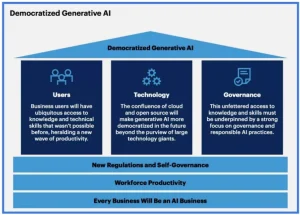 Universal Accessibility: It involves making AI accessible, affordable and usable for individuals, businesses, governments and communities so a wider population can use, build and influence AI systems.
- Core Structural Pillars: Researchers generally identify three core pillars:
- Democratizing AI Use
- Democratizing AI Development
- Democratizing AI Governance
- Access to Foundational Resources: It moves beyond just using “apps” to providing access to core building blocks like high-end computers, vast datasets, and model ecosystems.
- AI as Digital Public Infrastructure (India’s Approach): By treating AI as Digital Public Infrastructure (DPI), India ensures that a rural startup has the same technological foundation as a global giant.
Comprehensive Pillars of AI Democratization
- The Data Pillar (Accessibility & Quality): True democratization requires breaking down data silos to ensure that “Big Tech” doesn’t hold a monopoly on the “fuel” of AI.
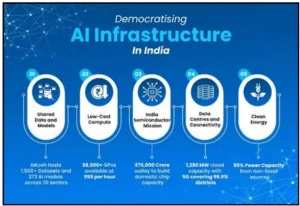
- Open Resources: Initiatives like AIKosh host over 7,500 datasets across 20 sectors, providing startups and non-profits the assets needed to build without astronomical collection costs.
 Synthetic & Representative Data: By utilizing synthetic data and Open-Source Datasets, developers can bypass privacy hurdles and data scarcity.
- Data Literacy: Fostering a “Citizen Data Scientist” movement ensures that data is accurately labeled and representative of diverse populations.
- The Compute Pillar (Infrastructure & Affordability): To bridge the “hardware gap,” high-end processing power must be treated as a utility rather than a luxury.
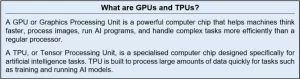
- Subsidized Power: Modern initiatives provide massive scale—such as 38,000+ GPUs and 1,050+ TPUs—at rates as low as ₹65 ($0.78) per hour, which is nearly one-third of the global average.
-
- Cloud & Edge AI: While Cloud Democratization allows students to “rent” GPU credits for pennies, Edge AI enables powerful models to run locally on affordable smartphones.
- Connectivity: Reaching 99.9% district coverage with 5G ensures that this compute power is accessible even in remote or rural areas.
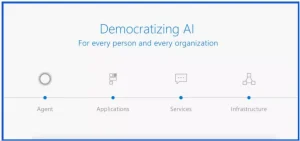 The Tools Pillar (Usability & Open Source): This pillar removes the “coding barrier” by shifting the focus from complex programming to intuitive, modular design.
-
- No-Code/Low-Code: Tools like AutoML allow small business owners to create complex forecasts via drag-and-drop interfaces.
- Foundation Models: Instead of building from scratch, users can fine-tune Pre-trained “Base” Models (like Llama, Mistral, or the indigenous BharatGen multimodal models) for specific regional languages or niche industries.
- Open Ecosystems: Frameworks like PyTorch and TensorFlow keep the latest breakthroughs in the public domain.
- The Knowledge Pillar (Literacy & Education): Tools are only effective if the workforce is equipped to use them. This focuses on Knowledge Equity across all professional levels.
- Reskilling: AI education is integrated into government programs for factory workers, medical staff, and educators, moving them from “consumers” to “overseers.”
- Democratizing Logic: By teaching the underlying logic of AI, the global population can better understand the technical limitations and risks of the technology.
- The Governance Pillar (Ethics & Safety): Democratization without oversight risks “shadow IT” and algorithmic bias. This pillar provides the “guardrails” for innovation.
- Bias Detection: Using Responsible AI toolkits, developers can audit algorithms to ensure they do not discriminate based on race, gender, or location.
- Regulatory Clarity: Frameworks like the EU AI Act or the 2025 India AI Guidelines provide a clear roadmap for smaller players to innovate safely.
- Public Trust: Transparent governance ensures that the AI of tomorrow is built on a foundation of security and accountability.
About Artificial Intelligence (AI)
- Refers: Artificial Intelligence is a branch of Computer Science that aims to create systems capable of Reasoning (using rules to reach conclusions), Learning (acquiring information and rules for using it), and Self-Correction.
- Objective: To drive economic growth, productivity enhancement, and national security, reflecting the view that AI leadership is a determinant of geopolitical power, economic competitiveness, and strategic autonomy.
- Technology Focus: AI technology focuses on building systems that can exhibit various intelligent behaviors, including:
- Machine Learning (ML): A subset of AI, ML enables systems to learn from data and improve over time without being explicitly programmed.
- Natural Language Processing (NLP): Aims to enable machines to understand, interpret, and respond to human language.
- Computer Vision: The ability of machines to interpret and make decisions based on visual inputs, such as images or video.
- Robotics: Combines AI with sensors and actuators to enable machines to interact with and perform tasks in the physical world.
- Deep Learning: A specialized area of ML that uses neural networks with many layers to process large amounts of data, often leading to breakthroughs in areas like speech and image recognition.
 Classification of Artificial Intelligence:
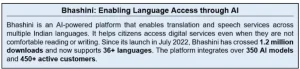
- Narrow AI (Weak AI): Task-specific systems designed to perform well-defined functions such as facial recognition, speech processing, recommendation engines, or language translation (e.g., Bhashini).
- Represents the current and dominant form of AI in real-world use.
 General AI (Strong AI): A theoretical form of AI capable of understanding, learning, and applying intelligence across any domain, comparable to human cognitive abilities such as reasoning, abstraction, and common sense.
- Does not yet exist; raises profound ethical and governance questions.
- Generative AI: A specialised subset of AI (largely within Narrow AI) that can generate new content—including text, images, audio, video, and code—by learning statistical patterns from large datasets (e.g., ChatGPT, Gemini, DALL·E).
- Economically disruptive due to its impact on creativity, productivity, and labour markets.
- AI Market Dimension:
- Global AI Market Size: The global AI economy is estimated at ~USD 400–450 billion (2026) and is projected to cross USD 2 – 2.5 trillion by early 2030s, driven by generative AI, cloud computing, and semiconductor demand.
- Growth Rate: AI continues to register high double-digit growth (≈26–30% CAGR), making it one of the fastest-growing technology markets globally.
- Infrastructure Spend: Hyperscaler AI capital expenditure (data centres, advanced chips, cloud infrastructure) is expected to exceed USD 2 trillion cumulatively by 2026, reflecting AI’s infrastructure-intensive nature and entry barriers.
- Indian AI Market Size: India’s AI market is projected to reach ~USD 15–20 billion by 2027, with strong momentum in AI services, platforms, and public-sector use cases.
- Growth Rate: India ranks among the fastest-growing AI markets globally, with an estimated 25 – 35% CAGR, supported by digital public infrastructure and startup activity.
- Talent Advantage: India accounts for ~16% of the global AI talent pool, ranking second worldwide.
- AI workforce demand is expected to approach 1 million professionals by end-2026, underscoring both opportunity and skilling challenges.
- Key Domains of Application: Governance, healthcare, agriculture, defence, manufacturing, education, finance, climate action, and digital public infrastructure.
Sectoral Applications- AI for Social Good
In 2026, AI is no longer a luxury but a core utility integrated into public service delivery to create tangible societal impact across critical sectors:
- Agriculture- Precision & Resilience: AI converts farming from input-based practices to information-based decision-making, reducing agrarian distress.
- Examples: Tools like Kisan e-Mitra provide a voice-based AI chatbot in 11+ regional languages to simplify access to government schemes.

-
- The National Pest Surveillance System uses computer vision and satellite data to identify 400+ pest species and provide real-time risk warnings for 61+ crops.
- Healthcare- Bridging the “Last Mile”: AI expands healthcare access by compensating for the shortage of specialist doctors and diagnostic infrastructure in rural areas.
- Examples: AI supports early disease detection through automated medical image analysis (X-ray, CT) for TB and cancer, while telemedicine platforms use AI-driven triage to prioritize critical cases in remote districts.
- Language & Inclusion- Removing the “Language Tax”: AI bridges the digital divide by enabling non-English speakers to access services in their own native dialects.
- Examples: The Bhashini platform has crossed 1.2 million downloads, utilizing AI to provide real-time translation and voice services across 36+ Indian languages, making internet services truly inclusive for all.
- Disaster Preparedness- Predictive Safety: AI enhances climate resilience through proactive intervention and high-precision early warning systems.
- Examples: The IMD utilizes AI for extreme weather forecasting, while the development of MausamGPT provides real-time, conversational safety advisories and hyper-local forecasts at the Panchayat level during cyclones and floods.

Why India Needs to Democratise AI?
In 2026, the democratization of AI is a cornerstone of India’s national strategy, moving beyond the “tech elite” to empower the 1.45 billion people at the center of its growth.
- Breaking the “Language Wall”: For a country as linguistically diverse as India, technology is often locked behind an English-language barrier.
- The Gap: Standard AI models are trained on Western data, which excludes the 90% of Indians who prefer their local mother tongue.
- The Progress: Platforms like Bhashini have flipped the script. By early 2026, the tool supports over 36 languages, allowing a street vendor to use voice commands to check government schemes or manage digital payments without needing to type in English.
- Empowering the “Invisible” Workforce: India’s 490 million informal workers—from gig delivery partners to small-scale artisans—have historically lacked access to high-end business tools.
- The Goal: Democratized AI acts as a productivity multiplier for the self-employed.
- Practical Impact: Through the Digital ShramSetu initiative, workers can now use AI to build micro-credentials based on their skills rather than degrees.
- This unlocks formal credit and global marketplaces that were previously out of reach for small economic actors.
- Securing “Digital Sovereignty”: India is determined not to be a “data colony” where local insights are used only to train foreign-owned models.
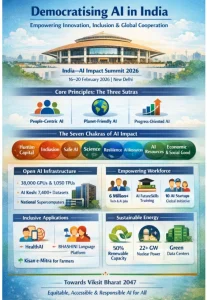
- Compute Independence: Under the IndiaAI Mission, the government has built a massive network of 38,000+ GPUs.
- These are rented out to local startups for as little as ₹65 per hour, allowing small teams to build world-class tech without massive capital.
- Homegrown Intelligence: February 2026 marks the debut of BharatGen, the nation’s first foundational AI model built specifically on Indian cultural and social data.
- Reskilling for a “Skills-First” Economy: Rather than fearing job loss, India is using AI to augment human talent.
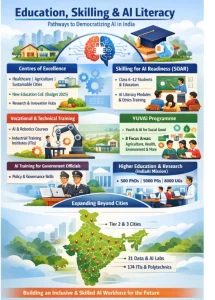
- The SOAR Program: The “Skilling for AI Readiness” (SOAR) initiative has introduced AI ethics and machine learning basics to students starting in Class 6.
- Regional Hubs: To ensure development isn’t limited to cities like Bengaluru, 31+ Data and AI Labs have been opened in Tier-2 and Tier-3 towns, training thousands of “Citizen Data Scientists.”
Initiatives taken to Democratise AI in India
- High-Performance Compute: “Sovereign Infrastructure”: India cannot democratize AI if it relies entirely on foreign cloud providers.
- National Compute Grid: A core requirement is the establishment of domestic GPU clusters. Under the IndiaAI Mission, the government has already operationalized a network of 38,000+ GPUs and 1,050 TPUs.
- Affordability: Startups can “rent” this power at subsidized rates of approximately ₹65/hour, removing the massive capital barrier to entry for small developers.
- Indigenous Hardware: Success also depends on the India Semiconductor Mission (ISM) 2.0, which received an allocation of ₹1,000 crore in the 2026 Budget to focus on advanced chip design and “industry-led” research.
- Digital Public Goods- The “AIKosh” Library: For AI to be inclusive, it needs data and models that reflect India’s unique social and linguistic diversity.
- Shared Resources: AIKosh serves as the national repository, currently hosting over 7,500 datasets and 273 pre-trained models. This allows a rural entrepreneur to build a solution without starting from scratch.
- Language Justice: The Bhashini platform remains a non-negotiable requirement. By February 2026, it supports 36 languages, ensuring that the 90% of Indians who do not use English as their primary language are not “locked out” of the digital economy.
- Sustainable Power- “Green AI”: AI data centers are energy-intensive, and scaling them requires a transition to sustainable power sources.
- SHANTI Act 2025: This landmark legislation (Sustainable Harnessing and Advancement of Nuclear Energy for Transforming India) targets 100 GW of nuclear capacity by 2047.
- Clean Energy Mix: Achieving 2026 targets requires leveraging India’s 50% non-fossil fuel capacity to run “Green Data Centers,” ensuring that technological growth doesn’t come at an environmental cost.
- Human Capital- The “School-to-Startup” Pipeline: Tools are useless without a workforce that knows how to use them safely and effectively.
- Early Education: Programs like YUVAi have introduced AI literacy to students aged 13–21, while the 2026 Budget mandates embedding AI basics into school curricula nationwide.
- AI Competency Frameworks: For government officials, these frameworks ensure that the state capacity is ready to use AI for better welfare targeting and grievance redressal.
| India’s Integrated AI Strategic Stack (2024–2026) |
| Category |
Initiative |
Primary Objective |
Strategic Impact (as of Feb 2026) |
| Compute & Hardware |
IndiaAI Mission & ISM 2.0 |
Building sovereign processing power and local chip manufacturing. |
38,000+ GPUs deployed; ₹76,000 Cr+ allocated for domestic semiconductor fabs. |
| Data & Models |
AIKosh & Bhashini |
Providing high-quality datasets and indigenous language models. |
7,541 datasets available; AI services active in 36+ local languages for rural access. |
| Infrastructure |
MeghRaj (GI Cloud) & 5G |
Secure government hosting and high-speed connectivity. |
2,170+ ministries onboarded; 99.9% district coverage for 5G processing. |
| Global Leadership |
India-AI Impact Summit 2026 |
Setting the agenda for the Global South. |
Shifted the global narrative from “Safety Only” to “AI for Inclusive Growth.” |
| Diplomacy |
DPI & Compute Equity WG |
Exporting “India Stack” and sharing GPU resources. |
MoUs with 23 countries; championing GPUs as a Global Public Good. |
| Sustainability |
SHANTI Act 2025 |
Ensuring clean energy for massive AI data centers. |
Nuclear power target of 22.38 GW to sustainably fuel the AI revolution. |
Challenges & Concerns that need to be Tackled

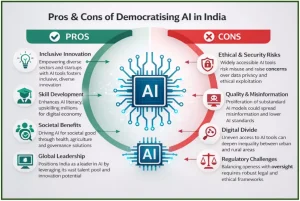
- The Cybersecurity “Agentic” Shift: In 2026, we have moved from simple chatbots to Agentic AI—autonomous systems that can plan and execute actions without human intervention.
- Autonomous Threats: Malicious actors now use AI agents to automate cyberattacks at “machine speed.”
- Recent reports indicate that AI-driven agents can scan and exploit 90% of enterprise vulnerabilities in under 90 minutes, rendering traditional “human-speed” defenses obsolete.
- Securing the “MeghRaj” Cloud: Protecting India’s government cloud infrastructure requires moving beyond firewalls to AI-driven Zero-Trust Architectures that can predict and neutralize autonomous threats in real-time.
- Algorithmic Bias- The “Caste & Context” Gap: Democratization often involves using open-source models trained on datasets that don’t reflect India’s social complexity.
- The Inclusion Trap: Models trained predominantly on urban or Western data can lead to “Algorithms of Oppression.”
- For instance, case studies in 2026 show AI welfare systems mistakenly rejecting valid pension applications from marginalized communities because their speech patterns or local data didn’t “fit” the model’s narrow training.
- The “Black Box” Problem: As tools become more accessible, fewer users understand their internal logic.
- When an AI denies a loan or health benefit, the lack of Explainable AI (XAI) makes it nearly impossible for a citizen to appeal the decision.
- Data Privacy vs. Open Innovation: The Digital Personal Data Protection (DPDP) Act 2023 creates a friction point between the need for massive “Open Data” to train AI and the right to individual privacy.
- Shadow AI: The democratization of tools has led to a surge in employees using unauthorized AI (Shadow AI) to process sensitive government or corporate data, leading to accidental leaks into public training sets.
- Consent Fatigue: As AI systems require more data, citizens are often forced into “all-or-nothing” consent models.
- The 2026 challenge is implementing Privacy-by-Design—technologies like Federated Learning that allow models to learn from data without ever actually “seeing” or storing it.
- The “Sovereign Compute” Bottleneck: Despite the success of the IndiaAI Mission, the global scramble for high-end hardware remains a constraint.
- GPU Scarcity: While India has deployed over 38,000 GPUs, the demand from 2 lakh+ startups far outstrips the supply.
- This creates a “Compute Divide,” where only well-funded startups can afford the processing power needed to build truly original, high-scale models.
- Environmental Cost: Large-scale AI training is energy-intensive. Scaling India’s AI dream without violating its Net Zero commitments requires a massive shift to “Green AI” powered by the renewable energy targets of the SHANTI Act 2025.
|
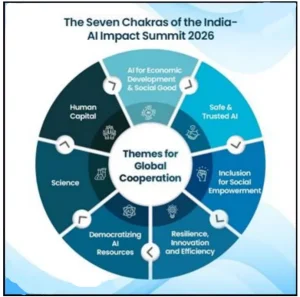
The Seven AI Chakras (2026): At the India-AI Impact Summit 2026, the path to democratisation was defined by these seven focus areas:
|
| Chakra |
The Core Objective |
2026 Reality |
| Human Capital |
Moving from “labor” to “innovation.” |
Employability has surged to 56%. |
| Inclusion |
Reaching the last village. |
Voice-AI used by 38 million farmers. |
| Safe & Trusted AI |
Ethics-first deployment. |
IndiaAI Safety Institute monitors bias. |
| Science |
Accelerating R&D breakthroughs. |
6th largest patent filer in AI globally. |
| Democratising Resources |
Shared digital public goods. |
AIKosh offers 7,500+ free datasets. |
| Resilience |
Environmental sustainability. |
AI-optimized grids saving 15% energy. |
| Social Good |
Tangible public outcomes. |
Telemedicine gap closing in rural zones. |
Way Forward
- The Infrastructure Chakra- Scalable & Affordable Compute: India’s first priority is ensuring that high-performance compute is a Digital Public Good rather than a private monopoly.
- National Compute Grid: Under the IndiaAI Mission, the government has already operationalized a cluster of 38,000+ GPUs and 1,050 TPUs. Startups and researchers can access this at subsidized rates of under ₹100 per hour, lowering the barrier for local innovation.
- Semiconductor Mission 2.0: With a fresh ₹1,000 crore allocation in the 2026-27 Budget, the focus is now on industry-led R&D and domestic chip fabrication to reduce long-term dependence on global supply chains.
- The Innovation Chakra- BharatGen & Sovereign Models: The way forward is to build AI that understands the Indian context—linguistically, culturally, and socially.
- BharatGen Launch: February 2026 marks the official rollout of BharatGen, India’s first sovereign foundational model. It currently supports 15 Indian languages, with plans to cover all 22 scheduled languages by year-end.
- Domain-Specific AI: Beyond general intelligence, the focus is on fine-tuned models like Agri Param (Agriculture), Ayur Param (Healthcare), and Legal Param (Justice) to solve specific sectoral challenges.
- The Governance Chakra- Safe & Trusted AI: To maintain public trust, India is institutionalizing safety and ethical standards.
- IndiaAI Safety Institute (AISI): As the technical arm of the IndiaAI Mission, the AISI is now operational, conducting mandatory safety testing and bias audits for high-risk AI applications.
- Policy-as-Code: New frameworks automate compliance with the DPDP Act 2023, embedding data privacy and protection directly into the software architecture of government-supported AI tools.
- The Global Chakra- Leading the Global South: India is positioning itself as the voice of developing nations through the “Democratizing AI Resources” Working Group.
- Multilateral Leadership: Co-chaired with Egypt and Kenya, this group seeks to create a “Shared Global Compute Hub,” allowing Global South nations to pool resources and datasets.
- The Three Sutras: All future cooperation is guided by the core principles of People, Planet, and Progress, ensuring AI development is sustainable and human-centric.
Conclusion
India’s strategy ensures that AI is a public good, not a luxury. By combining affordable compute, inclusive skilling, and indigenous innovation, the nation is narrowing inequalities and building a scalable, sustainable AI ecosystem that serves as a global model for inclusive development by 2047.


 11 Feb 2026








.png)






 Current Affairs




 GS Foundation
 Optional Course
 Combo Courses
 Degree Program