The 2026 New Delhi Summit marks a paradigm shift—from debating AI’s capabilities to defining its character. Under the UNESCO–India partnership, the focus moves from “Action” to “Impact,” asserting that AI progress must remain firmly human-centric to be meaningful.
About the UNESCO-India Partnership
The collaboration between UNESCO and India represents a unique synergy between a global normative authority and a rising digital superpower.
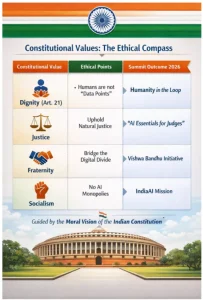
- Global Conscience: With a mandate spanning education, science, and culture, UNESCO acts as the world’s moral compass, translating the First Global Framework on Ethical AI into actionable national policies.
- The “Sutras” of Progress: The 2026 Summit successfully distilled global AI needs into three “Sutras”- People, Planet, and Progress.
- By hosting the first-ever Global AI Summit in the Global South, India has effectively shifted the narrative from mitigating risk (The Bletchley approach) to maximizing equitable opportunity (The Delhi approach).
- Also, India reinforces its role as a “Vishwa Bandhu” (Global Friend), bridging the gap between the technological standards of the Global North and the socio-economic aspirations of the Global South.
- Multilateral Leadership: The partnership emphasizes that AI governance cannot be unilateral; it requires the consensus of 194 Member States to prevent a fragmented digital world.
Key Ethical Outcomes
The summit moved beyond theoretical rhetoric to establish concrete, applied ethical interventions across three critical domains:
- Judicial Integrity & The Rule of Law: Recognizing that 44% of judicial professionals are already using AI without formal guidance, the summit released the ‘AI Essentials for Judges’.
- This seeks to prevent “Black-Box Justice,” ensuring that algorithmic tools remain subordinate to human reasoning and do not violate the Principles of Natural Justice or introduce systemic biases in legal adjudication.
- Environmental Stewardship & Energy Ethics: Training frontier AI models currently consumes the annual electricity of thousands of households.
- The summit launched the ‘Resilient AI Challenge’ to promote Lightweight AI models that offer a 90% reduction in energy consumption. This aligns with the principle of Intergenerational Equity, ensuring that our digital progress today does not compromise the ecological security of tomorrow.
- Humanity in the Loop (HITL): The summit advocated for a values-driven design where human oversight is a non-negotiable component of the AI lifecycle.
- By prioritizing Human Agency, the framework ensures that AI remains a tool for societal well-being and information integrity, rather than an autonomous force that erodes individual autonomy.
Moral Philosophy: The Foundation of “AI for Humanity”
The “Delhi Approach” can be interpreted through various philosophical lenses to justify its human-centric character:
- Deontology (Duty-Based Ethics): Anchoring AI in the MANAV framework suggests that certain human rights—privacy, dignity, and autonomy—are “categorical imperatives.”
- In Kantian terms, AI must be treated as a means to an end (human well-being) and never as an end in itself.
- Virtue Ethics (Aristotelian Approach): The summit’s focus on “defining the character” of AI mirrors Aristotle’s Phronesis (practical wisdom).
- By embedding ethics into the code (FIA: Fairness, Inclusiveness, Accountability), we are essentially teaching AI to “act virtuously” by design.
- Ubuntu & Vasudhaiva Kutumbakam: The summit bridges Western individualism with Eastern collectivism.
- The role of India as “Vishwa Bandhu” (Global Friend) reflects a cosmopolitan ethical duty to ensure that technological progress does not leave the Global South in a “state of nature” (Hobbesian) but brings them into a global “social contract.”
Ethical Theories: Resolving the “AI Dilemmas”
The summit addresses classic ethical conflicts using modern frameworks:
- Utilitarianism vs. Minority Rights: While big data seeks the “greatest good for the greatest number,” UNESCO’s focus on Bhashini (linguistic inclusion) prevents the “tyranny of the majority.”
- It ensures that minority languages and cultures are not marginalized by the “English-language premium.”
- Intergenerational Equity: The ‘Resilient AI Challenge’ (90% energy reduction) is a direct application of the Trusteeship Model.
- It asserts that the current generation has a moral debt to future generations to not exhaust the planet’s “carbon budget” for the sake of processing power.
- Rawlsian “Veil of Ignorance”: The Delhi Approach to “Democratizing the AI Stack” aligns with John Rawls’ Difference Principle.
- It argues that inequalities (digital divide) are only justified if they result in compensating benefits for the least advantaged members of society.
About UNESCO (United Nations Educational, Scientific and Cultural Organization)
- UNESCO is a specialized agency of the United Nations.
- Objective: Its mission is to build peace and security through global cooperation in education, science, culture, and communication.
- Established: 1945
- Headquarters: Paris, France
- Key Conventions:
- World Heritage Convention (1972)
- Convention for Safeguarding Intangible Cultural Heritage (2003)
- Convention on Protection & Promotion of Diversity of Cultural Expressions (2005)
- Flagship Programmes: World Heritage Sites, Man and the Biosphere (MAB), Global Geoparks, Memory of the World.
- Global Education Leader: UNESCO leads the “Education 2030” agenda (SDG 4), focusing on inclusive quality education. In 2026, a primary focus is digital transformation, ensuring that AI and technology empower rather than replace teachers and students.
- Ethics of Frontier Technology: UNESCO established the first global standard for the Ethics of Artificial Intelligence. It continues to work with member states to create legal frameworks that prevent bias and protect human rights in AI development.
- Science for the Planet: Through the Man and the Biosphere (MAB) and the Intergovernmental Oceanographic Commission, UNESCO coordinates global climate monitoring, tsunami warning systems, and the sustainable management of water resources.
|
Significance: Redefining the Global AI Order
The India–AI Impact Summit 2026 transitioned the global discourse from “existential safety” to “equitable utility,” marking three strategic shifts:
- Democratic Diffusion vs. Digital Colonialism: By championing the “Smaller Footprint, Bigger Impact” philosophy, the summit challenged the monopoly of trillion-parameter models.
- The Shift: It prioritizes Sovereign AI and Frugal Innovation, ensuring that nations with energy and compute constraints are not reduced to mere “data colonies” for Silicon Valley.
- Impact: This “Delhi Approach” democratizes the AI stack, allowing the Global South to build indigenous models that are culturally representative and economically viable.
- Strategic Trust-Building through “Techno-Legal” Governance: In an era of deepfakes and algorithmic bias, the summit moved beyond voluntary “codes of conduct” to a robust Techno-Legal Framework.
- The Framework: By integrating Fairness, Inclusiveness, and Accountability (FIA) into the very code of AI models, governance becomes proactive rather than reactive.
- Outcome: This strengthens the Social Contract between the state and citizens, ensuring that public service delivery—from digital payments to judicial assistance—remains transparent and “Safe by Design.”
- Operationalizing “Action to Impact” (The Macron-Modi Pivot): As noted by the French President Macron, the 2026 Summit successfully pivoted from the “Action” phase of the 2025 Paris Summit to a measurable “Impact” phase.
- Carbon-Ethics Linkage: Ethics is no longer just about bias; it is now embedded in the carbon footprint of the model.
- The New Standard: Through the “Resilient AI Challenge,” the summit established that a model’s success is measured by its energy efficiency (Planet Sutra) and its ability to solve real-world problems in agriculture and health (People Sutra), rather than just raw processing power.
Challenges that need to be tackled
- The Institutional “Guideline Gap” & Institutional Readiness: A staggering 91% of judicial professionals lack formal training despite high adoption rates (44%).
- This creates an Institutional Vacuum where technology outpaces the “Rule of Law.” Deploying AI without a normative framework violates the Principle of Legality and risks “Black-Box Justice,” where decisions are made without the transparency required by the Principles of Natural Justice.
- Crisis of “Moral Agency” & Discretionary Integrity: Public officials are increasingly delegating decision-making to algorithms, leading to a “Discretionary Void.”
- Administrative ethics mandates that an official cannot abdicate their Moral Agency.
- Over-reliance on AI leads to Automation Bias, where the “Human-in-the-Loop” becomes a mere rubber stamp, eroding the constitutional values of Individual Autonomy and personal accountability.
- Fiduciary Duty & “Safe by Design” Governance: The transition from voluntary ethics to Statutory Audits and Ethical Impact Assessments (EIA).
- As Trustees of Public Data, the state has a Fiduciary Responsibility to ensure “Techno-Legal” integrity. By integrating Fairness, Inclusiveness, and Accountability (FIA) into the code, administrators uphold the civil service values of Objectivity and Non-Partisanship, preempting “Hidden Biases” before they manifest in public service.
- Global Equity & the “Compute Divide”: Concentration of high-level hardware in private, Global North hands despite the push for “Lightweight AI.”
- This reflects a violation of Distributive Justice (Rawlsian Ethics). A fragmented global regulatory landscape, driven by economic competitiveness over ethical guardrails, threatens Global Fraternity and risks “Digital Colonialism,” where the Global South remains a data provider rather than a sovereign innovator.
| Earlier Such Global Actions: Building the Global Normative Architecture
The India AI Impact Summit 2026 does not exist in a vacuum; it is the culmination of a decade of international efforts to build a global “guardrail” system for emerging technologies:
- UNESCO Recommendation on the Ethics of AI (2021): This serves as the foundational moral compass for the international community.
- It was the first global standard-setting instrument—adopted by 193 Member States—that moved beyond technical safety to emphasize human rights, gender equality, and environmental protection as non-negotiable pillars of AI development.
- The Bletchley Declaration (2023): Emerging from the UK AI Safety Summit, this represented the first high-level international consensus on the existential and catastrophic risks posed by “Frontier AI” (highly capable, general-purpose models).
- It established a precedent for multilateral scientific cooperation to monitor the “unpredictable” capabilities of advanced systems.
- The EU AI Act (2024): Standing as the world’s first comprehensive, legally binding horizontal framework, this legislation introduced a risk-based regulatory approach.
- By categorizing AI into “Unacceptable,” “High,” and “Limited” risk tiers, it sets a global benchmark for protecting human dignity and democratic values from algorithmic overreach.
- G20 New Delhi Leaders’ Declaration (2023): Under India’s Presidency, this declaration was instrumental in shifting the narrative toward a “Pro-Innovation, Pro-Safety” approach.
- It successfully advocated for Responsible AI governance that bridges the digital divide, ensuring that AI serves as a catalyst for the Sustainable Development Goals (SDGs) rather than a tool for widening global inequality.
India’s Initiatives: From Digital Consumption to Technological Sovereignty
India has transitioned from being a mere consumer of Western technology to a pioneer of “Sovereign AI,” focusing on inclusive and scalable solutions:
- The IndiaAI Mission: This is a multi-layered flagship initiative designed to democratize AI Compute Power.
- By establishing a National AI Computing Grid, India is ensuring that startups and researchers have access to the massive “compute” required to build indigenous models, thereby reducing dependence on foreign proprietary infrastructure.
- Bhashini (National Language Translation Mission): A quintessential example of “AI for Social Inclusion,” Bhashini leverages AI to provide real-time translation across multiple Indian languages.
- It aims to eliminate the “English-language premium” in digital services, ensuring that the benefits of the internet and AI reach the “last mile” of the rural population in their mother tongue.
- AIRAWAT (AI Research, Analytics and Knowledge Dissemination Platform): This specialized AI supercomputing cloud is India’s answer to the global race for high-speed processing.
- By integrating this infrastructure with academic and industrial research, India aims to lead in high-impact sectors like precision agriculture, weather forecasting, and drug discovery.
- The Digital India Act (DIA): Positioned to replace the decades-old IT Act 2000, the DIA is a forward-looking legislative overhaul.
- It focuses on the “Safety and Trust” of the open internet, introducing stringent regulations for algorithmic accountability, data privacy, and the mitigation of AI-generated harms such as deepfakes and misinformation.
- GPAI (Global Partnership on AI) Leadership: As a founding member and former chair, India has consistently championed “Democratizing AI,” arguing that the “building blocks” of AI (data, compute, and algorithms) should be treated as Digital Public Infrastructure (DPI) for the benefit of all humanity.
|
Way Forward
To bridge the gap between “Action” and “Impact,” the following four-pronged strategy is recommended:
- Institutionalizing the MANAV Framework: India’s M.A.N.A.V. (Moral, Accountable, National Sovereignty, Accessible, Valid) vision should be the bedrock for national AI policies. This ensures that AI is not an “autonomous force” but a “force multiplier” for human aspirations.
- Operationalizing the “Seven Chakras”: Global cooperation must move from vague treaties to the seven specific pillars defined in the 2026 Declaration:
- Democratizing AI Resources: Ensuring affordable compute access.
- Economic Growth & Social Good: Focusing on MSMEs and agriculture.
- Secure & Trusted AI: Implementing the “Trusted AI Commons” for benchmarks.
- AI for Science: Pooling research through the International Network of AI Institutions.
- Access for Social Empowerment: Multilingual models for digital inclusion.
- Human Capital Development: Scaled reskilling and “AI literacy” for public officials.
- Resilient & Efficient AI: Prioritizing “Green AI” to reduce carbon footprints.
- Transition to Statutory Audits: Move beyond voluntary ethics. High-risk AI applications (in healthcare or law) must undergo Ethical Impact Assessments (EIA) as pioneered by UNESCO, making “Humanity in the Loop” a legal mandate rather than a design choice.
- Strengthening the “Digital Commons”: By supporting the Charter for the Democratic Diffusion of AI, nations can prevent “Digital Colonialism” and ensure that the Global South transitions from being “data providers” to “innovation creators.”
Conclusion
The India AI Impact Summit 2026 reinforces the philosophy that while AI may be the most powerful engine of the 21st century, Ethics must be its steering wheel. As we move forward, the success of AI will be measured not by the complexity of its algorithms but by its resilience, sustainability, and alignment with human dignity.


 26 Feb 2026







.png)






 Current Affairs




 GS Foundation
 Optional Course
 Combo Courses
 Degree Program