Arctic Thaw

8 Jan 2026

Arctic Thaw

The Arctic Report Card 2025 was recently released by National Oceanic and Atmospheric Administration (NOAA).
About the Arctic Report Card

  • The Arctic Report Card (ARC) has been issued annually since 2006, and the 2025 edition marks its 20th anniversary. 
  • The ARC provides reliable, clear, and concise environmental data on the current state of the Arctic ecosystem, offering a comparison to historical records.
  • Publication: The ARC is classified as a NOAA Technical Report

Key Highlights from the Arctic Report Card

In the Air

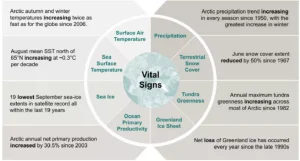
  • Surface Air Temperatures: The Arctic recorded its warmest surface air temperatures from October 2024 to September 2025 since 1900.
  • Temperature Trend: The last 10 years have been the warmest on record in the Arctic, with annual temperatures increasing more than double the global rate since 2006.
  • Precipitation: A record-high level of precipitation was recorded, with winter, spring, and autumn totals ranking among the top five since 1950.

In the Ocean

  • Sea Ice Extent: March 2025 saw the lowest annual maximum sea ice extent in the 47-year satellite record.
  • Decline of Thick Ice: The oldest, thickest Arctic sea ice (>4 years old) has declined by over 95% since the 1980s, now mostly confined to the areas north of Greenland and the Canadian Archipelago.
  • Phytoplankton Growth: Phytoplankton productivity increased by 80% in the Eurasian Arctic from 2003 to 2025, with regions like the Barents Sea and Hudson Bay showing growth of 34% and 27%, respectively.

On Land

  • Glacier Loss: Arctic glaciers in Scandinavia, Svalbard, and Alaska experienced significant ice loss, contributing to rising global sea levels.
  • Greenland Ice Sheet: Lost an estimated 129 billion tons of ice in 2025, continuing the long-term trend of ice loss.
  • Alaskan Glacier Shrinkage: Alaskan glaciers have lost an average of 125 vertical feet (38 meters) of ice since the mid-20th century.Rusting Rivers: Thawing permafrost has led to “rusting rivers” in over 200 Arctic Alaska watersheds, turning waters orange due to increased  iron, mercury, and toxic metals, impacting water quality and aquatic habitats.
  • Greening of the Arctic: The Arctic tundra showed the third-highest greenness in 2025, continuing a trend of increasing vegetation productivity since the late 1990s, impacting habitats and the carbon cycle.
  • Disrupted Ecosystems: The warming Arctic is reshaping ecosystems at an unprecedented rate. Species like polar bears, seals, and Arctic birds face habitat loss and food scarcity.

Arctic Thaw

Geopolitical Implications of Arctic Melting

  • Natural Resource Accessibility: The melting of Arctic sea ice is opening up access to vast reserves of natural resources, such as oil, gas, and critical minerals, which are becoming increasingly valuable.
  • Maritime Trade Routes: The Northern Sea Route (NSR), once inaccessible due to ice, is now opening up. 
    • This reduces travel time between Europe and Asia by 40%, making it a highly strategic and economic route.
  • Global Competition: With the Arctic opening up, non-Arctic countries, including India and China, are becoming more involved in the region. 
    • India has shown interest in utilizing the NSR for enhancing trade with Europe, reducing shipping time, and boosting its energy resource diversification.

India’s Arctic Interests and Policy

  • Arctic Council: India became an observer in the Arctic Council in 2013
  • Arctic Policy 2022: India released its Arctic Policy in 2022, which outlines six key areas: scientific research, climate protection, economic development, transportation, governance, and national capacity building.
  • Focus on Scientific Research: India has a long-standing presence in the Arctic, with its research station Himadri in the Svalbard archipelago since 2008
    • India aims to enhance scientific cooperation in the region to better understand the impact of Arctic changes on India’s monsoon patterns.
  • Collaboration with Russia: India has been actively supporting infrastructure development for the Northern Sea Route with Russia, aiming to improve its connectivity between Chennai and Vladivostok, enhancing trade with Europe.

Check Out UPSC CSE Books

Visit PW Store

online store 1

Arctic Council

  • Established in 1996, consisting of 8 member states (Canada, Denmark, Finland, Iceland, Norway, Russia, Sweden, USA).
  • Promotes cooperation and protection of indigenous communities in the Arctic.

About the Arctic Region

Arctic Thaw

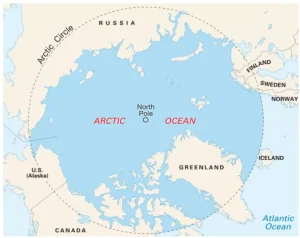
  • The Arctic is the northernmost region of Earth, centered around the North Pole and includes parts of Canada, Denmark (Greenland), Finland, Iceland, Norway, Russia, Sweden, and the United States (Alaska).
  • Continental Shelf: The Arctic Ocean is home to the longest continental shelf in the world.
  • Arctic Ocean:
    • The Arctic Ocean is the smallest and shallowest of the five major oceans on Earth.
    • It is partly covered by sea ice (frozen seawater) throughout the year, especially in the winter months.
  • Salinity & Temperature: 
    • The surface temperature and salinity of the Arctic Ocean vary seasonally due to the freezing and thawing of the ice cover.
    • Its salinity is the lowest of all major oceans because of low evaporation, heavy freshwater influx from rivers and streams, and limited connection to surrounding oceanic waters.

Need help preparing for UPSC or State PSCs?

Connect with our experts to get free counselling & start preparing

Aiming for UPSC?

Download Our App

      
Quick Revise Now !
AVAILABLE FOR DOWNLOAD SOON
UDAAN PRELIMS WALLAH
Comprehensive coverage with a concise format
Integration of PYQ within the booklet
Designed as per recent trends of Prelims questions
हिंदी में भी उपलब्ध
Quick Revise Now !
UDAAN PRELIMS WALLAH
Comprehensive coverage with a concise format
Integration of PYQ within the booklet
Designed as per recent trends of Prelims questions
हिंदी में भी उपलब्ध

<div class="new-fform">


    </div>

    Subscribe our Newsletter
    Sign up now for our exclusive newsletter and be the first to know about our latest Initiatives, Quality Content, and much more.
    *Promise! We won't spam you.
    Yes! I want to Subscribe.