Recently, the U.S. President Donald Trump invited India to join the proposed Board of Peace for Gaza.
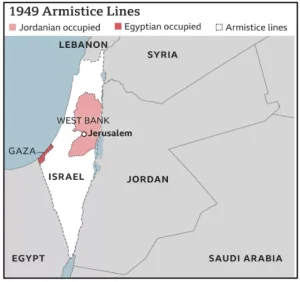
Armistice Line
- The Armistice Line refers to the demarcation lines established under the 1949 Armistice Agreements between Israel and its neighbouring Arab states after the first Arab–Israeli war.
- Commonly known as the Green Line, it marked the ceasefire boundaries between Israel and Jordan, Egypt, Syria, and Lebanon.
- The line was explicitly described as a military ceasefire line, not an international border, and it separated Israel from the West Bank (then under Jordanian control) and the Gaza Strip (administered by Egypt).
- The Armistice Line remains a key reference in peace negotiations and discussions on a two-state solution.
|
About the Board of Peace for Gaza
- It is a U.S.-led, invitation-only mechanism proposed under President Trump’s Gaza peace plan to oversee post-conflict governance, stabilisation, and reconstruction in Gaza.
- It represents a shift towards ad hoc conflict-management arrangements outside traditional UN-centric frameworks.
- Origin: It was first proposed in October 2025.
- UN Backing : UNSC Resolution 2803, which authorised supervision of Gaza’s transition till 2027
- Objectives
- Supervise Gaza’s transitional governance through a technocratic, apolitical Palestinian administration.
- Ensure stabilisation and reconstruction, including management of international funding.
- Oversee arrangements until the Palestinian Authority completes institutional reforms.
- Act as a potential global template for conflict resolution amid UN Security Council paralysis.
- Members of the Board
-
- Chair: U.S. President Donald Trump.
- Composition: Select invited countries and global leaders, including figures like former UK Prime Minister Tony Blair.
- Nature: Non-universal with invitation-based body membership.
Key Challenges
- Undermining Multilateralism: Risks bypassing the UN Charter and collective decision-making.
- Concentration of Power: Perceived as centralising authority in the U.S.-led executive structure.
- Precedent Risk: May divert legitimacy, funding, and attention away from the UN system.
India’s Stance
- Principled Position: India consistently supports a Two-State Solution with Israel and Palestine coexisting peacefully.
- Selective Engagement: India welcomed humanitarian aspects of Trump’s plan but has ruled out troop participation in the non-UN International Stabilisation Force.
- Strategic Caution: India has not formally responded, balancing ties with the U.S. while safeguarding commitment to UN-centric multilateralism.
PWOnlyIAS ExtraEdge
About Gaza

- Gaza, commonly referred to as the Gaza Strip, is a narrow, densely populated coastal territory that has remained central to the Israel–Palestine conflict.
- Location: Gaza is located on the eastern coast of the Mediterranean Sea, bordered by Israel to the east and north, Egypt to the southwest, and the Mediterranean Sea to the west.
- Geography: The territory spans about 365 square kilometres and consists mainly of flat, sandy plains with limited natural resources and high population density.
- Political Demarcation: Politically, Gaza is separated from the West Bank and has been under the de facto control of Hamas since 2007, following its split with the Palestinian Authority.
|
Conclusion
India’s invitation to the Board of Peace for Gaza places it at a diplomatic crossroads.
While engagement may offer influence and flexibility, uncritical participation risks weakening the UN-based order India seeks to reform, a calibrated approach engaging diplomatically while defending multilateral principles is needed.