In January 2026, the Union Home Minister announced a massive three-year nationwide campaign to combat the drug menace in India.
- This mission is set to officially commence on March 31, 2026, coinciding with the government’s deadline to eliminate Naxalism, and aims to achieve a “Drug-Free India” (Nasha Mukt Bharat) by 2029.
About Three-Year National Anti-Drug Campaign (2026–2029)
- A time-bound, target-driven campaign to make India drug-free.
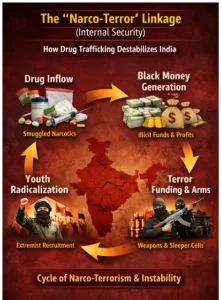
- Strategic Framework: The government has adopted a “Whole of Government” approach, reframing the narcotics issue as a matter of narco-terrorism and a national security threat rather than just a law-and-order problem.
- Focus on Three Pillars:
- Supply Control (Ruthless Approach): Focusing on the supply chain, targeting drug kingpins, traffickers, and their financial networks.
- This includes a zero-tolerance policy with no compassion for manufacturers or sellers.
- Demand Reduction (Strategic Approach): Concentrating on demand reduction through massive awareness campaigns in schools, universities, and communities to protect the youth.
- Harm Reduction (Humane Approach): Treating the victims of drug abuse (users) with compassion, viewing addiction as a medical and health issue rather than a crime, and facilitating their rehabilitation.
- Key Directives and Monitoring:
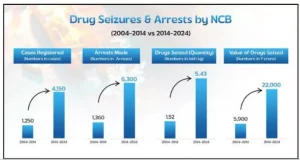 Roadmap 2029: All central departments and State Directors General of Police (DGPs) have been directed to finalize detailed roadmaps and monitoring mechanisms by the March 31 launch date.
- NCORD Mechanism: The campaign will be executed through the four-tier Narco-Coordination Centre (NCORD) structure, ensuring coordination from the Apex Level (Union Home Secretary) down to the District Level.
- Technological Integration: The mission emphasizes the use of Artificial Intelligence (AI), Darknet analysis tools, and Forensic Science Laboratories (FSL) to track anonymous transactions and increase conviction rates.
- Enforcement Gains: The Home Minister noted that between 2014 and 2025, approximately 1.11 crore kilograms of drugs worth ₹1.71 lakh crore were seized, a significant jump from the previous decade.
- Key Targets:
- Timely Chargesheets: Improving the pace of legal proceedings and convictions.
- Drug Destruction: Directives issued to states for the timely disposal and destruction of seized narcotics.
- Viksit Bharat 2047: The mission is a critical step toward the vision of a developed and self-reliant India by the centenary of its independence.
Narco-Coordination Centre (NCORD)
- NCORD is a multi-agency coordination mechanism to tackle drug trafficking and substance abuse in India.
- Establishment: Established in 2016 by the Ministry of Home Affairs (MHA).
- Re-organised and strengthened in 2019 for better operational effectiveness.
- Objectives:
- Improve inter-agency coordination between Centre and States.
- Enable real-time intelligence sharing on drug networks.
- Ensure effective enforcement, prevention, and rehabilitation.
- Organisational Structure (Four-Tier):
- Apex Level: Headed by Union Home Secretary
- Executive Level: Headed by Special Secretary, MHA
- State Level: Headed by Chief Secretaries
- District Level: Headed by District Magistrates
- NCORD Portal: Centralized platform for knowledge management, data sharing, best practices, and information on drugs & enforcement.
- Supports initiatives like:
- MANAS (Madak-Padarth Nished Asoochna Kendra) Helpline (1933 — 24×7 toll-free)
- NIDAAN (National Integrated Database on Arrested Narco-Offenders) Portal.
- Mission SPANDAN (Spiritual Partnership Against Narcotic Drug Abuse – Nationwide).
- Role in National Security: Treats drug trafficking as a national security threat, not merely a law-and-order issue.
- Addresses links between drugs, terror financing, and organised crime.
|
About Drug Menace in India
- Refers: The drug menace in India involves the illegal production, trafficking, distribution, and consumption of narcotic drugs and psychotropic substances, posing severe challenges to public health, social cohesion, economic productivity, and internal security.
- Intensification of Issue: The drug menace in India is officially categorized by the Government of India as a national security threat linked to narco-terrorism.
- In recent years, the problem has intensified due to India’s strategic geography, evolving drug markets, socio-economic stress, and technological enablers, warranting a national emergency response.
- Emerging Chemical Threats (Synthetic Drugs): The government has flagged a dangerous rise in Amphetamine-Type Stimulants (ATS) and other synthetic substances:
- Methamphetamine (Meth): A crystal-like drug that causes severe brain and heart damage.
- Mephedrone: Often called a “party drug,” it leads to confusion, anxiety, and heart issues.
- Cocaine: A white powder stimulant linked to high addiction and heart attacks.
- Hashish: A concentrated cannabis product that severely impacts memory and mental health.
Drug Prevalence in India
- As of January 2026, the Ministry of Social Justice and Empowerment (MoSJE) and the Narcotics Control Bureau (NCB) provide the following detailed landscape of the crisis:
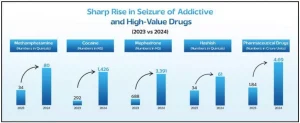
- Population Impact and Major Substances:
- Total Affected Population: Latest estimates for 2026 suggest that approximately 10.7 crore people in India are affected by narcotics and substance use.
- Alcohol: Remains the most widely used substance. According to updated data, over 17 crore people consume alcohol, with roughly 19% of them (approx. 3.2 crore) suffering from alcohol dependence.
- Cannabis (Ganja/Charas): Prevalence stands at approximately 2.8% to 3.3% of the population, with over 3.1 crore users.
- There is a growing concern regarding synthetic cannabinoids and high-grade hydroponic versions.
- Opioids (Heroin/Opium): About 2.1% of the population (roughly 2.3 crore people) use opioids.
- Heroin is the most common, but pharmaceutical opioids (like Tramadol and Codeine) are a rising concern for the Ministry of Home Affairs (MHA).
- Emerging Trends:
- The “Synthetic Surge”: In urban centers like Mumbai, Delhi, and Bengaluru, there has been a 200% increase in the seizure of synthetic drugs such as Mephedrone (MD) and Methamphetamine.
- These are often cheaper and more potent than traditional drugs.
- Digital Trafficking: The Narcotics Control Bureau (NCB) has flagged that Darknet marketplaces and Cryptocurrency are now used in over 60% of high-grade drug transactions in Tier-1 cities.
- Vulnerability in Youth: Nearly 1.58 crore children (ages 10–17) are estimated to be engaged in some form of substance use, frequently starting with inhalants and tobacco.
The Narcotics Control Bureau (NCB)
- It was established on 17th March 1986 by the Government of India to lead the national effort against drug trafficking and abuse.
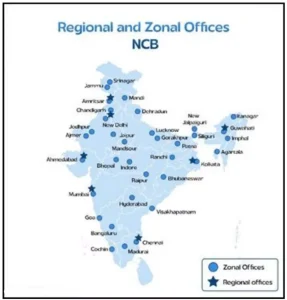 Operating under the supervision of the Central Government, NCB coordinates enforcement actions across states and various agencies under the Narcotic Drugs and Psychotropic Substances (NDPS) Act, 1985 and related laws. Operating under the supervision of the Central Government, NCB coordinates enforcement actions across states and various agencies under the Narcotic Drugs and Psychotropic Substances (NDPS) Act, 1985 and related laws. - It also ensures India’s compliance with international conventions, supports global cooperation to combat drug trafficking, and works with other ministries to address issues related to drug abuse.
- NCB-specific Expansion:
- Regional Offices: Increased from 3 to 7 (e.g., Amritsar, Guwahati, Chennai, Ahmedabad)
- Zonal Offices: Expanded from 13 to 30, including new ones at Gorakhpur, Siliguri, Agartala, Itanagar, and Raipur.
- Staff Strength: Added 536 posts raising sanctioned strength to 1,496.
- Narco-Canine Pool: Nar-K9 units deployed in 10 zonal offices for enhanced detection.
|
- Regional Hotspots:
- Northern Frontier: Punjab, Jammu & Kashmir, and Himachal Pradesh face a high prevalence of opioid abuse, often tied to cross-border drone-based smuggling.
- Northeastern States: Mizoram, Manipur, and Nagaland have the highest per-capita drug prevalence, largely due to proximity to the “Golden Triangle”.
- Mizoram currently has an adult prevalence rate nearly 13 times the national average.
- High-Crime Clusters: Uttar Pradesh and Maharashtra consistently record the highest number of FIRs under the NDPS Act, reflecting both high consumption and aggressive enforcement.
Key Reasons for Drug Abuse in India
- Geographical Vulnerability:
- Strategic Location (“Sandwich Effect”): India lies between the Golden Crescent (Afghanistan–Pakistan–Iran) and the Golden Triangle (Myanmar–Laos–Thailand), two of the world’s largest illicit drug production belts.
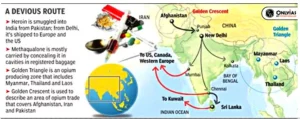 Historically a transit route, India has transformed into a destination market due to rising domestic consumption, especially in border states such as Punjab and the North‑Eastern Region.
- Porous borders, difficult terrain, and limited surveillance infrastructure amplify drug inflows and local availability.
- Socio‑Economic Stress Factors:
- Unemployment and Regional Distress: High unemployment, lack of gainful employment, and agrarian distress in states like Punjab, Himachal Pradesh, Manipur, and Nagaland create frustration among youth.
- This socio‑economic stagnation increases vulnerability to substance use as coping or escape behavior.
- Poverty–Affluence Consumption Divide: Economically disadvantaged groups resort to cheap substances such as inhalants, whitener, and low‑grade opioids.
- Affluent urban populations increasingly consume synthetic and designer drugs (e.g., cocaine, MDMA — 3,4‑Methylenedioxymethamphetamine).
- Psychological and Social Drivers:
- Peer Pressure and Social Conformity: The desire to “fit in” within groups, especially among adolescents and young adults, often triggers first‑time drug use.
- Academic and Work Stress: High competition in education and careers leads to misuse of stimulants (for performance) and sedatives (for relief), creating pathways to dependency.
- Shifting Family Structures: The transition from joint families to nuclear families reduces emotional support and community supervision, weakening early safeguards against substance initiation.
- Digital Exposure and Easy Access:
- Glamorisation through Media: Films, music videos, and social media often portray drug use as trendy or fashionable, eroding perceived risks among youth.
- Darknet and Cryptocurrency Channels: Darknet markets and cryptocurrency payments enable anonymous, direct delivery of high‑potency drugs, bypassing traditional interdiction and complicating enforcement.
- Pharmaceutical Drug Misuse:
- Over‑the‑Counter Availability: Weak regulation allows non‑prescription access to medicines containing codeine, Tramadol, and Alprazolam.
- Prescription drug diversion through pharmacies and online vendors increasingly contributes to dependency trends.
- Cultural and Historical Factors:
- Traditional Substance Use Norms: In some regions, culturally accepted use of bhang and opium during festivals or rituals lowers resistance to experimentation.
- Exploitation by Traffickers: Traffickers exploit cultural tolerance of mild substances to introduce stronger and more addictive drugs such as heroin and synthetic opioids.
Impacts of Drug Abuse in India
- Internal Security:
- Funding Insurgency: Narcotics profits are used to buy arms for terrorist groups in Jammu & Kashmir and insurgents in the Northeast.
- Organized Crime: Trafficking is rarely a standalone crime; it is linked to human trafficking, money laundering, and illegal arms trade.
- Hybrid Warfare: Hostile foreign actors use drugs as part of “Unconventional Warfare” to destabilize India’s border regions and cripple the next generation.
- Public Health Crisis:
- Disease Burden: Injecting Drug Users (IDUs) face a high risk of HIV (9.26% prevalence) and Hepatitis C, which is much higher than the general population.
- Organ Damage: Long-term use causes irreversible damage to the cardiovascular system (heart attacks), liver, and kidneys.
- Mental Health Nexus: Reports from AIIMS (2025) show a direct link between narcotics and a rise in psychosis, clinical depression, and anxiety disorders.
- Healthcare Strain: The demand for rehabilitation and harm reduction services is outpacing the current infrastructure, shifting drug use from a “moral failing” to a chronic medical condition.
- Youth and the “Demographic Dividend” at Risk:
- Prime Age Group: The NCB (2026) reports that the majority of users fall between 15–35 years. This is the core working-age population.
- Productivity Loss: Addiction leads to early dropouts and decreased employability. A youth trapped in addiction is a loss to the nation’s human capital.
- Regional Crisis: In states like Punjab and Delhi, high drug prevalence among students has significantly lowered participation in competitive exams and the formal job market.
- Socio-Economic Consequences:
- Family Breakdown: Addiction is a primary driver of domestic violence and broken homes.
- Debt Trap: Families often spend their entire savings on rehabilitation or buying drugs, pushing middle-class families into poverty.
- Economic Costs: The nation loses billions annually due to workforce absenteeism, increased police expenditure, and the cost of healthcare interventions.
- Cultural and Social Erosion:
- Loss of Values: High drug prevalence leads to a breakdown of community trust and social cohesion.
- Intergenerational Transmission: When drug use becomes common in a neighborhood, younger children grow up seeing it as a social norm, leading to a cycle of addiction across generations.
- Cultural Destabilization: Regions with high addiction rates often see a decline in traditional arts, sports, and community participation, leading to a “hollowed-out” society.
Constitutional Provisions
- Article 21: Right to Life and Personal Liberty, ensuring health and well-being of citizens.
- Directive Principles of State Policy (Article 39 & 47): Mandating the State to secure health, nutrition, and prevention of intoxicant consumption.
- Article 51A (Fundamental Duties): Encouraging citizens to develop a sense of social responsibility, including awareness and participation in drug-free initiatives.
|
India’s Initiatives & Actions to Tackle Drug Abuse in India
- Legislative Framework:
- Narcotic Drugs and Psychotropic Substances (NDPS) Act, 1985: The primary law regulating the production and trafficking of drugs. It features a “Zero Tolerance” approach toward commercial traffickers.
- Prevention of Illicit Traffic in Narcotic Drugs and Psychotropic Substances (PITNDPS) Act, 1988: This allows for the preventive detention of repeat offenders to break the supply chain before new crimes occur.
- Drugs and Cosmetics Act, 1940: Regulates the legal sale of medicines to prevent the diversion of pharmaceutical drugs (like painkillers and cough syrups) into the black market.
- Institutional Measures:
- Narcotics Control Bureau (NCB): The central Nodal Agency for drug law enforcement. It coordinates with international bodies and regional desks like the SAARC Drug Offences Monitoring Desk (SDOMD).
- National Investigation Agency (NIA): The premier Counter-Terrorism agency that investigates the Narco-Terrorism link, where drug profits fund anti-national activities and cross-border infiltration.
- Directorate of Revenue Intelligence (DRI) & Customs: These agencies act as the first line of defense at international borders, ports, and airports to seize illicit shipments.
- Multi-Agency Centre (MAC) – Darknet & Crypto Task Force: A specialized unit focused on monitoring cyber-trafficking trends and illegal cryptocurrency transactions used in drug trades.
- Empowered Border & Railway Forces: Agencies including Border Security Force (BSF), Sashastra Seema Bal (SSB), Assam Rifles, and Railway Protection Force (RPF) are authorised under the NDPS Act to conduct searches, seizures, and arrests, strengthening a whole-of-government approach to drug control and internal security.
- Strategic Social Initiatives:
- National Action Plan for Drug Demand Reduction (NAPDDR): A flagship scheme providing funds for preventive education, capacity building, and the setup of District De-Addiction Centres (DDACs).
- NAPDDR Service Infrastructure: The plan operates through a specialized four-tier network to provide a continuum of care:
- IRCAs (Integrated Rehabilitation Centres for Addicts): 342 centers providing in-patient treatment, detoxification, and social re-integration.
- CPLIs (Community-Based Peer Led Intervention): 47 programs focusing on children below 18 years to create awareness and teach life skills.
- ODICs (Outreach and Drop-In Centres): 74 centers providing screening, assessment, and referral services in high-risk areas.
- DDACs (District De-Addiction Centres): 53 specialized facilities that consolidate the services of IRCA, CPLI, and ODIC under one roof for better accessibility.
- Nasha Mukt Bharat Abhiyaan (NMBA): A massive “Jan Andolan” (People’s Movement) launched to sensitize the public, specifically focusing on 1.58 crore children and the youth in high-risk districts.
- Project Sunrise: A specialized health initiative in the Northeast targeting HIV/AIDS among people who inject drugs through harm-reduction services.
- Technological and Digital Integration:
- NIDAAN (National Integrated Database on Arrested Narco-offenders): A comprehensive digital platform used by all states to track the criminal history and links of drug traffickers.
- Seizure Information Management System (SIMS): An online portal developed by the Narcotics Control Bureau to digitize and monitor drug-related offenses and seizures in real-time.
- NCORD (Narco-Coordination Centre) Portal: A four-tier coordination mechanism (from the District to the Union Home Ministry) that ensures seamless information sharing between security and civil agencies.
- Public Health and Rehabilitation Infrastructure:
- National Drug Dependence Treatment Centre (NDDTC): Operated by AIIMS, this institution leads the country in research and high-end medical treatment for addiction.
- Addiction Treatment Facilities (ATFs): These are being expanded to every government hospital to provide free detoxification and social reintegration services.
- Manas Helpline (1933): A 24/7 toll-free helpline for citizens to report smuggling or seek immediate psychiatric counseling.
Global Initiatives & Actions to Tackle Drug Abuse in India
- UN Conventions: International drug control is built on three major United Nations treaties. These provide the legal basis for India’s Narcotic Drugs and Psychotropic Substances (NDPS) Act, 1985:
- 1961 Single Convention on Narcotic Drugs: Limits drug use strictly to medical and scientific purposes.
- 1971 Convention on Psychotropic Substances: Regulates synthetic drugs (LSD, MDMA) created after the 1961 treaty.
- 1988 UN Convention against Illicit Traffic: Targets the “business” of drugs, focusing on money laundering, precursor chemicals, and the extradition of traffickers.
- International Day Against Drug Abuse and Illicit Trafficking:
- Origin: On 7 December 1987, the United Nations General Assembly designated 26 June as this global day of action.
- Key Global Monitoring Bodies:
- United Nations Office on Drugs and Crime (UNODC): The leading global body that assists nations in policy-making and publishes the annual World Drug Report.
- International Narcotics Control Board (INCB): An independent body that monitors how well governments are following the UN drug treaties.
- Financial Action Task Force (FATF): Sets global standards to stop money laundering from drug profits. It is vital for tracking Cryptocurrency used in Darknet trafficking.
- Enforcement and Regional Cooperation:
-
- International Criminal Police Organization (INTERPOL): Coordinates global stings like Operation Lionfish (targeting maritime routes) and Operation Pangea (targeting illegal online pharmacies).
- Regional Alliances:
- SAARC Drug Offences Monitoring Desk (SDOMD): Facilitates real-time intelligence sharing in South Asia.
- BIMSTEC Sub-Group on Anti-Narcotics: Helps India’s Northeast coordinate with Southeast Asian neighbors to secure the Golden Triangle border.
- Colombo Plan: Focuses on Drug Demand Reduction and professional training for addiction treatment in the Asia-Pacific region.
|
Key Challenges to Control Drug Menace in India
- The “Maritime Shift” (Death Crescent & Death Triangle): Traffickers are moving away from heavily guarded land borders to the sea.
 The Death Crescent: A new term for the maritime route originating from the Golden Crescent (Makran Coast of Pakistan and Iran) toward India’s western coast (Gujarat, Maharashtra).
- Maritime seizures increased nearly 500 times between 2019 and 2024.
- The Death Triangle: Refers to the trafficking of synthetic drugs from the Golden Triangle (Myanmar, Thailand, Laos) via the Andaman Sea and the eastern coastline.
- The “Drone Menace”: The use of Unmanned Aerial Vehicles (UAVs) has fundamentally changed border management.
- Surge in Cases: Drone-borne smuggling cases skyrocketed from just 3 in 2021 to 179 in 2024, primarily in Punjab.
- Narco-Terrorism Nexus: These drones carry not just narcotics (Heroin/Chitta) but also weapons and explosives, directly funding insurgent activities in border states.
- Pharmaceutical Diversion: India’s role as the “Pharmacy of the World” is being exploited internally.
- Regulatory Gaps: In 2024, enforcement agencies flagged a five-fold increase in the diversion of controlled medications (painkillers, cough syrups, and injections) into the black market.
- Substandard/Spurious Drugs: As of January 2026, the Central Drugs Standard Control Organisation (CDSCO) has alerted the public to “spurious” or counterfeit batches of medicines being used as cheap psychotropic substitutes.
- Localized Manufacturing: India is transitioning from being a “Transit Point” to a “Production Hub.”
- Hidden Labs: There is a rising trend of illegal drug factories in industrial zones (like Maharashtra and Gujarat) where synthetic drugs are manufactured domestically to reduce the risk of cross-border smuggling.
- Case Example: The 2024 discovery of a large-scale Methamphetamine lab in Greater Noida, linked to international cartels, highlights the penetration of global syndicates into the Indian heartland.
Way Forward
- Strategic Enforcement:
- High‑Level Syndicate Targeting: Shift law enforcement emphasis from small‑time users to dismantling organized cartels and kingpins.
- Network Mapping: Implement a “Top‑to‑Bottom” model (targeting leaders) and a “Bottom‑to‑Top” model (tracing street seizures to international networks) for comprehensive investigations.
- Financial Disruption: Use the Prevention of Money Laundering Act (PMLA) and align with Financial Action Task Force (FATF) standards to freeze narco‑assets, disrupt hawala channels, and curtail revenue flows of crime syndicates.
- Anti‑Narcotics Task Forces (ANTF): Establish and empower state‑level ANTF units as the backbone of local enforcement, coupled with central‑state coordination cells for information sharing and joint operations.
- Technological Modernization:
- Blockchain Track‑and‑Trace: Implement blockchain systems to monitor precursor chemicals, pharmaceutical supply chains, and high‑risk consignments end‑to‑end.
- Artificial Intelligence (AI) and Big Data: Deploy AI algorithms for anomaly detection in maritime traffic, social media, and online marketplaces to identify emergent drug routes and darknet marketplaces.
- Anti‑Drone Systems: Deploy indigenous anti‑drone technology (jammers, spoofers) along the International Border to neutralize aerial drug drops and smuggling attempts.
- Public Health and the Humane Approach:
- Health‑Centric Treatment: Recognise drug addiction as a public health issue — decoupling users from criminalisation while ensuring traffickers face legal consequences.
- Harm Reduction Models: Expand syringe exchange programs and Opioid Substitution Therapy (OST) under initiatives such as Project Sunrise.
- Infrastructure Expansion: Double the number of District De‑Addiction Centres (DDACs) and ensure that every district hospital houses a fully equipped Addiction Treatment Facility (ATF) with standardized clinical services.
- Social Reintegration: Scale up vocational training programs, halfway homes, and long‑term support systems for recovered users to reduce relapse and social isolation.
- Jan Andolan (Community‑Led Prevention):
- National People’s Movement: Use the Nasha Mukt Bharat Abhiyaan (NMBA) as a platform to make drug prevention a grassroots movement, engaging citizens across all regions.
- School‑Based Intervention (NEP Integration): Introduce life skills, mental health education, and drug awareness modules into the National Education Policy (NEP) curriculum to build resilience among children before the age of experimentation.
- Mobilising Volunteers and SHGs: Train community leaders, women’s groups, and Self‑Help Groups (SHGs) to act as first responders for families confronting addiction, providing early support and referral pathways.
- Stigma Reduction Campaigns: Conduct mass media campaigns to normalise seeking help, reduce social shame, and encourage early engagement with treatment services.
- Policy and Regulatory Reforms:
- Pharmaceutical Regulation: Strengthen prescription monitoring for controlled substances like codeine, Tramadol, and Alprazolam to prevent diversion into the black market.
- Synthetic Drug Monitoring: Regulate and track precursor chemicals and emerging synthetic formulations with real‑time surveillance.
- Data‑Driven Policy Frameworks: Use periodic national surveys, state data dashboards, and impact metrics to evidence‑base policy decisions and resource allocation.
- Socio‑Economic Interventions:
- Youth Employment and Livelihoods: Align with skill development missions, rural employment schemes, and entrepreneurship programmes to reduce vulnerability to substance use.
- Poverty Alleviation and Social Security: Expand social security nets for economically marginalised communities with drug prevalence risk factors.
- Strengthening Family Systems: Promote counselling, mentorship, and community support resources to build protective family environments.
Conclusion
The three-year nationwide campaign against drugs, aligned with Articles 21, 39, 47, and 51A, ensures a people-centric, constitutionally backed, and sustainable approach, integrating prevention, treatment, enforcement, and community engagement to mitigate India’s drug menace effectively.


 22 Jan 2026








.png)






 Current Affairs




 GS Foundation
 Optional Course
 Combo Courses
 Degree Program